Maze shapes change the solving experience more than most people expect. A square maze reads like a map, a circular maze pulls your eyes around in arcs, and a hex maze feels woven, like navigating a honeycomb. Same rules, very different solve.
This guide compares the three main maze shapes so you can pick the right one for a worksheet, a puzzle night, or a kid who is bored of squares. To make it concrete, we generated the same maze in all three shapes with our own engine and measured what changed. Browse each shape free at rectangular mazes, circular mazes, and hex mazes, or build any of them in the maze generator.
the three shapes at a glance
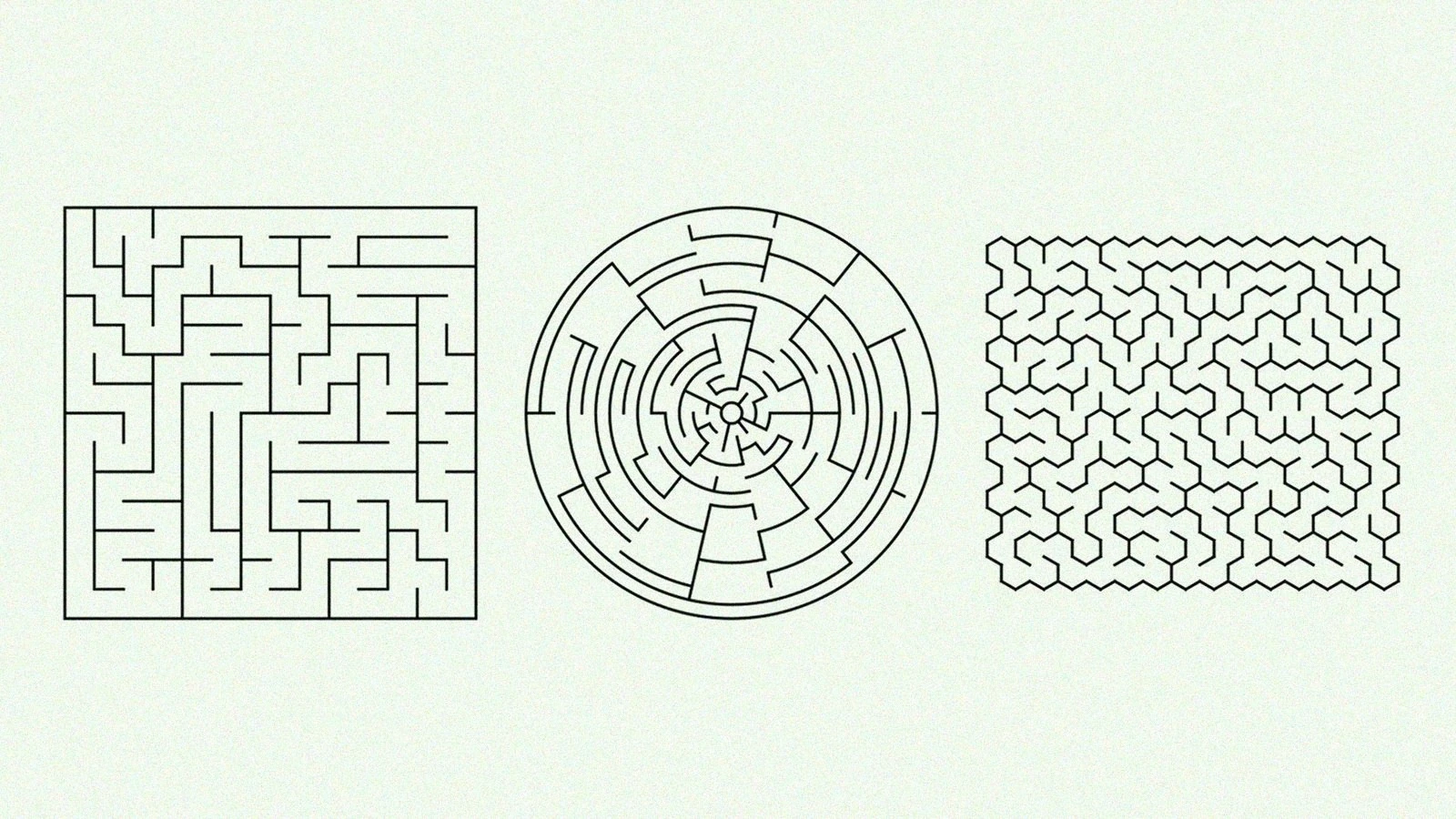
The same 14×14 medium maze generated in all three shapes: rectangular, circular, and hex. All three came from the same seed and the same algorithm.
| Shape | How it feels to solve | Best for | Watch out for |
|---|---|---|---|
| Rectangular | Orderly; you scan in rows and columns | Classrooms, young kids, quick warm-ups | Can feel like homework after a while |
| Circular | Spiraling; you scan in arcs toward the center | Puzzle nights, variety, gifts | Corners of the page go unused when printing |
| Hex | Dense and woven; no long sight lines | Puzzle fans, a visual challenge | Feels a notch harder than its label |
Maze researchers have names for these: a standard grid maze is an orthogonal maze, a circular one is a theta maze, and a hexagonal one is a sigma maze, per the classification on Walter Pullen's Think Labyrinth, the long-running reference site for maze construction. You do not need the vocabulary to enjoy them, but it is handy if you fall down this rabbit hole the way we did.
we generated the same maze in three shapes. here is what changed
Numbers first. We generated a 14×14 maze from the same seed in each shape and pulled the stats straight from our difficulty scorer:
| Measured | Rectangular | Circular | Hex |
|---|---|---|---|
| Difficulty label | medium | medium | medium |
| Solution path length | 64 cells | 118 cells | 51 cells |
| Junctions (real choices) | 15 | 21 | 15 |
| Dead ends | 17 | 23 | 17 |
One run is not a scientific study, but it matches what we see across the whole catalog:
- Circular mazes route long. The rings subdivide as they grow outward, so a "14×14" circular maze packs in more cells, and the correct path winds nearly twice as long as its rectangular sibling before it escapes. You can see it in the red solution path below.
- Hex solutions are often shorter but harder to follow. Corridors leave each cell at up to six angles instead of four, so your eye loses the thread more easily even when the route itself is shorter.
- The difficulty label stays honest across shapes. We score every maze on the same ingredients (solution length, junctions, dead ends), so a medium hex and a medium rectangle are comparable challenges even though they feel different. More on that in how maze difficulty works.
square and rectangular mazes: the worksheet default
The square maze, and its rectangular cousin, is the default for a reason. Your eyes already know how to scan a page in rows and columns, the corridors run at right angles, and the shape fills a sheet of Letter or A4 paper edge to edge, so you get the biggest possible cells for a given grid.
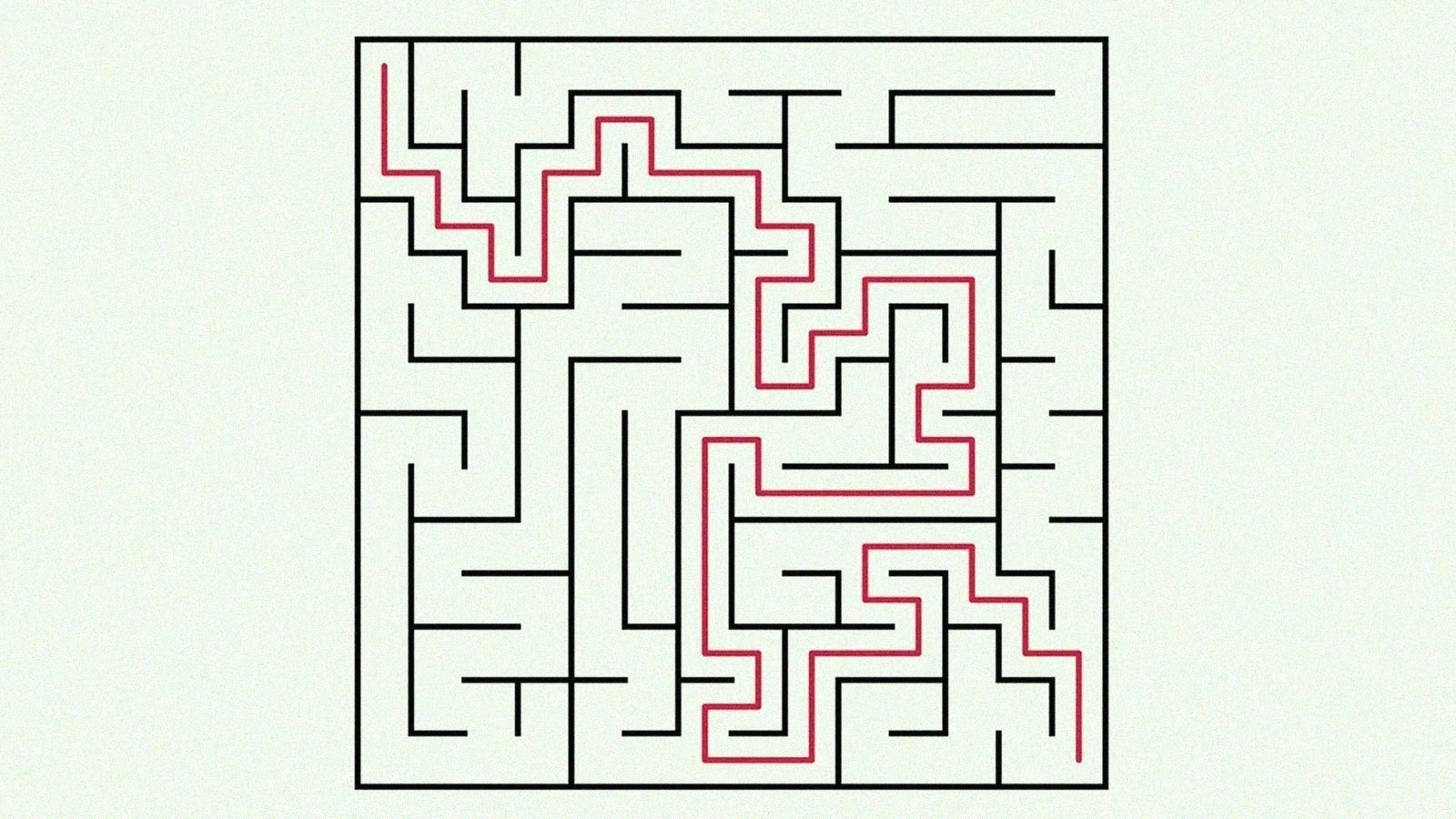
The rectangular version, solution in red: 64 cells from corner to corner, mostly straight runs with right-angle turns.
Pick rectangular when:
- You are printing for kids or a classroom. It is the easiest shape to trace with a pencil, and the one every difficulty guide assumes; our mazes by grade guide is built on rectangular sizes.
- You want maximum maze per page. No wasted corners, biggest corridors.
- You want a quick warm-up. Familiar scanning means people start solving immediately instead of orienting.
A note on the word square maze: a square maze is simply a rectangular maze with equal sides, like 12×12. Square grids feel balanced and print well as a full page; wider-than-tall rectangles are useful when you want two mazes stacked on one sheet. Start with easy rectangular mazes or the Easy Starters Pack.
circular mazes: rings, arcs, and a pull toward the center
A circular maze (a theta maze, or simply a round maze) is built from concentric rings sliced into sectors, usually with the goal at the center or the outer rim. It is the shape people reach for when they want a maze that looks special, and the solving experience genuinely differs: you stop scanning rows and start following arcs, and the center exerts a constant pull on your attention.
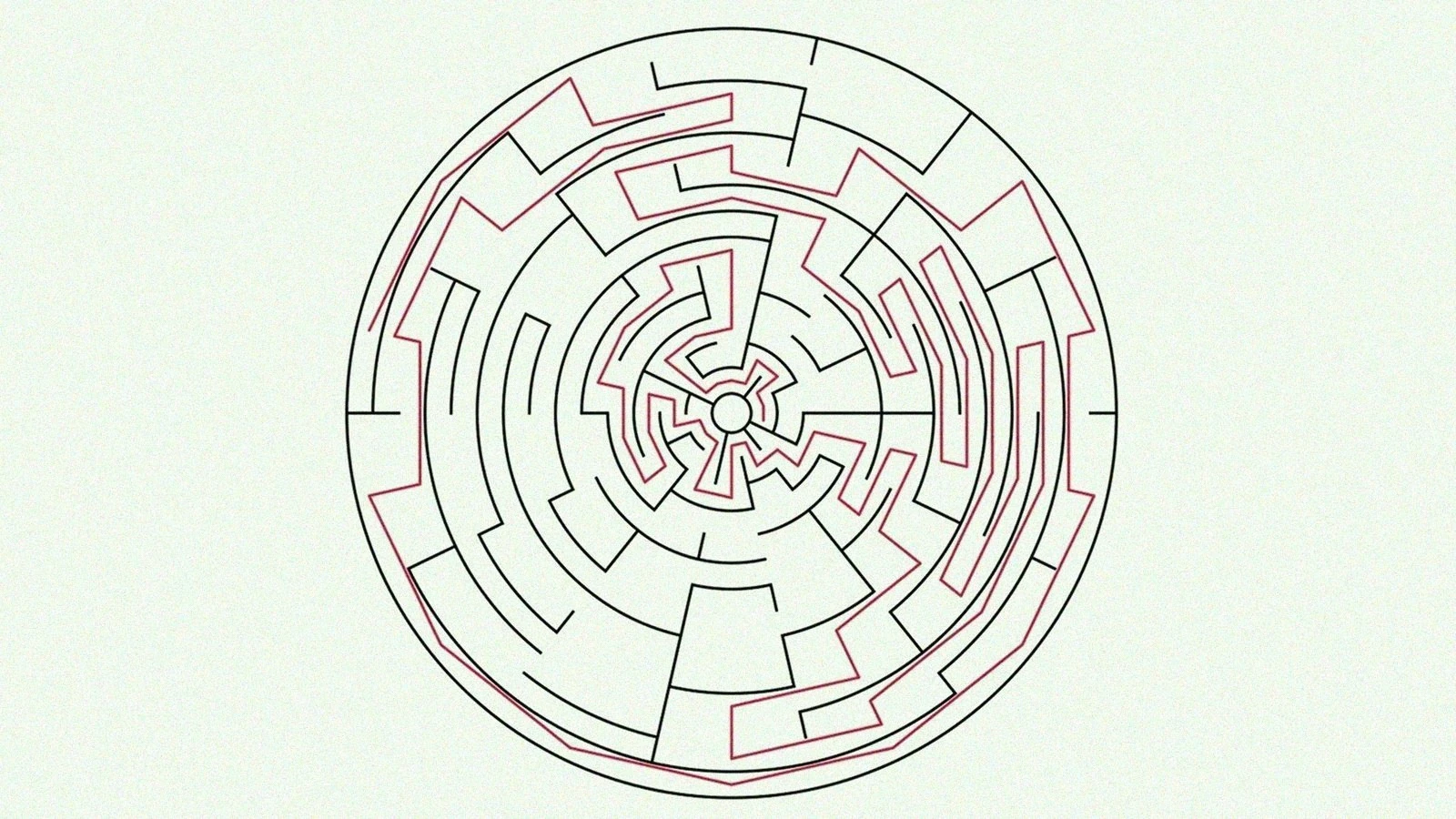
The circular version, solution in red: 118 cells, almost double the rectangular route. Notice how the path orbits, doubling back around rings before breaking outward.
The first time I printed one for a family puzzle night, the thing I noticed was people rotating the page as they solved, something nobody does with a rectangle. Arcs are harder to trace at a fixed orientation, so solvers spin the sheet like a steering wheel. Kids especially love this; it makes the puzzle feel like a device.
Circular mazes carry an old lineage. The winding-rings form goes back to walking labyrinths like the one on the floor of Chartres Cathedral, though a labyrinth (including the classic spiral maze with no forks) has a single path with no choices, while a circular maze branches and dead-ends like any other. The distinction is worth two minutes: see maze vs labyrinth. If you want to try drawing the classic form by hand, this tutorial on the five-circuit Chartres pattern is the best one we have found:
Browse circular mazes, or make a custom one with the circular maze generator.
hex mazes: six directions and a woven look
A hex maze, or hexagonal maze (a sigma maze), tiles the plane with hexagons, which changes the geometry of every decision: a cell can connect to up to six neighbors instead of four. In practice that means more directions to check at each junction and no long straight corridors for your eye to slide down. The wall lines zigzag constantly, which is where the "woven fabric" look comes from.
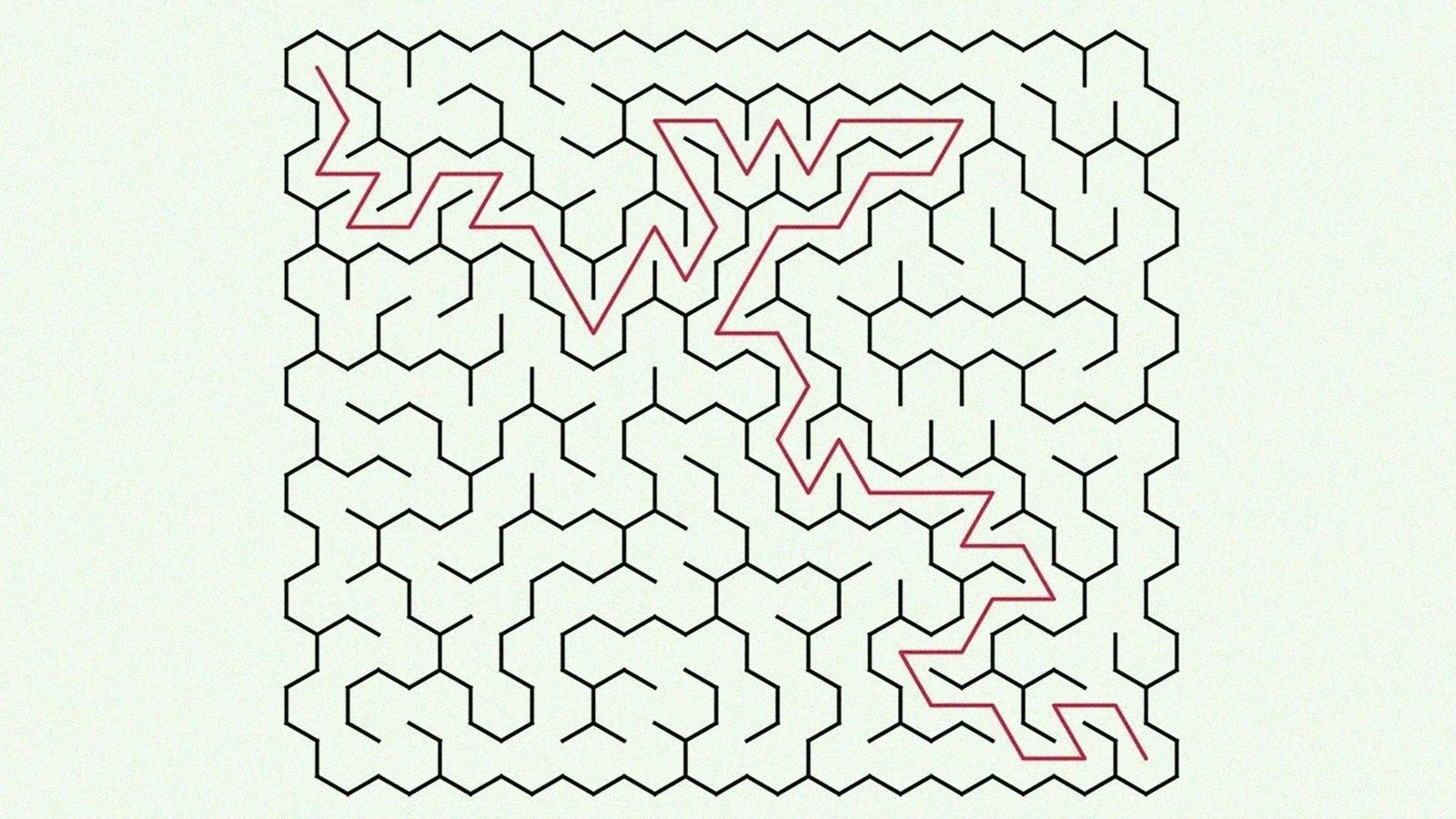
The hex version, solution in red: only 51 cells, the shortest route of the three, yet most people we hand these to rank it the hardest to follow by eye.
My honest take after printing a lot of these: treat a hex maze as half a difficulty level above its label. A medium hex sits between a medium and a hard rectangle in how it feels, purely because of the angles. That makes hex the right tool for two situations:
- A puzzle fan who claims medium is too easy but is not ready for a genuinely hard maze.
- Anyone bored of squares. Same rules, new terrain.
For kids, start hex mazes smaller than you think (a size down from their rectangular level) and keep the corridors chunky; maze sizes explained has the size-picking logic. Browse the collection at hex mazes.
what about triangles and other shapes?
The classification does not stop at three. Triangle-grid mazes are called delta mazes, and there are octagon-and-square hybrids and diagonal-passage variants too, per Think Labyrinth's classification. We generate the three shapes on this page; if you want a triangle maze, the honest answer is to draw one yourself, and how to draw a maze shows the technique that works for any grid.
Shape in the tiling sense is also different from maze types in the broader sense (logic mazes, picture mazes, corn mazes, braid mazes). For that taxonomy, read what is a maze, and for mazes you can physically walk through, famous mazes around the world.
which shape should you pick?
For teachers: rectangular as the routine, circular as the reward. A circular maze at the same difficulty is the cheapest novelty you can hand a class that has done maze warm-ups all term; it feels like a new activity and requires zero new instructions. The rotation fits neatly into classroom maze warm-ups.
For kids at home: whichever one they finish. If rectangular has started to feel like schoolwork, a circular maze turns the same skill practice back into a game. If your kid is the type who wants a challenge announced, hand them a hex maze and say so.
For adults and puzzle fans: rotate. Rectangular for speed, circular for a change of scanning, hex when you want the maze to fight back a little. A same-difficulty rotation across all three shapes is a genuinely different session than three rectangles; the Mixed Bag Pack exists for exactly this.
printing tips by shape
All three shapes print cleanly on Letter and A4, but each has one thing worth knowing:
- Rectangular is the safest print. It fills the page, so cells come out as large as the grid allows.
- Circular leaves the page corners empty by nature, so the maze itself prints smaller than a rectangle of the same grid. Print at 100% scale and do not be tempted by "fit to page" to compensate; it distorts margins instead. One test page before a batch.
- Hex packs more cells into the same width, so corridors run slightly narrower. On a cheap printer, choose one size smaller than you would for rectangular so the walls stay crisp.
If anything clips at the edges, print mazes without cropping has the fixes, and PDF vs SVG explains which download to grab (short version: PDF for printing).
FAQ
What are the main maze shapes?
The four common grid shapes are square or rectangular (orthogonal), circular or round (theta), hexagonal (sigma), and triangular (delta). Square grids dominate printable mazes because they are the easiest to scan and print; circular and hex change how the maze feels without changing the rules.
Which maze shape is hardest?
At the same difficulty label they are comparable by design, but shape changes how the difficulty is delivered. In our same-seed test, the circular maze had the longest route (118 cells vs 64 rectangular) while the hex maze was hardest to track visually despite the shortest route. If you want the maze that feels hardest, most people say hex.
What is a circular maze called?
A circular maze built from concentric rings is technically a theta maze. Circular single-path designs with no dead ends are labyrinths, not mazes; the difference matters.
What is a maze with hexagons called?
A sigma maze. Each hexagonal cell can connect to up to six neighbors, which is why hex mazes feel denser than square-grid mazes of the same size.
What is the difference between a square maze and a rectangular maze?
Only the proportions. A square maze has equal width and height (like 12×12); a rectangular maze can be any proportion. They solve identically, so pick by how you want the page to look.
Can I print circular and hex mazes for free?
Yes. Every maze on circular mazes and hex mazes downloads free as PDF, SVG, or PNG in Letter and A4, same as the rectangular collection, no account needed.
Can I generate my own circular or hex maze?
Yes. Pick the shape, size, and difficulty in the maze generator, then export a print-ready PDF. The circular maze generator page goes straight to the round kind.
next step
- Simplest start: easy rectangular mazes.
- Something different tonight: print one circular and one hex maze at your usual difficulty and see which one fights back.
- Build your own: choose any shape and size in the maze generator.
Sources and further reading: Walter D. Pullen's Think Labyrinth maze classification (orthogonal, theta, sigma, and delta tessellations) and the Wikipedia entry on mazes. Shape measurements above come from our own generator and difficulty scorer.