Ariadne's Thread: Mythology's Original Life Hack for Not Getting Lost
The Greek myth of Theseus and the Minotaur is usually sold as a monster-slaying story. It's really a story about a much harder problem: how do you get out of somewhere once you've found your way in? Theseus had to enter a structure specifically designed to disorient him, kill something at the center of it, and then reverse the entire trip. His sword did the easy part.

The Bull That Started Everything
Start with Minos, king of Crete, a man who made a deal with a god and then didn't keep his end of it.
Minos wanted proof that the gods backed his claim to the throne, so he asked Poseidon for a sign. Poseidon sent a magnificent white bull up out of the sea, with the understanding that Minos would sacrifice it back to him. Minos took one look at the bull, decided he liked it too much to kill it, and swapped in a lesser animal instead — hoping, apparently, that the god of the sea wouldn't notice the switch.
He noticed.
Poseidon's punishment landed on the royal family in the strangest way imaginable: Queen Pasiphaë gave birth to a creature with a man's body and a bull's head. They named him Asterion, though history remembers him by his job title instead — the Minotaur, "bull of Minos."
He grew up powerful, violent, and impossible to hide, and that left Minos with a problem money and pride couldn't fix. He needed somewhere to put a monster he was ashamed of. So he called in an engineer.
Daedalus Builds a Trap With No Exit
Daedalus was the closest thing the ancient world had to a genius inventor on retainer. If a story needed something built that shouldn't have been possible, Daedalus built it.
For Minos, he built the Labyrinth of Crete — a structure of looping, doubling-back corridors, built specifically so that a person could walk deeper into it while feeling like they were getting closer to the exit. That's the clever part, and it's worth sitting with: a good maze doesn't need moving walls or hidden traps. It just needs every direction to feel equally right.
Some versions of the myth claim even Daedalus struggled to find his own way out once he'd finished the thing. Whether that detail is original to the myth or added later for flavor, it's a nice bit of irony either way — the one man alive who understood the maze completely still got fooled by his own design.
Maze or Labyrinth? Turns Out There's a Difference
We use these words interchangeably now, but puzzle designers actually split them apart.
A maze branches. It gives you real choices, dead ends, loops, and paths that double back to nowhere — solving it means picking correctly, over and over. A labyrinth, in the strict sense, doesn't branch at all. One path, folded and twisted, that eventually reaches the center. No decisions required, just patience.
By that definition, Daedalus's creation gets called a labyrinth but behaves like a maze in nearly every retelling — full of choices, not just folds. Ancient artwork can't settle the question either; some pieces show one winding path, others suggest something far more tangled. No blueprint survived, which is exactly why the structure has been redrawn by artists and game designers for something like two and a half thousand years. Everyone gets to build their own.
Was Any of This Real?
No one has dug up the actual Labyrinth. But one real place probably fed the legend anyway: the Palace of Knossos, on Crete.
British archaeologist Arthur Evans began major excavations at Knossos in 1900 and found an enormous palace — hundreds of rooms, stacked across multiple levels, laced with staircases and storage rooms and workshops. Walk through that without a map and you'd start believing in labyrinths too.
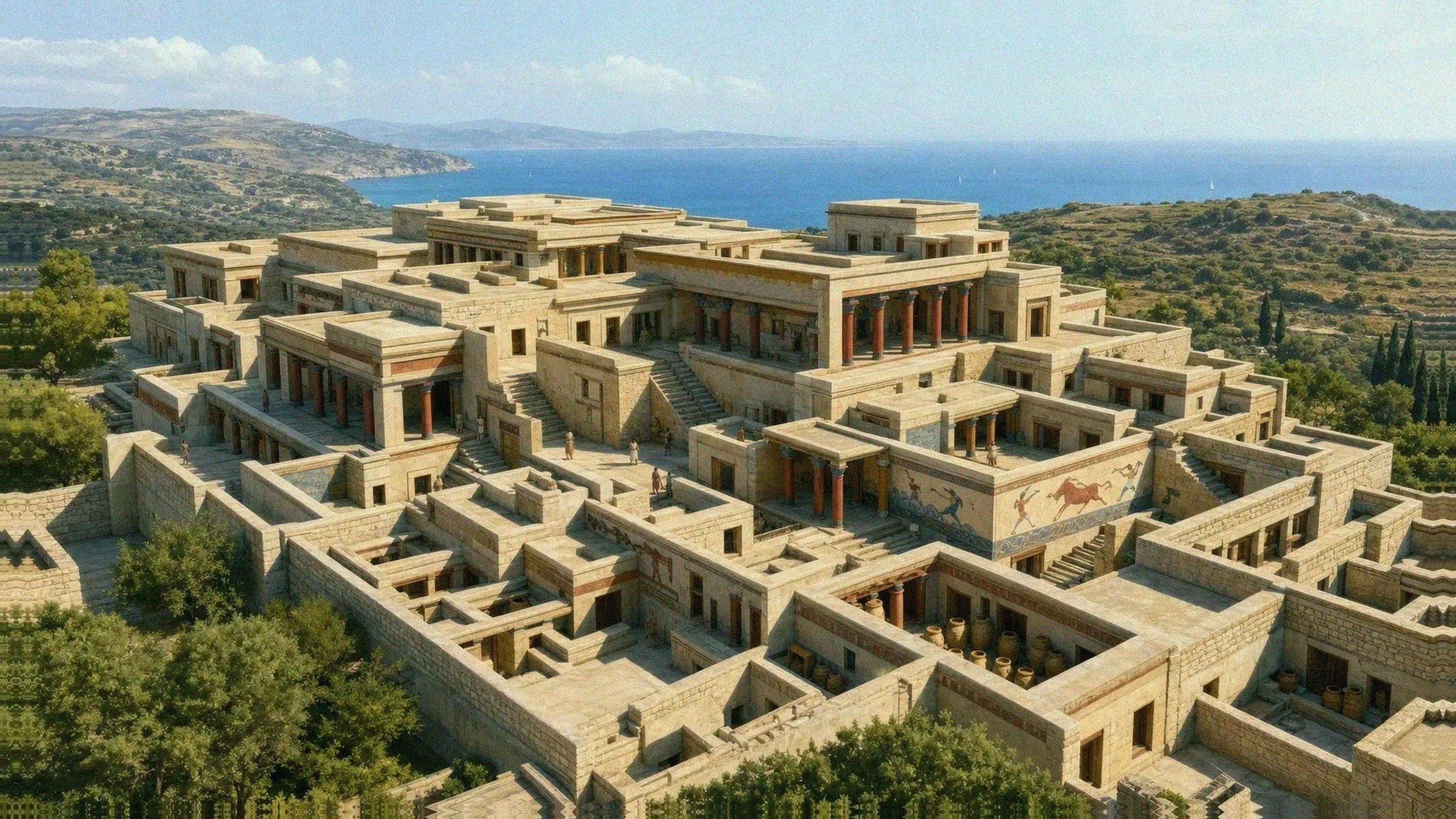
A sprawling Minoan palace could feel labyrinthine without being a puzzle. Editorial reconstruction, not a photograph.
Bulls show up constantly in the site's artwork, including scenes of people vaulting over charging bulls in a ritual historians now call bull-leaping. None of this proves a Minotaur ever existed. But it does show the myth wasn't built from nothing — a genuinely confusing palace, real royal power, and a culture obsessed with bulls, all fused together by generations of storytelling into something bigger than any of its parts.
Why Athens Kept Sending Its Kids to Crete
The myth's political backstory is grim, and it doesn't get told often enough.
Androgeus, one of Minos's sons, died while visiting Athens — the stories disagree on how, blaming either political rivals or a bull sent by King Aegeus himself. Minos didn't wait for details. He went to war, won, and forced Athens into a tribute that's hard to read as anything but cruelty: every so often, fourteen young Athenians, seven men and seven women, shipped off to Crete and fed into the Labyrinth. Nobody expected them back.
Theseus, the son of Aegeus, volunteered to go with one of these groups. His plan was simple and not exactly modest: get inside, kill the Minotaur, end the tribute for good.
Before the ship left, he made a promise to his father. Black sails on the way out. If he survived, the crew would swap them for white ones on the way home, so Aegeus would know the outcome before the ship even docked.
Keep that promise in your back pocket. It matters later, and Theseus is about to forget it completely.
Ariadne Does the Actual Thinking
Theseus gets the myth named after him, but Ariadne, Minos's daughter, is the one who solves the actual problem.
She handed him a sword for the monster and a ball of thread for the maze — and the thread mattered more. Tie one end near the entrance, unspool it while walking in, and when the job's done, follow it straight back out. No memorizing turns, no guessing. Just a physical, unbroken record of every step already taken.
That's the whole trick, and it's why the phrase "Ariadne's thread" outlived the myth itself — it now describes any method or clue that gets you through a genuinely confusing problem. It's also just good maze advice: mark your route, whether with actual string or a pencil line on paper, so confusion never gets the chance to compound.
There's a small linguistic echo here too: the word clue comes from clew, an old spelling for a ball of thread. A thread that guides you through a maze became a clue that guides you through a problem.
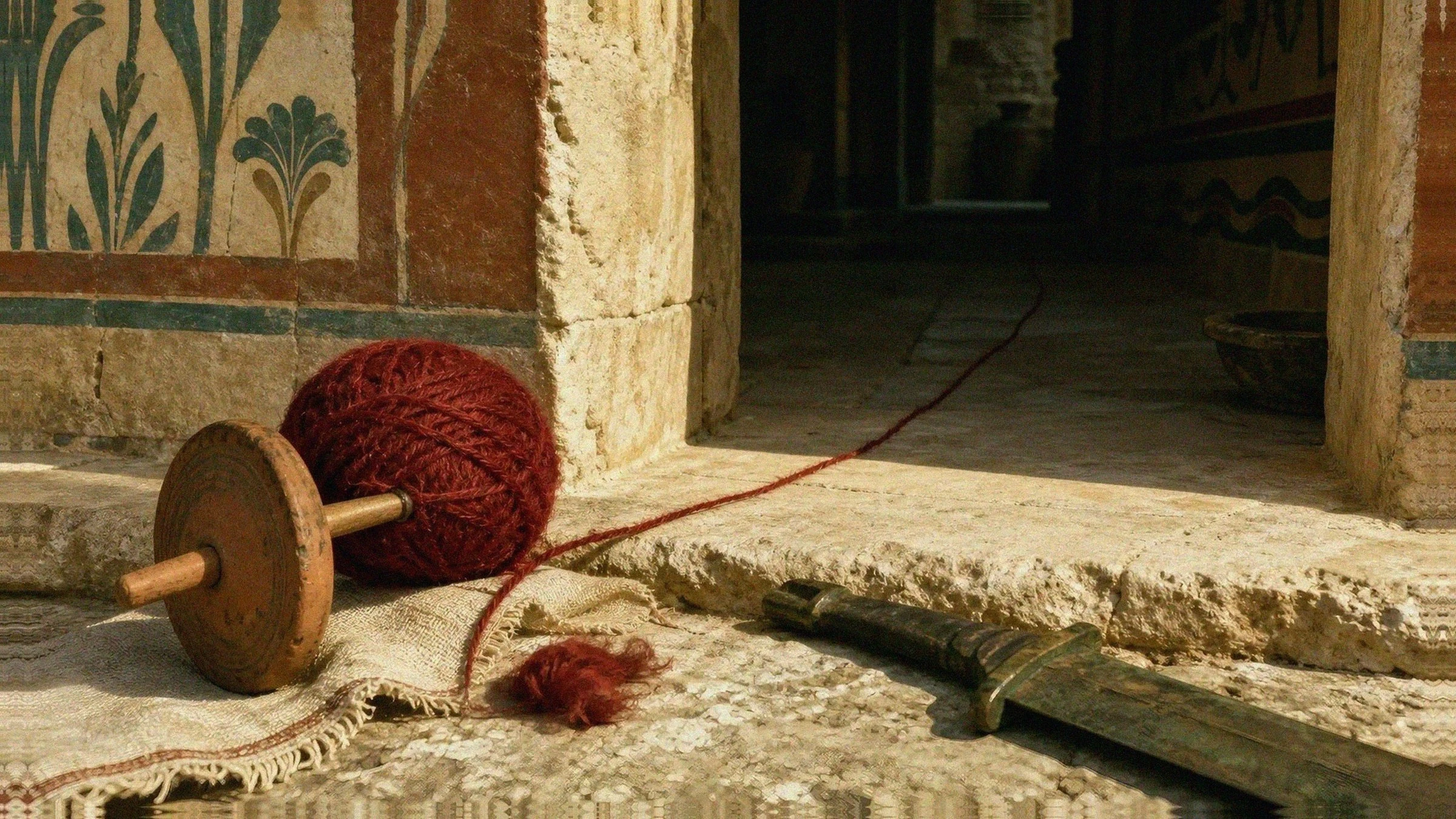
The thread is practical, not magical: a continuous line turns a confusing route into a retraceable one. Editorial reconstruction.
Inside the Labyrinth
Theseus tied off the thread and walked in. The deeper he went, the harder the passages got to read — which was the entire design brief Daedalus had been handed. Eventually he reached the center and found the Minotaur waiting.
He killed it. Ancient depictions can't agree on how — sword, club, bare-handed grappling, depending on which vase you're looking at — but the outcome never changes.
Here's the part that actually deserves the credit, though: killing the monster was the easy half. Getting back out was the mission. Theseus followed the thread in reverse, gathered the other Athenians, and made it to the ship. Without that thread, a dead Minotaur and a very much still-trapped hero would have been the actual ending.
The Ariadne Problem
Theseus sailed off with Ariadne and the rescued Athenians. They stopped at Naxos. When the ship left again, Ariadne wasn't on it.
The ancient sources can't agree on why, and honestly, none of the explanations make Theseus look great. One version has Dionysus arriving and claiming her as his own. Another blames a storm that blew the ship off course before Theseus could stop it. A third just calls it what it looks like: abandonment, full stop, and plenty of ancient writers said so directly.
Later tradition tried to soften the ending — Dionysus finds her, marries her, and sets her crown among the stars as Corona Borealis, the Northern Crown. It's a lovely image. It doesn't erase the fact that Theseus left the one person who'd saved his life stranded on an island.
One Forgotten Sail
Theseus sailed home a hero and immediately proved he didn't deserve the title.
He forgot the sails. The ship came into view still flying black, and King Aegeus, watching from the coast, assumed the worst and threw himself into the sea. Greek tradition names the Aegean after him.
Theseus remembered every twist of a maze designed to make him forget. He forgot one flag on one mast, and it cost his father's life.
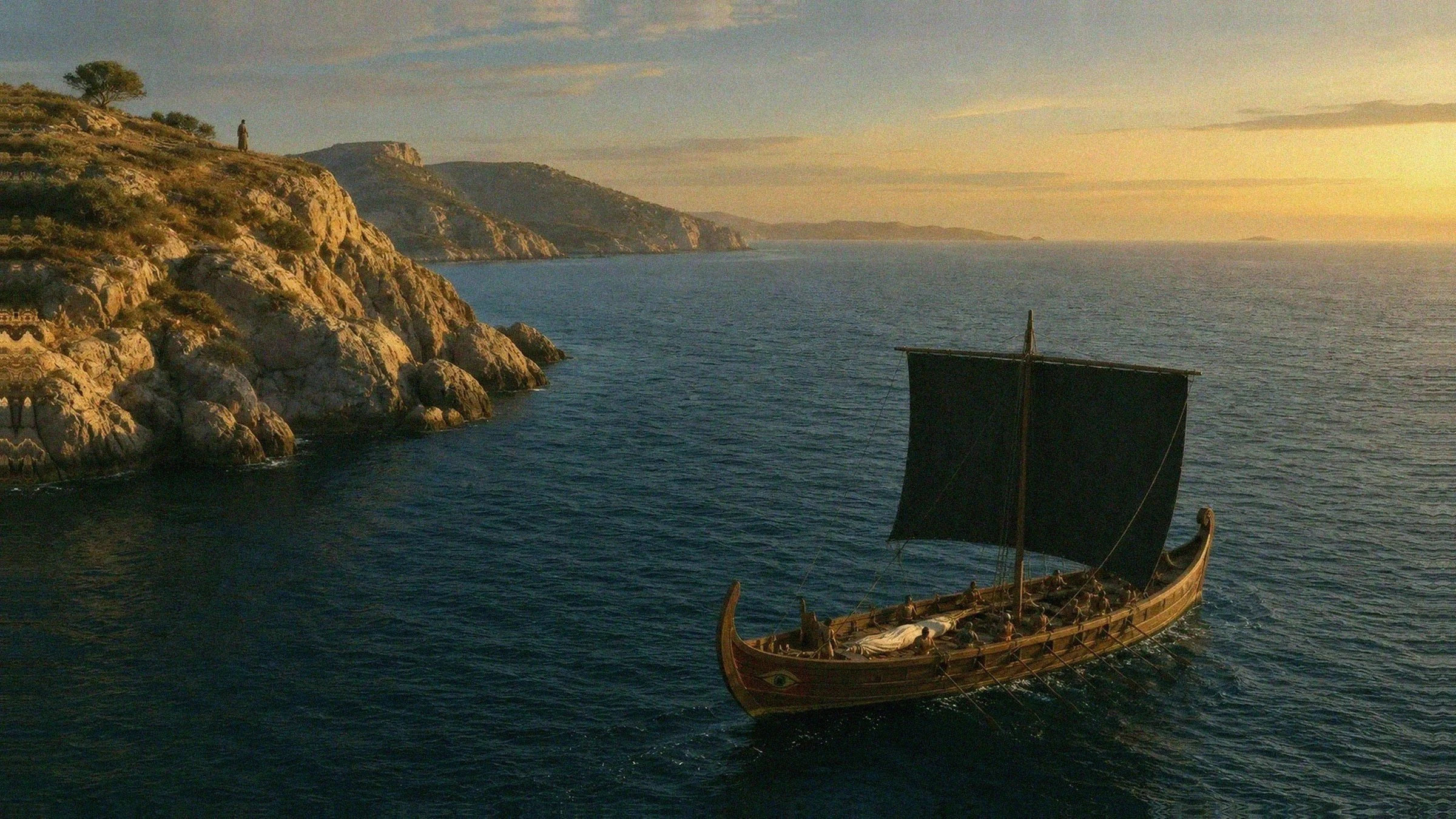
In the myth, one forgotten signal tells Aegeus that Theseus has died. Editorial reconstruction.
What Actually Works When You're Lost in a Maze
The myth's practical lesson is almost embarrassingly simple: track your route, and getting unstuck stops being about memory and starts being about method. A few things that actually help:
- Find the entrance and exit before you commit to a direction.
- Use a pencil, not a pen — you'll want to erase wrong turns.
- Mark dead ends once. Don't test them twice.
- Scan a few turns ahead before committing.
- Stuck? Go back to the last junction you're sure about, not further.
- Go slow. Speed is what sends you back into the same dead end you just left.
Theseus had string. You've got a pencil and the freedom to just start over — which, honestly, might be the better deal.
Go Get Lost on Purpose
You don't need a Cretan palace to test any of this. Maze Printables has free printable mazes for kids, adults, and classrooms — rectangular, circular, hexagonal, whatever shape you're in the mood for. Teachers and parents can dig through the maze worksheets, or build something custom with the free maze generator.
Just do yourself one favor Theseus almost didn't: keep track of how you're getting back out.