The center looks three steps away.
Then the path bends hard to the left, carries you toward the outer edge, loops around again, and somehow leaves you farther away than when you started.
Annoying? A little. That strange detour is also the point.
Walking a labyrinth means following one winding path from the entrance to the center, pausing there, and taking the same route back out. No route planning. No dead ends. You just keep moving.
People use labyrinths for meditation, prayer, remembrance, and quiet thinking. Some walk because they’re curious. Others saw a stone circle behind a hospital, wondered what it was, and had fifteen minutes before their next appointment.
Both count.

What Labyrinth Walking Means
A traditional labyrinth has one continuous path. It twists, doubles back, and spends a surprising amount of time pretending the center is nearby.
But it never branches.
A maze works differently. It gives you choices, wrong turns, loops, and the occasional dead end placed there by a puzzle designer who may enjoy your suffering a bit too much.
The technical words are unicursal and multicursal. A labyrinth is usually unicursal, meaning one route. Mazes are multicursal because several possible routes branch away from one another.
The Labyrinth Society describes labyrinths as paths that wind repeatedly without being designed to confuse the walker. Most designs remain visible from the outside, though seeing the full pattern doesn’t tell you how the walk will feel.
A turn can bring you within arm’s reach of the middle and then pull you away for another five minutes.
Rude, but effective.
Why People Walk Them
A labyrinth gives your body a repetitive task while your mind deals with something else. Or avoids dealing with it for a while. That happens too.
People may walk one to pray, think through a decision, remember somebody, or slow down after a loud day. Others enjoy the physical pattern and have no spiritual goal whatsoever.
A few common reasons include:
-
Prayer.
-
A difficult decision. Carry the question while you walk. You don’t have to force an answer before reaching the center.
-
Getting away from a screen for twenty minutes.
-
Someone may walk after a death, birthday, divorce, graduation, or another event that doesn’t fit neatly into a normal Tuesday afternoon.
-
Curiosity, which is enough by itself.
Labyrinth meditation can be easier for people who hate sitting still. Your attention has somewhere physical to land. One foot moves, then the other. A corner arrives. You follow it.
And if your mind suddenly replays something stupid you said in ninth grade, congratulations, your brain remains fully operational.
How to Walk a Labyrinth
Pause near the entrance before stepping onto the path.
You might choose a word to carry with you. Patience works. So does a short prayer, somebody’s name, or the question you’ve been circling for a week without getting anywhere.
You can also begin with no plan.
Take one or two slow breaths, then enter. Walk at a pace that feels comfortable in your own body. People sometimes adopt an exaggerated slow-motion shuffle because they think meditation requires it. It doesn’t.
My first labyrinth walk was on a painted canvas in a church hall. Around the fourth turn, I kept looking at the center and stepped directly onto the blue boundary line. Nobody rang an alarm. The woman behind me was more concerned about the squeaky gym floor.
Keep going.
Notice your breathing if that helps. Feel the ground under your shoes. Watch how your body responds when the path swings away from the center again.
You do not have to produce a meaningful thought at every turn. That would be exhausting.

When Other People Are Walking
Shared labyrinths can become mildly awkward. Walkers travel inward and outward on the same narrow path, often at very different speeds.
The etiquette is simple enough:
-
Give people room.
-
Passing is fine. Step off the line briefly, move around the slower person, and return to the path. Try not to turn the whole thing into airport security.
-
If somebody approaches from the opposite direction, one person can step aside.
-
Silence is common, though each location has its own rules.
-
Stop if you want. Just glance behind you first.
Outdoor paths bring their own small problems. Wet grass. Uneven bricks. That one pine needle glued to the sole of your left shoe for half the walk.
Wear shoes that make sense for the surface. At Chartres Cathedral, visitors are specifically told to keep their shoes on.
The Center Might Feel Ordinary
Stay in the middle for a few breaths or several minutes.
You can pray, listen, look around, or stand there feeling unsure about what people normally do with their hands. There is no required pose.
Some walkers feel peaceful. Others become emotional. A person may suddenly understand what’s been bothering them, while the next person mostly notices a ceiling fan clicking every seven seconds.
Do not manufacture an experience because the setting seems important. In my experience, trying too hard makes the whole thing feel like a performance.
When you’re ready, begin the walk outward.
Release, Receive, Return
Many labyrinth guides divide the walk into three stages.
Release happens while moving toward the center. Let thoughts come and go. You might set down a worry, resentment, or the need to solve everything before lunch.
Receive.
The center becomes a place to wait for whatever arrives. Maybe insight. Maybe quiet. Stay open without demanding fireworks.
Return covers the path outward. This is where some people consider what they will do after the walk, especially if a practical idea showed up somewhere around turn seventeen.
I like this structure. It gives the walk a loose shape without making it feel like homework.
But you may forget the stages entirely because a crow lands beside the path and stares at you like you owe it money. That’s fine..
Labyrinth Meditation for Restless People
Sitting meditation asks the body to remain mostly still. Walking a labyrinth keeps the body occupied with a gentle, repetitive movement.
The brain gets one manageable job. Follow the path.
You can pair your steps with breathing, though the timing doesn’t need to be perfect. Some people repeat a word. Others pay attention to the pressure under each foot or listen to nearby sounds.
Try one of these during a labyrinth meditation:
-
Count four steps, then begin again.
-
Use a short phrase. Repeat it quietly whenever your thoughts scatter.
-
Listen.
-
Match a few steps to each breath if that rhythm feels natural. Stop if it becomes uncomfortable; this is a walk, not breath-holding practice.
-
Let the path carry your attention without adding another exercise.
Research on labyrinth walking remains fairly limited. Baylor University has studied group walks in which participants reported connection, reflection, and spiritual meaning. Those findings are interesting, although a labyrinth should not be treated as medical care or a guaranteed fix for stress.
Some walks feel good. Some feel boring. Occasionally they’re both.
Using a Prayer Labyrinth
Churches often place labyrinths in halls, gardens, chapels, or temporary spaces during Lent and Advent. A prayer labyrinth turns the physical walk into a moving prayer.
A Christian walker might repeat a Bible verse, pray for a different person on each section, or bring one concern before God. The inward path can become a time of confession or release. At the center, wait and listen. The journey outward may focus on gratitude or action.
Nobody needs an elaborate script.
You could repeat one line of the Lord’s Prayer. You might pray for family on the way in and for people outside your immediate circle while returning. Another approach is to carry a single question and resist answering it too quickly.
Prayer labyrinths also make room for silence, something modern church life does not always have in generous supply.
People from other religious traditions use labyrinths too. And plenty of walkers approach them in a secular way, as spaces for reflection or mindfulness.
The path doesn’t require an explanation from you.
The Chartres Labyrinth
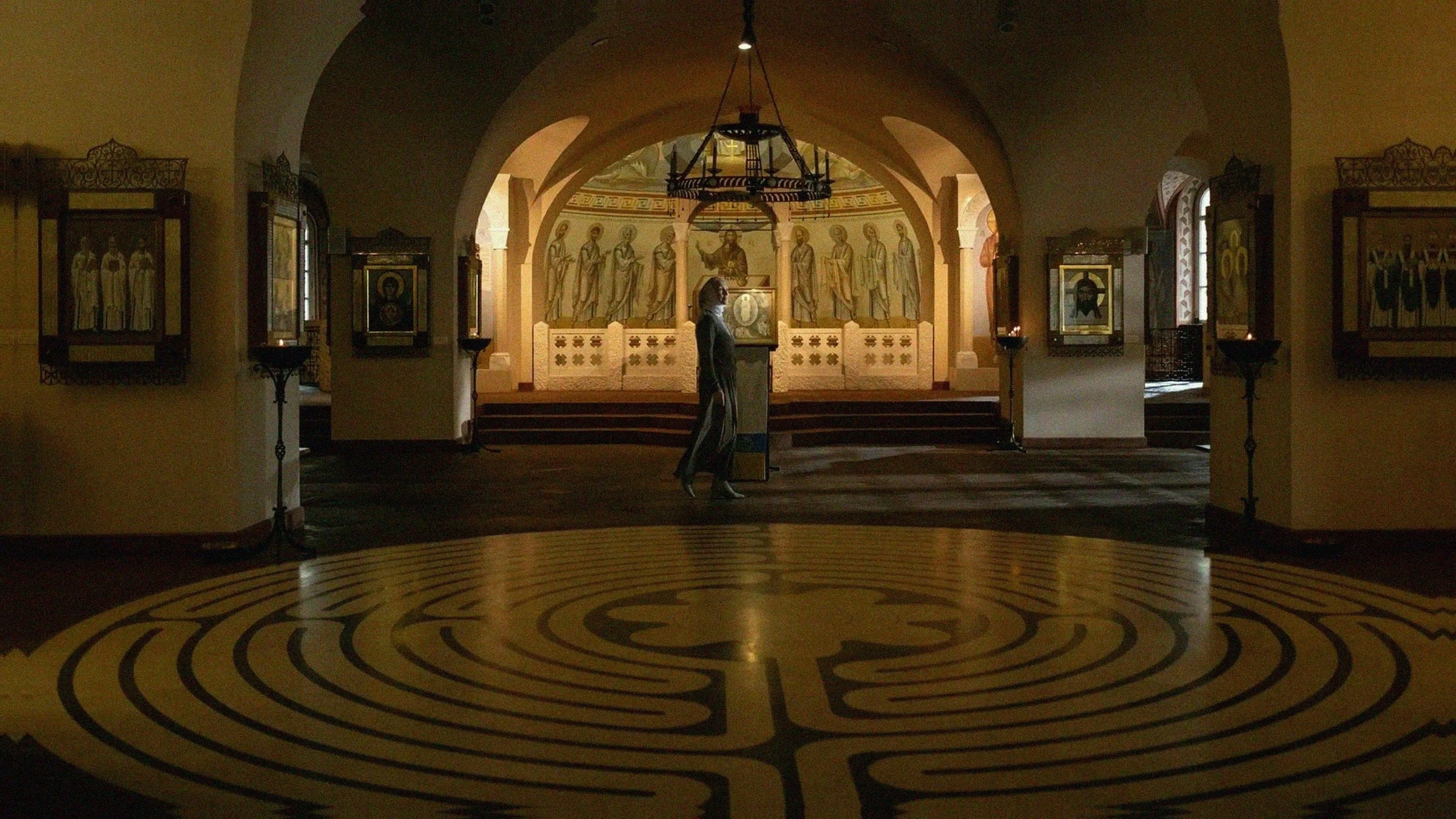
Set into the stone floor of Chartres Cathedral in France, the Chartres labyrinth dates to around 1200. It uses an eleven-circuit design that winds through four broad sections before reaching a six-lobed center.
It is intricate. Perhaps overly intricate, in my mildly unfair opinion.
The labyrinth sits in the cathedral’s nave and remains part of an active religious building. On designated days, the chairs covering it are removed so visitors can walk the path. Anyone planning a visit should check the cathedral’s current schedule because ceremonies can affect access.
According to the official Chartres Cathedral account, the design invites pilgrimage, meditation, forgiveness, and reflection on Christian life. Research cited by the cathedral also connects its early use with Easter Vespers.
You may have heard that medieval Christians walked church labyrinths as replacements for pilgrimages to Jerusalem. That explanation appears everywhere. Direct historical evidence for the practice is shaky, so it’s safer to treat it as a possibility rather than settled fact.
Medieval documentation left us hanging there.
The Chartres pattern still became the model people copy most often. Full-size versions now appear in churches, universities, retreat centers, and gardens far beyond France.
What the Labyrinth Symbol Can Mean
The pattern has shown up in religious buildings, mosaics, manuscripts, gardens, artwork, and community spaces. Its meaning changes with the people using it.
A circle may suggest wholeness or continuity. The entrance can mark a beginning. Some walkers see the center as God, rest, insight, home, or simply the halfway point.
Then you return.
Different traditions have connected the labyrinth symbol with pilgrimage, protection, life’s indirect course, spiritual growth, and death followed by renewal. No universal interpretation controls all of them.
Context matters here. A medieval church floor and a colorful school playground can share the same basic shape while doing very different work.
Finger Labyrinths Fit on a Desk
A finger labyrinth shrinks the full path onto paper, wood, fabric, or another handheld surface. You trace the route with a finger or stylus instead of walking it.
Useful when there isn’t a cathedral nearby.
Place the design on a table and locate the entrance. Trace inward without lifting your finger, pause in the center, and then follow the route back to the opening.
Move slowly enough to notice the turns. Using your nondominant hand can make the motion less automatic, a method also suggested in Baylor University’s finger labyrinth guidance.
A finger labyrinth can work during travel, at a desk, in a classroom, or for somebody who cannot comfortably walk a large path. It also gives fidgety hands somewhere to go during prayer.
One small warning. Printed designs slide around on smooth tables. Hold down a corner unless you want your meditative practice interrupted by chasing a sheet of paper under the couch.
Finding a Labyrinth Near You
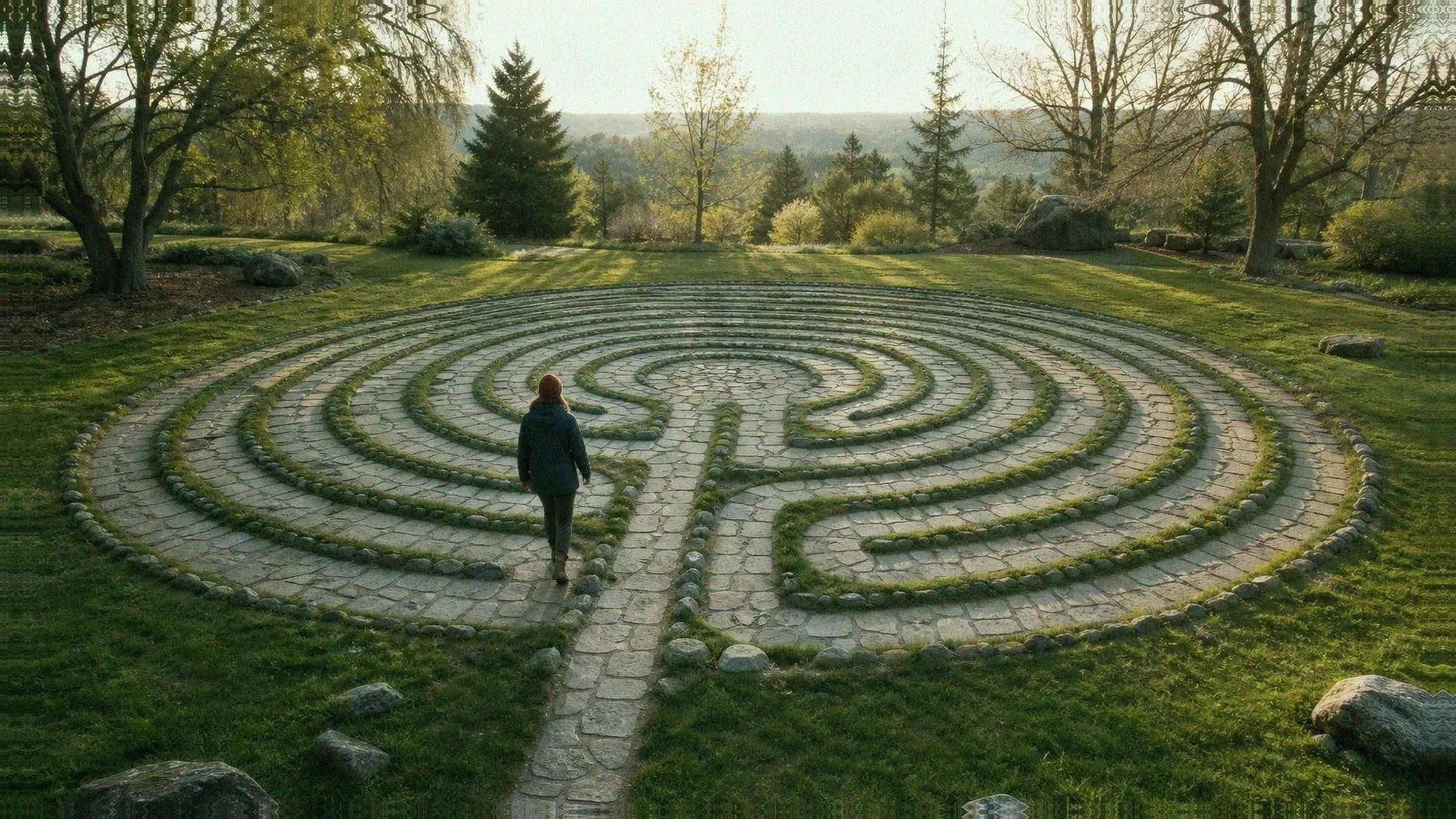
Churchyards are a good place to look. So are university campuses, public gardens, hospitals, retreat centers, and the slightly neglected corner of a community park.
The World-Wide Labyrinth Locator lets you search by city, region, or country. Check the listing before visiting since some paths sit on private property or open only during certain hours.
A few practical points:
-
Read the sign. Local rules beat advice from a blog post.
-
Shoes may be required indoors. Elsewhere, people might ask you to remove them.
-
Call ahead if you’re bringing a group of twelve restless eighth-graders.
-
Private property means private property.
-
Leave the stones alone. Somebody placed them there on purpose, even if one seems two inches out of line.
Flat, paved labyrinths may be usable with a wheelchair or mobility aid. Surface quality varies a lot, so contact the location if access information isn’t listed.
Making One at Home
Chalk works on a driveway. Masking tape can turn a large room into a temporary path, though removing fifty yards of it afterward loses its spiritual charm pretty quickly.
Rope, stones, or lines drawn in sand also work.
Start with a three-circuit or seven-circuit pattern. A complete Chartres layout takes more space and planning than people expect, especially once the path becomes wide enough for comfortable walking.
Measure first. Seriously.
For a smaller option, print a finger labyrinth and trace it at a table. If you want an actual pathfinding puzzle, Maze Printables has free printable mazes, including circular maze designs. You can also build a custom puzzle with the free maze generator.
A maze asks you to discover the route. A labyrinth hands you one and gives you time to notice what happens along the way.
A Few Things People Wonder About
Getting Lost
A traditional labyrinth has one path, so there’s nowhere else to go. Keep following the line and it will take you to the center.
If you reach a dead end, somebody built a maze. Or the groundskeeper parked a wheelbarrow across the route again.
How Long It Takes
Small labyrinths may take around ten minutes. A full-size pattern, a slow pace, or several people sharing the path can stretch the walk much longer.
Leave twenty to thirty minutes for a first attempt. You may finish early. No issue.
What to Think About
Bring a question if one is already bothering you. Repeat a prayer. Watch your breathing.
Or think about dinner.
Walking the Same Path Out
The return route is part of the usual practice. Follow the line from the center until it brings you back to the entrance.
Taking a direct shortcut across the pattern saves time, though it removes half the walk and may annoy whoever spent Saturday morning lining up all those stones.
Religion
Christian communities have a long connection with labyrinths, especially through medieval church designs such as Chartres.
No religious belief is required for a labyrinth walk. Someone can use the same path for prayer, secular meditation, a memorial, or ten quiet minutes before picking up the kids.
The entrance remains where it was. Step onto the line when you’re ready, watch for that damp patch near the third turn, and follow wherever it already goes.