A maze is a network of paths with a start, a goal, and choices along the way. Most of those paths are decoys that branch off and quit on you; only one connects all the way through. The puzzle is finding that route without getting lost in the rest.
That is the short answer. If you only wanted a definition, you have it. But "maze" covers a surprising range of puzzles, from a one-page worksheet to a corn field you can walk through, so the more useful question is what kind of maze you mean. This post is the hub. It defines the parts, sorts the main types of mazes, and points you to the right printables and tools for each. If you want to skip straight to making one, open the maze generator or browse printable mazes.
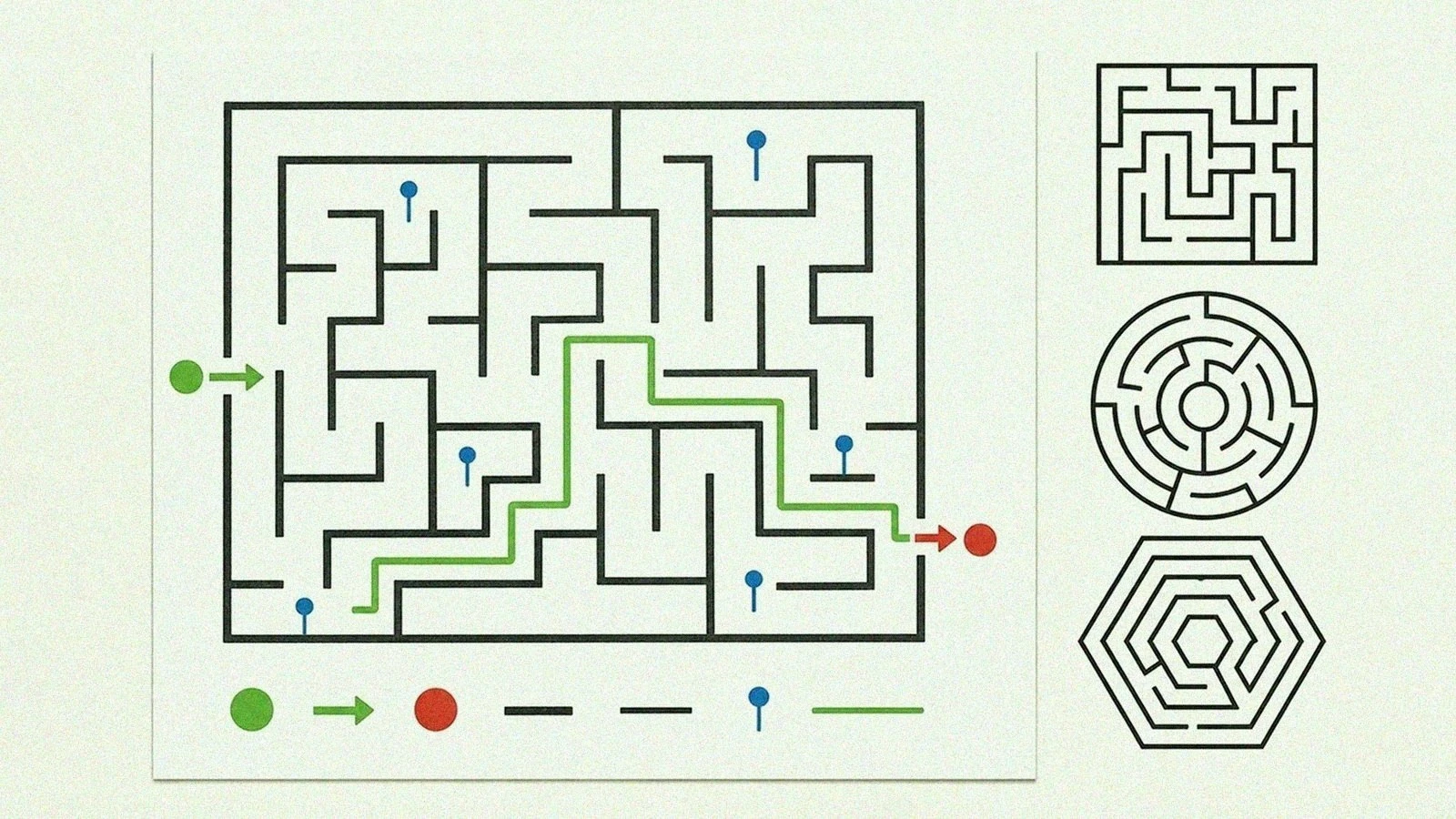
quick links
- The big shape families: rectangular mazes, circular mazes, hex mazes
- Browse by shape: all mazes, rectangular, circular, hex
- By audience: for kids, for adults
- By level: easy, hard, and how maze difficulty works
- Make your own: maze generator and maze worksheets
- Related reads: maze vs labyrinth, how to draw a maze, how to solve a maze
what is a maze?
Here is that same idea in slower motion. You drop in at the start and head for the goal, which is usually a center or a marked exit. Everything in between is the trap. Paths peel off in directions that look right and then quietly dead-end, and only one of them runs the whole way through. Solving the maze is finding that one honest route.
What makes it a puzzle is choice. At each fork you have to commit before you know whether that direction pays off, and the small gamble is the whole game. Take the choices away and there is nothing left to solve, just a path that winds to the center on its own (that is a labyrinth, more on it below). The opposite extreme is a maze so tangled and arbitrary that solving it feels like a chore. The good ones get the balance right, with lots of real decisions but a single clean route hidden underneath, so the answer feels earned when you finally trace it.
That pull is why mazes turn up everywhere, and at every age. The same itch that makes a four-year-old drag a crayon through a chunky path keeps an adult hunched over a dense grid with a coffee, or sends a whole family wandering into a corn field in October. The format changes completely while the puzzle underneath stays the same.
maze vs labyrinth (the one-paragraph version)
Most people use "maze" and "labyrinth" to mean the same thing, and in everyday speech that is fine. Puzzle people are fussier. A labyrinth, strictly speaking, is unicursal: a single path that snakes in to the center and back out, with no forks and no way to get lost. There is nothing to solve, which is exactly the point of the ones laid into cathedral floors for walking meditation. A maze is the multicursal kind. It branches, and it uses dead ends to fool you, which is why you can really get lost in a hedge maze. You could call a labyrinth a maze with the choices stripped out, though almost no one does. Where it gets murky is the naming: plenty of famous "mazes" are really labyrinths, and vice versa. That history is a rabbit hole, and we go down it in maze vs labyrinth.
the anatomy of a maze
Before sorting types, it helps to name the parts. Every maze, printed or physical, is built from the same handful of pieces.
- Walls (or barriers). The lines, hedges, or panels you cannot cross. Walls force the path to wind.
- Passages (or corridors). The open space between walls where you actually travel. On a printed maze this is the white gap your pencil follows.
- Cells. Imagine the maze on a grid: each square (or hexagon, or wedge) is a cell. Mazes are usually described by their cell count, like a 15 by 15 grid.
- The start and the goal. Two marked points. On worksheets these are often an arrow in and an arrow out, or a picture pair like "help the bee reach the flower."
- Junctions. Any point where the path forks and you choose a direction. More junctions usually means a harder maze.
- Dead ends. Passages that stop. Hitting one tells you that branch was wrong, so you backtrack. Dead ends are the maze's main defense.
- The solution path. The single continuous route from start to goal. On our answer keys this is the highlighted line. For the technique to find it without a key, see how to solve a maze.
Once you can see these pieces, the type system below stops feeling abstract. Every type of maze is really a choice about how the walls, junctions, and dead ends are arranged, or about what material the walls are made of.
the types of mazes
There is no single official list, because mazes can be sorted along several independent axes at once. A printable maze can be perfect, multicursal, rectangular, paper-based, and made with a recursive backtracker all at the same time. So instead of one flat list, here are the axes that matter, from the most structural to the most physical.
types at a glance
| Axis | Type | In one line |
|---|---|---|
| Routing | Perfect | No loops, no closed circuits, exactly one path between any two points. |
| Routing | Braid | No dead ends, all loops; passages coil back on each other. |
| Routing | Partially braided | A mix; some loops, some dead ends. |
| Solver path | Unicursal | One path, no choices (a true labyrinth). |
| Solver path | Multicursal | Branches and choices (a true maze). |
| Shape | Rectangular | Square or grid cells; reads like a map. |
| Shape | Circular (theta) | Concentric rings; reads like a target. |
| Shape | Hexagonal | Six-sided cells; dense and woven. |
| Medium | Hedge, corn, mirror, panel, turf, paper, 3D, logic | The physical or printed form the maze takes. |
by routing: perfect, braid, and partially braided
This is the most important axis and the one casual solvers never notice, even though they feel it.
A perfect maze (also called simply-connected) has no loops and no closed-off regions. From any point there is exactly one path to any other point. That sounds technical, but it has a practical consequence. A perfect maze is full of dead ends, and you can solve it with the old "wall follower" trick, keeping one hand on the same wall the whole way. Most one-page printable mazes are perfect mazes. They feel clean and fair, and when you back out of a dead end you know you have eliminated a whole branch.
A braid maze has no dead ends at all. Every passage loops back into another, so you can never get stranded; you just keep flowing. That sounds easier, and for very young kids it can be. For an experienced solver, though, a braid maze is often nastier than a perfect maze of the same size, because the wall-following trick fails and you can circle for a long time without realizing you are going in loops. A braid maze feels like a river system. A perfect maze feels like a tree.
A partially braided maze sits between the two: mostly a tree, but with a few loops carved in to kill some dead ends. This is the sweet spot for a lot of adult puzzles, because the occasional loop removes the easy wall-follow shortcut without turning the whole maze into a frustrating spiral. When you tune difficulty in our tools, "braid amount" is one of the levers under the hood. See how maze difficulty works for the full picture.
by solver path: unicursal vs multicursal
This axis is simpler. A multicursal maze branches: you face choices, you can take wrong turns, you can get lost. Almost everything people call a maze is multicursal. A unicursal maze has a single path with no branches, so there is no way to make a wrong move. That is a labyrinth, and people walk them for focus and calm rather than for the challenge. Both have a place: multicursal for puzzles, unicursal for tracing, handwriting warm-ups, and quiet activities. The distinction is laid out in maze vs labyrinth.
by shape: rectangular, circular, and hexagonal
Shape changes the solving experience more than people expect, even when the difficulty label is identical.
- Rectangular mazes use square cells on a grid. They read like a map. Your eyes scan left to right and top to bottom, and they print cleanly on Letter and A4. This is the worksheet default. Browse rectangular mazes or the rectangular hub.
- Circular mazes (the technical name is theta) are built from concentric rings with a goal in the center. They read like a target, and most solvers scan in arcs instead of rows, which feels fresh without changing the rules. Browse circular mazes or the circular hub.
- Hexagonal mazes use six-sided cells. Because each cell connects to as many as six neighbors, hex mazes feel dense and woven, and they tend to play harder than the label suggests. Browse hex mazes or the hex hub.
There is also the delta maze, built from interlocking triangles. You will see it in puzzle collections, though it is less common in classroom printables. For a side-by-side on the three main shapes, read rectangular vs circular vs hex mazes.
by dimension and medium: where the maze lives
This is the axis most people actually picture when they hear "maze." Same puzzle idea, very different materials.
- Paper and printable mazes. The flat, two-dimensional maze in a puzzle book, on a worksheet, or printed at home. Cheap, endless, and easy to size for any age. That is most of what we make here at Maze Printables.
- Hedge mazes. Walls made of tall shrubs, designed to be walked. The garden classic, like the one at Hampton Court Palace.
- Corn (maize) mazes. Cut into a corn field, usually a seasonal autumn attraction. The pun on "maize" is not an accident.
- Mirror mazes. Glass-and-mirror rooms where many of the passages are reflections, so part of the challenge is telling a real opening from an illusion.
- Block, panel, or wall mazes. Built from movable or fixed panels, often as theme-park or museum attractions.
- Turf mazes. Ancient designs cut into grass or earth. Most surviving turf mazes are unicursal labyrinths rather than branching mazes.
- 3D and multi-level mazes. Mazes that use stairs, bridges, ramps, or stacked floors, so the path moves up and down as well as across. Far harder to track because you lose the bird's-eye view.
- Logic, number, and conditional mazes. Mazes where a rule governs your moves rather than just walls, such as arrow mazes, color mazes, or number mazes where the value of a square tells you how far to jump. Good for math practice, and we use them in maze worksheets.
by how they are generated: a plain-English tour of the algorithms
Every printable maze on a site like ours is built by an algorithm, and the algorithm leaves a fingerprint on how the maze feels to solve. You do not need the math, just the gist. (For how we keep ours reproducible, read behind the scenes: deterministic maze generation.)
- Recursive backtracker (depth-first search). Carves a long path, only backing up when it hits a wall. The result is long, winding corridors with relatively few but deep dead ends. These mazes feel like rivers: commit to a corridor and you ride it a long way before it matters.
- Prim's algorithm. Grows the maze outward from a starting cell like spreading frost. It produces lots of short branches and a bushy texture with many shallow dead ends near wherever you are. Feels twitchy, with constant small decisions.
- Kruskal's algorithm. Knocks down random walls while never creating a loop, joining regions together. The texture comes out even, with no obvious grain. Feels balanced and a little anonymous.
- Recursive division. Instead of carving passages, it starts with an open room and keeps slicing it with walls, poking one gap in each wall. The result has a blocky, room-within-room structure. Feels architectural.
- Wilson's algorithm. Uses random walks to build a maze where every possible maze is equally likely, with no statistical bias toward any pattern. Feels the most neutral of all, which is the point.
Here is a short visualization of several of these algorithms drawing themselves, which makes the differences obvious at a glance:
what makes a maze easy or hard
Size is the obvious lever, but it is not the only one, and it is not even the most important one. A small maze can be brutal and a large maze can be gentle. The factors that actually move difficulty:
- Cell count. More cells means more decisions. This is the headline number on most packs.
- Junction density. A maze with frequent forks is harder than one with long single corridors, even at the same cell count.
- Dead-end depth. Long dead ends that look promising for a while are harsher than short obvious ones.
- Braid amount. A touch of braiding removes the hand-on-wall shortcut and makes a maze feel less forgiving.
- Shape. As noted above, hex tends to play harder than rectangular at the same settings because of the extra connections.
- Corridor clarity in the printed version. For young kids, thin corridors are hard for a different reason: their pencil control. Bigger cells fix that without touching the logic.
We control these on purpose so a level label means something. The full breakdown lives in how maze difficulty works, and the practical sizing guidance is in maze sizes explained. If you just want a level, jump to easy printable mazes or hard printable mazes.
maze ideas and uses
Once you see mazes as a flexible format rather than just a kids' puzzle, the uses pile up.
- Classrooms. A two-minute maze makes a good settle-down warm-up or transition activity. We wrote a whole routine in classroom maze warm-ups.
- Brain breaks. A single page between harder tasks resets focus without turning into screen time.
- Parties and events. Themed mazes on the table, in a goodie bag, or as a station at a birthday party. Easy to print thirty at once.
- Fine-motor and handwriting practice. Tracing a path builds the same pencil control young kids need for letters, which is where unicursal mazes earn their keep. See preschool and kindergarten maze worksheets for age-appropriate picks.
- Focus and calm. Adults use mazes the way some people use coloring books, as a low-stakes, absorbing task. Quiet, finite, and satisfying.
- Therapy and occupational settings. Visual tracking, planning, and patience all get a workout, with difficulty you can dial in precisely.
- Math and logic drills. Number and arrow mazes hide arithmetic inside a puzzle kids actually want to finish.
For ready-to-go mazes by audience, start with printable mazes for kids or adult printable mazes. To build a set tuned to your exact needs, the maze generator lets you pick shape, size, and difficulty.
glossary of maze terms
| Term | Meaning |
|---|---|
| Maze | A puzzle of connected paths with a start, a goal, branches, and dead ends. |
| Labyrinth | A unicursal pattern with a single non-branching path; no choices. |
| Unicursal | Having one path and no junctions. |
| Multicursal | Having branches and choices; a true maze. |
| Perfect (simply-connected) maze | A maze with no loops; exactly one path between any two points. |
| Braid maze | A maze with no dead ends; all passages loop back together. |
| Partially braided maze | A maze with both dead ends and some loops. |
| Junction | A point where the path forks and you choose a direction. |
| Dead end | A passage that stops; signals a wrong branch. |
| Solution path | The single continuous route from start to goal. |
| Cell | One unit of the maze grid (square, hexagon, or wedge). |
| Theta maze | A circular maze made of concentric rings. |
| Delta maze | A maze made of interlocking triangles. |
| Wall follower | The hand-on-one-wall solving method; works on perfect mazes, fails on braid mazes. |
faq
what is a maze in simple terms?
A maze is a puzzle made of paths. You start at one point and try to reach a goal, but the paths branch and many of them are dead ends, so the challenge is finding the one route that connects start to goal.
what is the difference between a maze and a labyrinth?
A labyrinth has a single winding path with no choices, so you cannot get lost. A maze branches and has dead ends, so you can. Every labyrinth is a maze with the choices removed, but not every maze is a labyrinth. Full detail in maze vs labyrinth.
what are the main types of mazes?
You can sort mazes by routing (perfect, braid, or partially braided), by solver path (unicursal or multicursal), by shape (rectangular, circular, hexagonal), and by medium (paper, hedge, corn, mirror, panel, turf, 3D, or logic). Any one maze usually fits several of these at once.
what is a perfect maze?
A perfect, or simply-connected, maze has no loops and no closed-off areas. There is exactly one path between any two points, which is why the hand-on-one-wall method always solves it. Most one-page printable mazes are perfect mazes.
what is a braid maze?
A braid maze has no dead ends. Every passage loops back into another, so you can never get stranded, but you can circle for a long time. For an experienced solver, a braid maze is often harder than a perfect maze of the same size, even though it has no dead ends.
which type of maze is hardest?
It depends on the solver. For experienced adults, braided or partially braided mazes can be tougher than perfect mazes because the wall-follow shortcut fails. Hex shapes also tend to play harder than rectangular ones at the same settings. See how maze difficulty works.
are all printable mazes the same type?
No. Most printable worksheets are perfect, rectangular, multicursal mazes, but you can also print circular and hex shapes, braided mazes, and unicursal tracing labyrinths. Pick what you need in the maze generator.
next step
- New here? Start with the basics at printable mazes or browse all mazes by shape.
- Pick a shape: rectangular, circular, or hex.
- Pick a level: easy, hard, or read up on maze difficulty and maze sizes.
- Pick an audience: for kids or for adults.
- Make your own from scratch: open the maze generator or build a sheet with maze worksheets.
- Keep reading: how to draw a maze, how to solve a maze, and famous mazes around the world.
Sources and further reading: Maze (Wikipedia), Think Labyrinth: Maze Glossary by Walter Pullen, and Maze generation algorithm (Wikipedia).