A maze is one of the few worksheets a three-year-old will pick up without being asked twice. There is a start, there is a goal, and the whole thing is over in a minute or two, which is about the attention span you are working with. This page has free printable maze worksheets for preschool and kindergarten, sorted by age (3, 4, and 5 year olds), by theme, and by skill, plus the things that actually decide whether a maze lands or ends in a frustrated scribble.
I have handed these out to my own two kids at the kitchen table and to a room of twenty-six during my years teaching preschool and kindergarten, and the lesson is the same in both places: the level has to be right. Too easy and they are bored in ten seconds. Too hard and the crayon goes straight through the hedge wall and so does the mood. I learned that the hard way the afternoon I gave my then-three-year-old a maze meant for a six-year-old and watched her draw one defiant line clean off the edge of the page.
Want the worksheets right now? Print our easy mazes for kids and printable mazes for kids, or generate unlimited fresh ones in any size with the maze generator. All free, no account needed, in Letter and A4.
the fastest way to get free printable maze worksheets
Most sites give you a fixed PDF of 12 or 18 mazes and an email form. We do it two ways, both free and both without a signup:
- Print a ready set. Start with the Easy Starters Pack (the one I print first), the Medium Mix Pack for kids who race ahead, or the Mixed Bag Pack for a range in one download. Each pack includes a separate answer key in Letter and A4.
- Make your own, unlimited. Open the maze generator, pick a size, and print as many fresh mazes as you want. When your child finishes the pack, you are not stuck waiting on a new download, you just make ten more. Browse everything at all mazes.
If you only have thirty seconds, grab the easy rectangular mazes and skip to printing tips so the finish line does not get cut off the bottom of the page.
what age can a child start doing mazes?
This is the question I get most, and the honest answer is "earlier than you think, if the maze is simple enough." Here is the progression I have seen with hundreds of kids, lined up against what occupational therapists and the CDC's developmental milestones say children can usually do at each age.
| Age | What they can usually do | The right maze | How to help |
|---|---|---|---|
| 2.5 to 3 | Scribble, imitate a line, hold a crayon in a fist | One short, wide, almost-straight path | Trace it together with a finger first |
| 3 (milestones) | Draw a circle, turn pages, copy a line | Wide path, 1 to 2 gentle turns, no real dead ends | Finger scout, then crayon |
| 4 (milestones) | Draw a person, use scissors, more pencil control | One or two honest dead ends, a longer route | Let them try alone; nudge, do not solve |
| 5 to 6 (milestones) | Draw shapes and letters, plan ahead | Several real forks, longer path, smaller grid | Teach "mark the dead end and back up" |
So yes, a 4 year old can absolutely do a maze, as long as it is built for four and not for eight. The trick is never the child. It is the path width and the number of choices.
printable mazes for 3 year olds
At three, a maze is really a fine-motor exercise wearing a puzzle costume. The goal is getting a crayon to travel inside a line, not outsmarting dead ends. So the first mazes should be almost embarrassingly easy:
- Wide paths a wobbly line can stay inside (think highway, not footpath).
- Short and direct, a handful of turns at most.
- No real dead ends, one clear route and maybe one obvious trap.
- A picture payoff, because "help the puppy reach the bone" beats "start" and "finish" every single time.
The first maze my daughter ever finished on her own was a dog-to-bone one, and I still remember the exact moment it clicked: she ran her finger along the path twice, looked up to check I was watching, then dragged a fat green crayon the whole way without lifting it. That finger-first pass is the single best trick I know for this age. It turns "I can't" into "oh, like that."
If a worksheet still feels too hard, shrink the grid in the maze generator and the paths automatically get wider. A 5x5 maze is a completely different animal from a 10x10 one for a three-year-old.
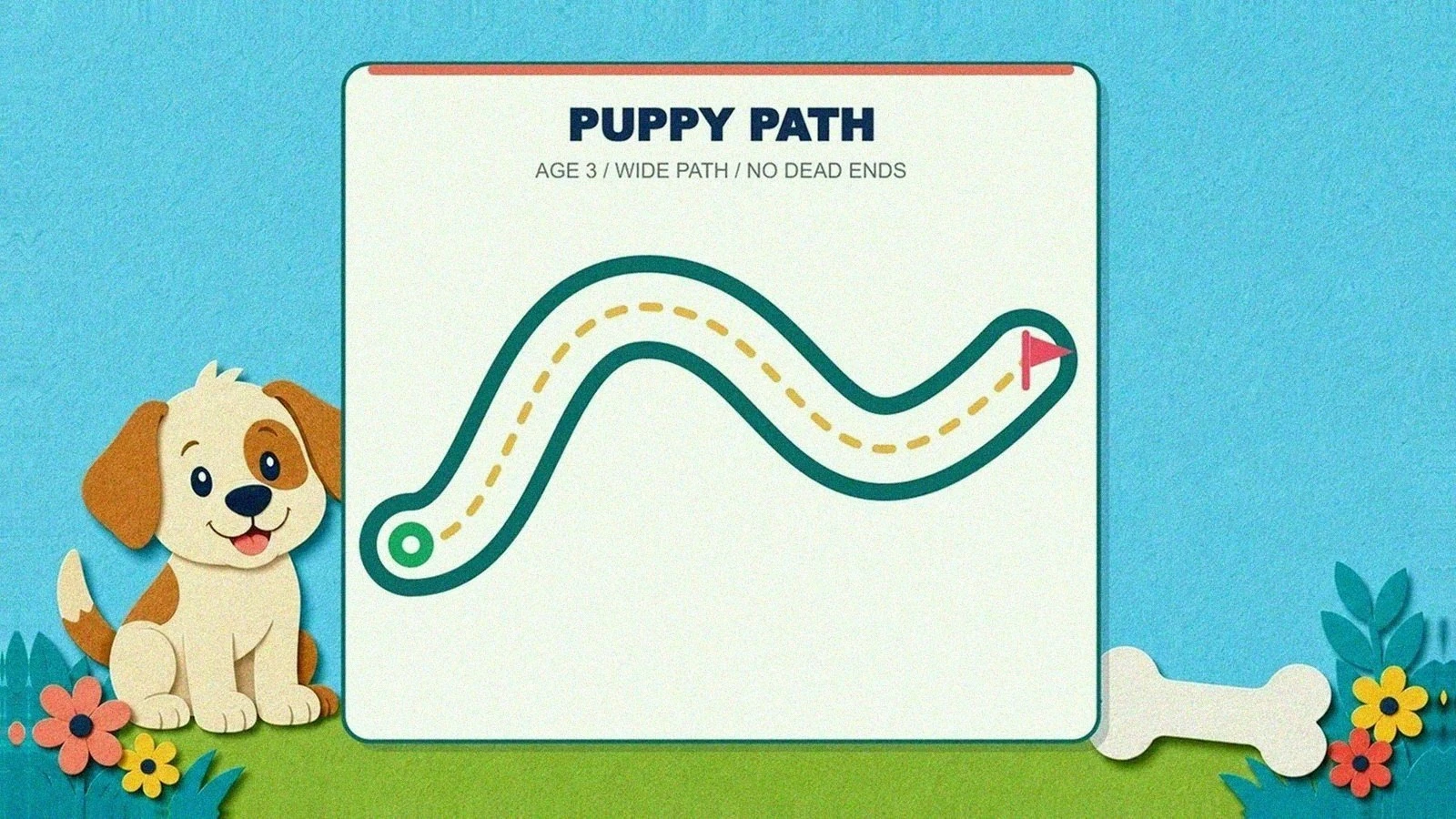
A 3-year-old maze: wide corridors, one or two turns, and a picture goal instead of "start" and "finish."
printable mazes for 4 year olds
Four is the sweet spot where a maze starts doing its real job: making them choose. By now most kids can keep a line in the corridor, so you can add the first honest dead end, the one wrong turn that quietly stops and sends them back.
Good four-year-old mazes have:
- One or two real decisions, forks where the wrong path dead-ends.
- A slightly longer route, so finishing feels earned.
- Still-generous spacing; narrow grids look impressive and frustrate four-year-olds.
This is also the age to start naming the strategy out loud: "uh oh, that one stopped, let's go back to where the path split." You are teaching backtracking without calling it that. Print these from the easy mazes collection and move up a level only when wrong turns stop causing a meltdown.
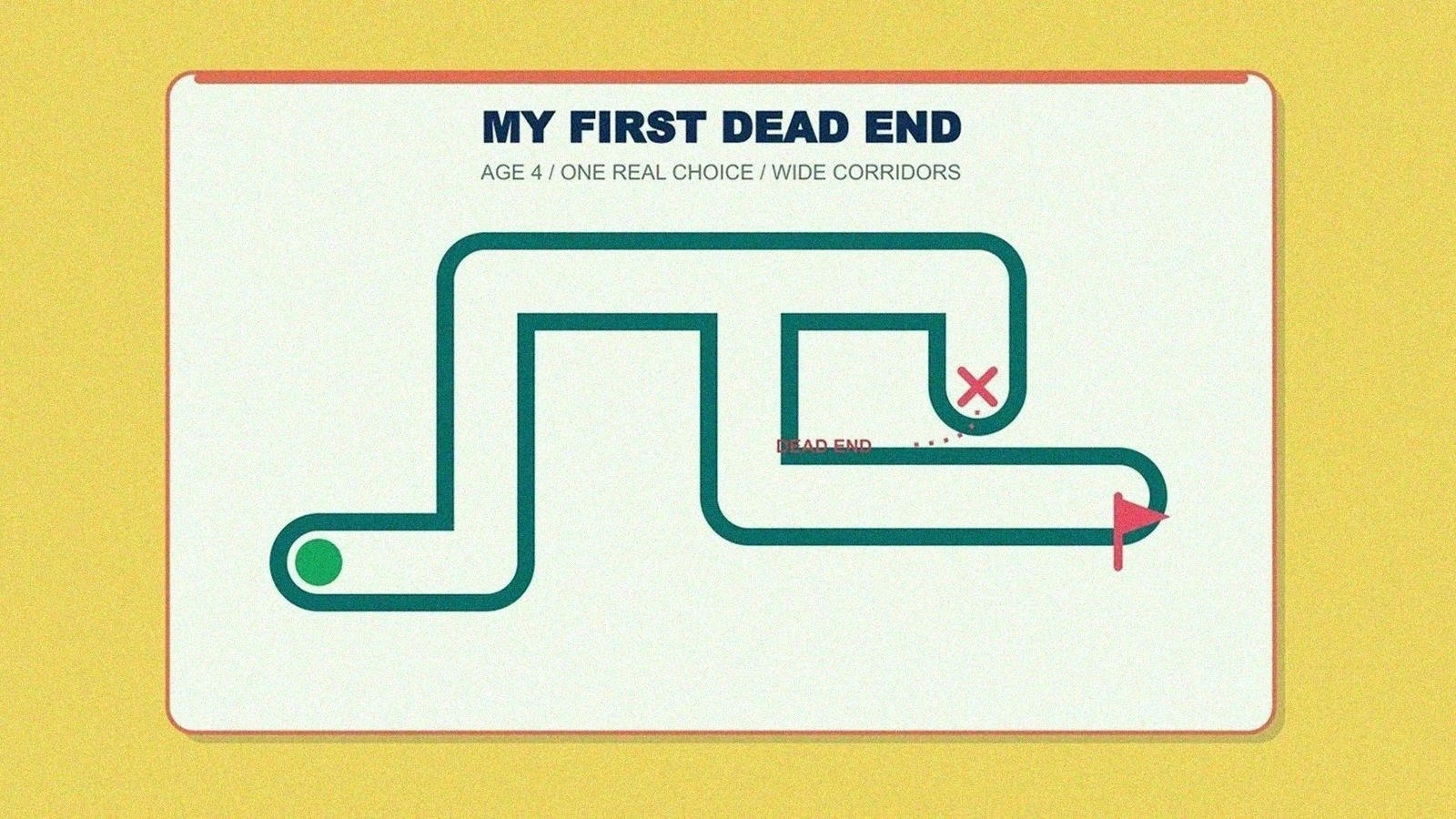
A 4-year-old maze adds the first honest dead end, the wrong turn that teaches backtracking.
kindergarten maze worksheets (ages 5 to 6)
By kindergarten, kids can plan a few steps ahead, so the maze can finally have several real forks and a route long enough to feel like an accomplishment. This is where dead ends earn their keep and where you can teach a repeatable solving habit.
Good kindergarten maze worksheets usually have:
- Three or more honest forks, with wrong paths that dead-end.
- A longer, twistier route.
- A smaller grid (about 7x7 to 10x10), still with clear corridors.
One of my favorite kindergarten moves: tell them to put a small X at every dead end. It keeps the page readable, turns the maze into a calm search instead of a guessing game, and gives the racers something to do besides shout "I'm done." A confident kindergartner is ready for a Medium Mix Pack maze; for everything in the easy-to-medium range, printable mazes for kids is the page I send parents to. To match a level to a specific child, use our pick difficulty by grade guide.
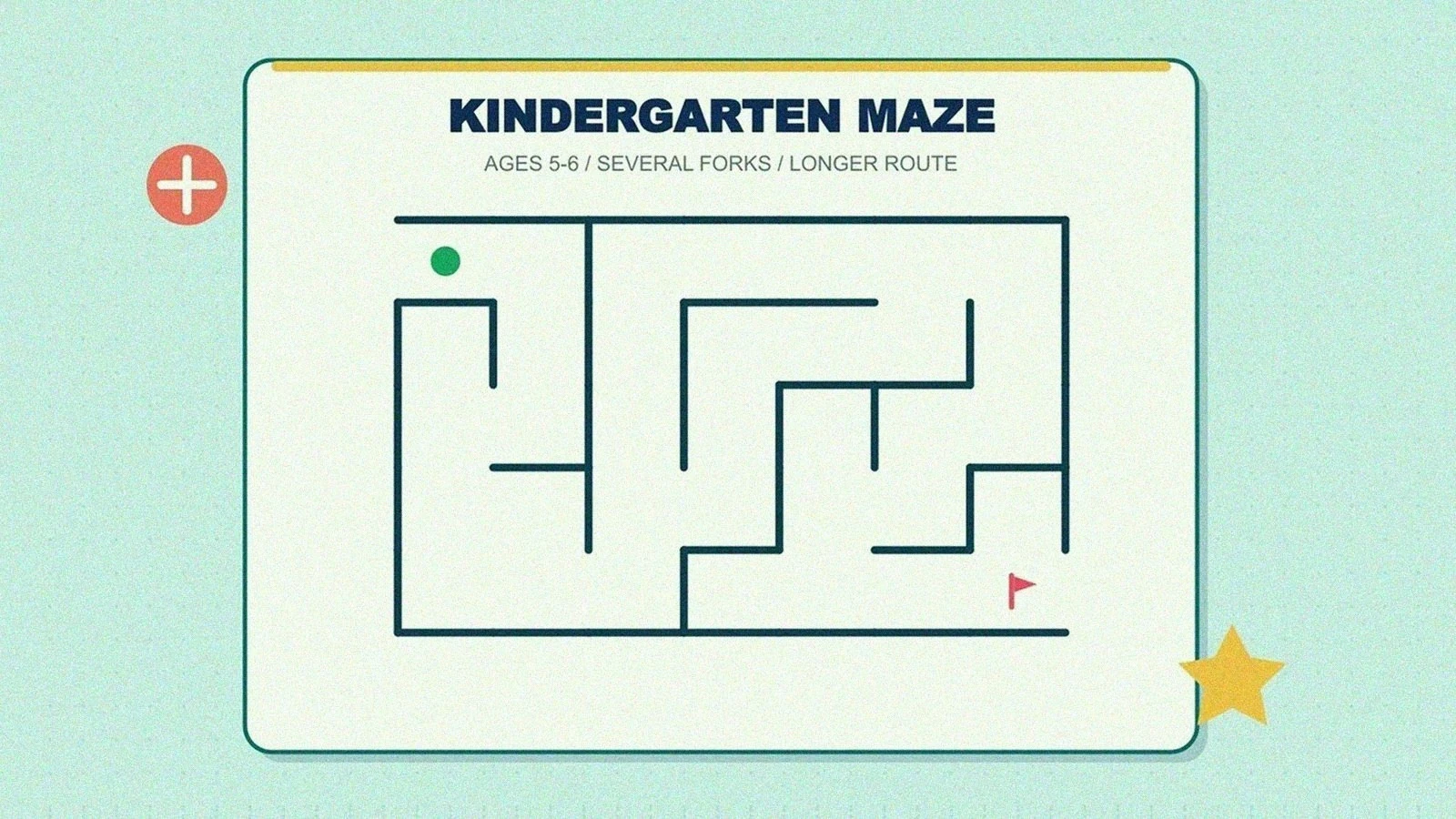
A kindergarten maze: several real choices and a route long enough to feel earned.
maze worksheets by theme
The fastest way to get a reluctant preschooler to do "a worksheet" is to stop calling it one. Put a dinosaur at the end of the path and the whole thing turns into a rescue mission. Themed mazes are where a lot of the search traffic and a lot of the fun lives:
- Animals: dog, cat, bunny, dinosaur, bug, ocean.
- Seasons and holidays: pumpkin and spider-web mazes in October, snowman and stocking mazes in December, hearts in February, eggs in spring.
- Vehicles and space: rocket-to-planet and car-to-garage routes.
You can build any of these by adding a picture at the start and the goal of a plain maze. Print a clean route from the maze generator, then draw or paste a sticker at each end. It takes ten seconds, and a sticker is often the difference between a shrug and "again!"
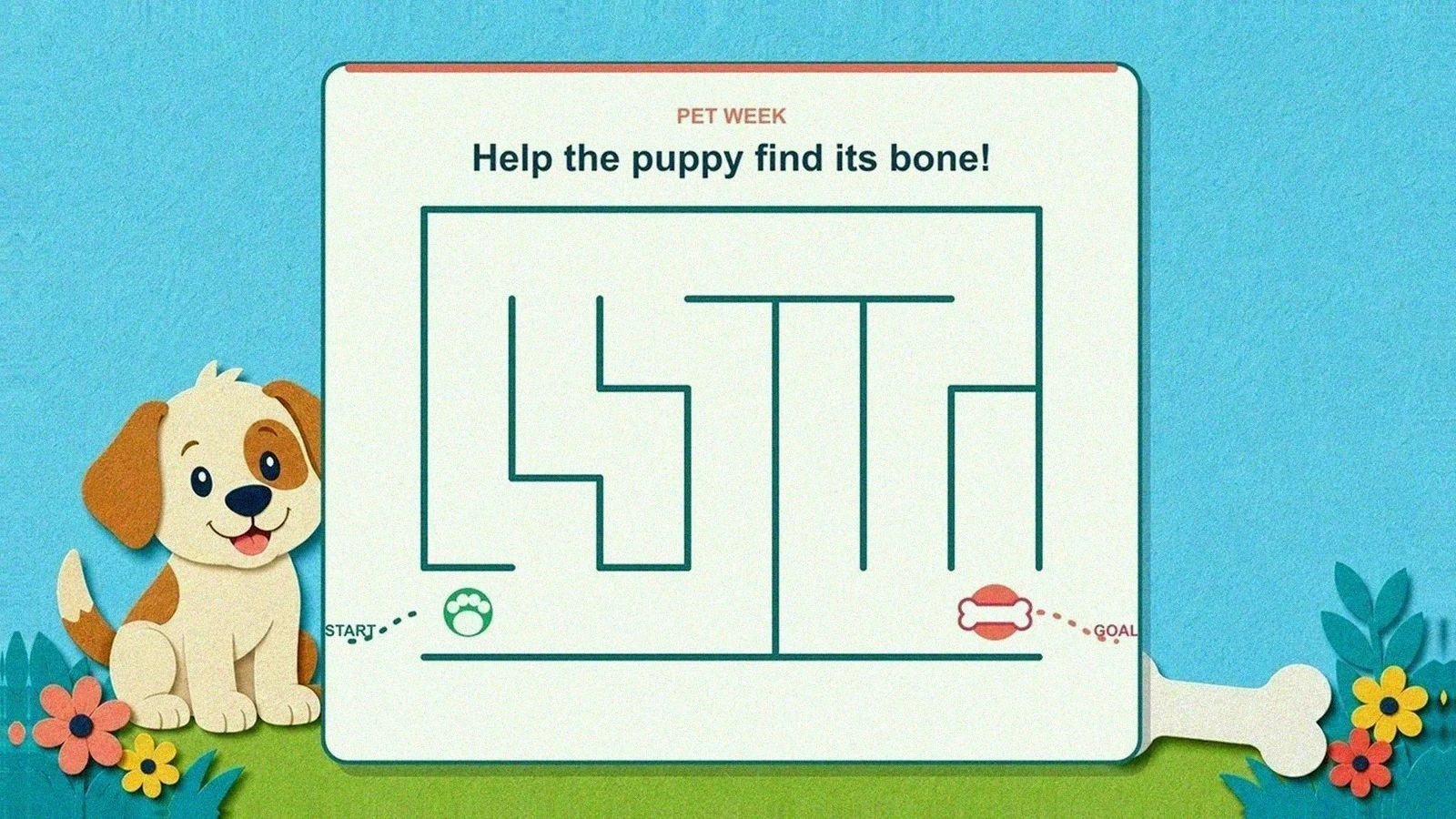
A themed maze: a picture at each end turns a plain worksheet into a rescue mission.
Preschool teachers lean on themed mazes hard, and this clip from PreschoolVibes shows exactly why they work as a hands-on, "every theme you can think of" fine-motor station:
maze worksheets by skill (alphabet, numbers, shapes)
Mazes quietly stack academic practice on top of the motor practice, which is why they survive in classrooms long after the novelty wears off. You do not need special "alphabet maze" or "number maze" worksheets to get it, though; a plain maze plus one spoken instruction does the same work:
- Letter mazes: name the letter at the start and the letter at the goal as they trace.
- Number and counting mazes: have them count the dead ends they hit, or count turns out loud.
- Shape and color mazes: "follow only the path next to the circles," using a highlighter.
- Mazes inside a picture: solve the path first, then color the scene around it. The easy pages in our coloring maze set, like the puppy and the penguin, keep the paths wide enough for a crayon.
Turning a maze into a counting or alphabet warm-up costs nothing, and you can print a fresh one any time from the maze generator. For more classroom variations, see our classroom maze warm-ups.
what mazes actually teach: the developmental benefits
Mazes look like a time-filler. They are not. Pediatric occupational therapists use them on purpose, and once you know what to look for, you can watch the skills add up. According to OT resources like Your Therapy Source and The OT Toolbox, a single maze can work on all of the following at once:
| Skill area | What the maze is training | Why it matters later |
|---|---|---|
| Fine motor and grasp | Gripping the crayon, controlling pressure, precision | Handwriting, buttons, scissors |
| Pencil control | Keeping the line inside the corridor | Letter formation |
| Visual-motor integration | Eyes and hand working together | Copying from a board, writing |
| Visual perception | Tracking the path, telling it from dead ends (figure-ground) | Reading, spotting details |
| Executive function | Planning the route, not jumping ahead, sequencing | Following multi-step directions |
| Bilateral coordination | One hand steadies the paper, one draws | Cutting, tying shoes |
That "one hand holds the paper while the other draws" detail is the one parents miss most. It is real bilateral coordination practice, the same skill behind cutting and, eventually, shoe-tying. A maze is pencil-control and planning practice a child will actually ask to do again, which is more than most worksheets can claim.
how to teach a young child to do a maze
Here is the exact routine I use, plus a short video showing the fine-motor control a maze leans on.
- Finger first. Trace the whole path with a finger before any crayon touches the page. This removes the fear of "messing up."
- Name the start and the goal. "We start at the bunny, we are going to the carrot."
- Highlighter before crayon. A highlighter is forgiving and feels like a grown-up tool. OTs love it because the wide tip rewards staying in the corridor.
- Mark dead ends with a small X, then back up to the last fork. This is the whole strategy, and it works for life.
- Try a vertical surface. Tape the maze to the wall or use an easel. OTs recommend this for younger kids because it builds wrist and shoulder stability, and honestly it makes the activity feel new.
When a child gets genuinely stuck and frustrated, do not grab the crayon and finish it. That ends the frustration and the learning in one move. Offer one nudge instead: "back up to the last spot where the path split." Our guide on helping a kid who gets stuck has more of these, and how to solve a maze covers the techniques for older kids.
how to make a maze easier or harder
The same maze worksheet can fit a wobbly three-year-old or a sharp six-year-old; you just change a few settings.
| To make it easier | To make it harder |
|---|---|
| Shrink the grid (wider paths) | Grow the grid (narrower paths) |
| Remove dead ends, keep one route | Add more dead ends and forks |
| Print larger (fill the page) | Print smaller or two-per-page |
| Trace together with a finger first | Add a gentle timer or "bonus round" |
| Use a fat crayon or highlighter | Switch shape: try circular or hex |
Every one of these is a single setting in the maze generator, and you can read more about what drives difficulty in how maze difficulty works.
printing and reusing maze worksheets
A maze worksheet is only as good as its print, and small issues quietly turn an easy maze into a hard one.
Get the print right
- Print at 100% scale, never "fit to page," which shrinks the maze and the margins unpredictably.
- Set margins to "None" or "Minimum" if any edge gets cut. I now run one test page first, ever since the afternoon I printed thirty copies with the finish line sliced off the bottom.
- Use PDF for consistent sizing across printers. If you are weighing formats, see PDF vs SVG for printing mazes, and for cropping fixes, print mazes without cropping.
- Paper size: Letter (8.5 x 11 in) or A4, both available on every download.
- Save ink by printing in grayscale; mazes are line art, so they lose nothing.
Reuse them forever
- Laminate or slip the page into a clear sheet protector, then solve with a dry-erase marker and wipe clean. One maze becomes a hundred. This is my single best tip for car trips and restaurant waits; that dry-erase squeak is the sound of a quiet back seat.
- Cardstock holds up better than copy paper for little hands that press hard.
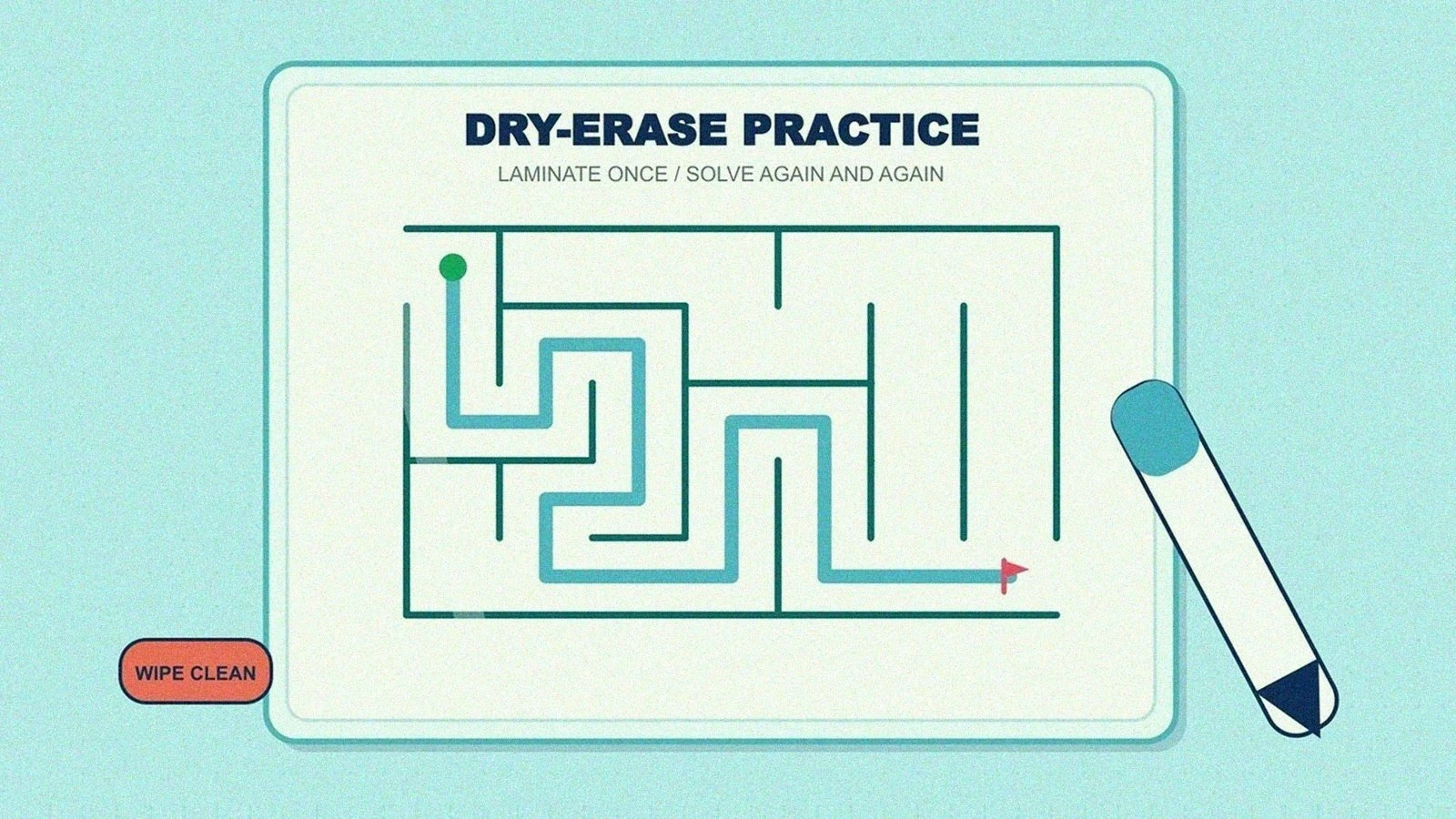
Laminate or use a sheet protector with a dry-erase marker, and one maze becomes a hundred.
The right tool for little hands
- Triangular crayons or chunky pencils fit a developing grip and stop the death-grip you see at three.
- Washable markers and highlighters glide more easily than a pencil, so beginners stay in the lines and stay happy.
a simple maze you can draw yourself
Sometimes the best worksheet is one you scribble on a napkin. To draw a simple maze for a young child:
- Mark a start and a goal at opposite corners.
- Draw one clear winding path connecting them, with wide gaps.
- Add one or two short "branches" that go nowhere (the dead ends).
- Add a picture at each end.
That is the whole recipe, and it is genuinely how the easy ones are built. For a step-by-step with examples, see how to draw a maze.
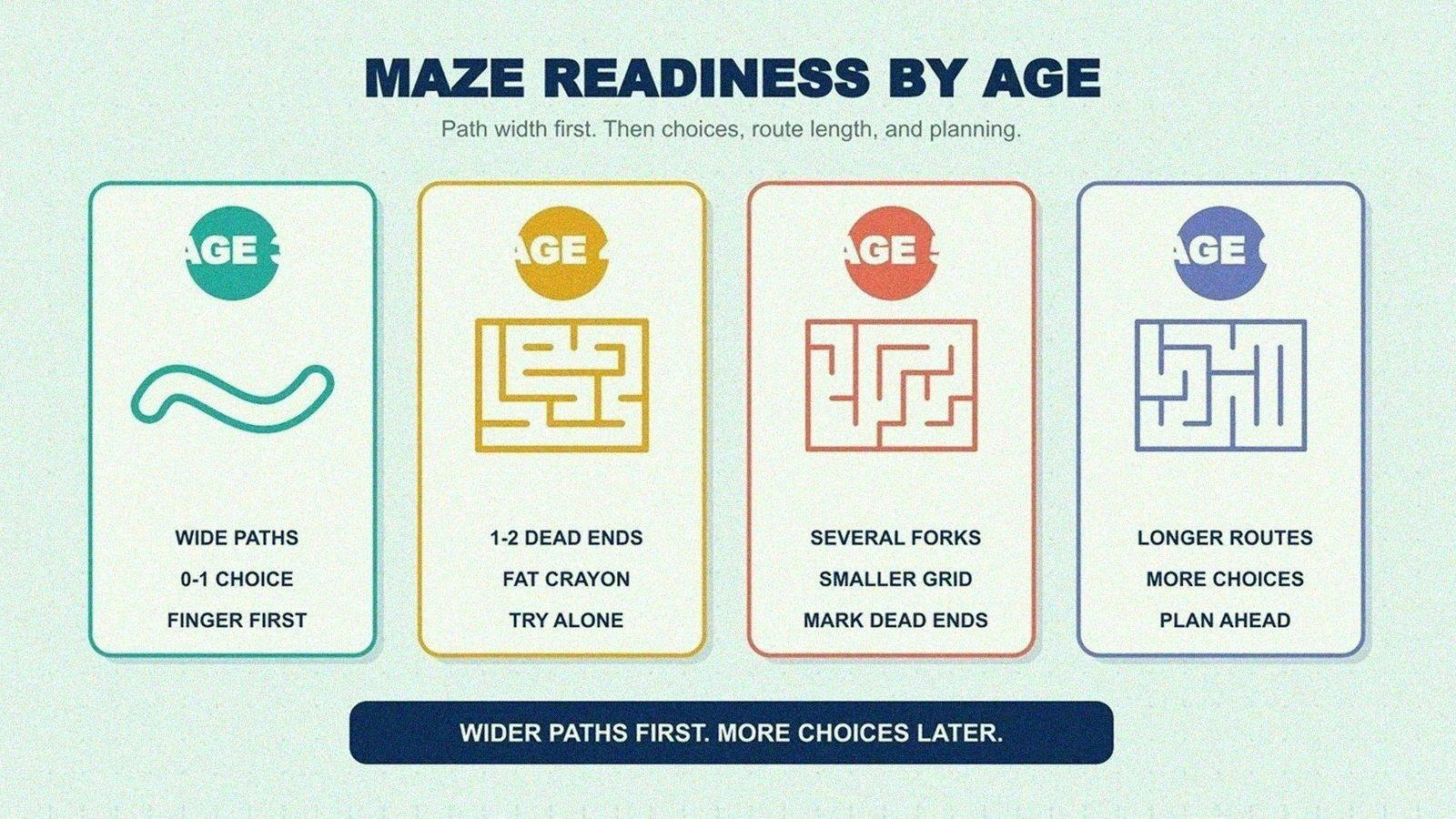
Maze readiness by age, at a glance: path width and number of choices carry most of the difficulty.
the difference between a maze and a labyrinth
Worth a quick note, since people search for both. A maze branches: it has forks and dead ends, so you can take a wrong turn. A labyrinth has one single path that winds to the center with no choices, so you cannot get lost. For young kids, a labyrinth (one path) is the gentlest possible starting point, and a maze (choices) is the next step up. We go deeper in maze vs labyrinth, and what is a maze covers the full vocabulary.
FAQ
Can a 4 year old do a maze?
Yes. A typical four-year-old can solve a simple maze with wide paths, a short route, and one or two dead ends, especially if they trace it with a finger first. If a four-year-old struggles, the maze is almost always too hard, not the child. Drop to a smaller grid with wider corridors.
What age can kids start doing mazes?
Around three, with very simple, wide-path mazes and a finger-first pass. Most kids solve easy mazes independently by four or five. Start with the simplest easy mazes and move up only when they finish without help.
Are maze worksheets good for preschoolers?
Very. Occupational therapists use mazes to build fine motor control, pencil grip, visual-motor integration, visual tracking, planning, and bilateral coordination, all in a format kids actually enjoy. The key is matching the difficulty so it feels like a win.
How do I make a maze easier for a 3 year old?
Shrink the grid so the paths get wider, remove the dead ends, print it large, and trace it together with a finger before they use a crayon. A fat triangular crayon or a highlighter also helps a developing grip stay in the lines.
Are these maze worksheets free and available as PDF?
Yes. The easy mazes, printable mazes for kids, and starter packs are all free to download and print as PDFs in Letter and A4, answer keys included, no account required.
What is the difference between preschool and kindergarten mazes?
Mostly difficulty. Preschool mazes are tiny, wide, and nearly single-path. Kindergarten mazes are longer and add several real dead ends so the child has to choose. See printable mazes for kids by grade to match a level to an age.
What are the two types of mazes?
The two main types are multicursal mazes (branching, with dead ends, the kind you can get lost in) and unicursal labyrinths (one single path to the center). Most kids' "mazes" are multicursal. See maze vs labyrinth.
next step
- Print a few easy mazes for kids tonight, or grab the Easy Starters Pack with its answer key.
- Keep the Medium Mix Pack ready for kids who finish fast.
- Want a specific size, shape, or theme? Build it with the maze generator.
- New to mazes? Start with what is a maze, then try how to draw a maze or how to solve a maze.
Sources and further reading: Your Therapy Source: Printable Mazes for Kids, The OT Toolbox: Shamrock Directionality Maze, and the CDC's developmental milestones.