Ten walk-through mazes and one medieval labyrinth make the useful shortlist here; the big numbers run from Hampton Court's one-third acre to Luc Pelletier's 266,106 m² temporary corn maze in Quebec.
A maze gives you choices. A labyrinth gives you one winding route. That difference matters here, because Chartres is not a maze in the strict sense, while Hampton Court, Longleat, the Peace Maze, Villa Pisani, and the crop mazes below are built to make you choose wrong turns.
Record claims need a category attached. A permanent hedge maze, a bamboo maze, and a temporary corn maze are not competing for the same title.
A quick word on who is writing this, because for a list like this it matters. I have been a maze person since I was eight, when my parents lost track of me for twenty minutes in a garden maze in Cornwall and I came out grinning instead of in tears. Three decades later I still plan detours around them, these days usually with two reluctant kids and a long-suffering husband in tow. Of the ten mazes and one labyrinth below, I have actually been to five. I will flag which ones as we go, and I will be straight about the rest, which are carefully sourced and sitting on my own wishlist.
Want a paper version instead of a travel plan? Start with our printable mazes or make one with the maze generator.
what is a hedge maze?
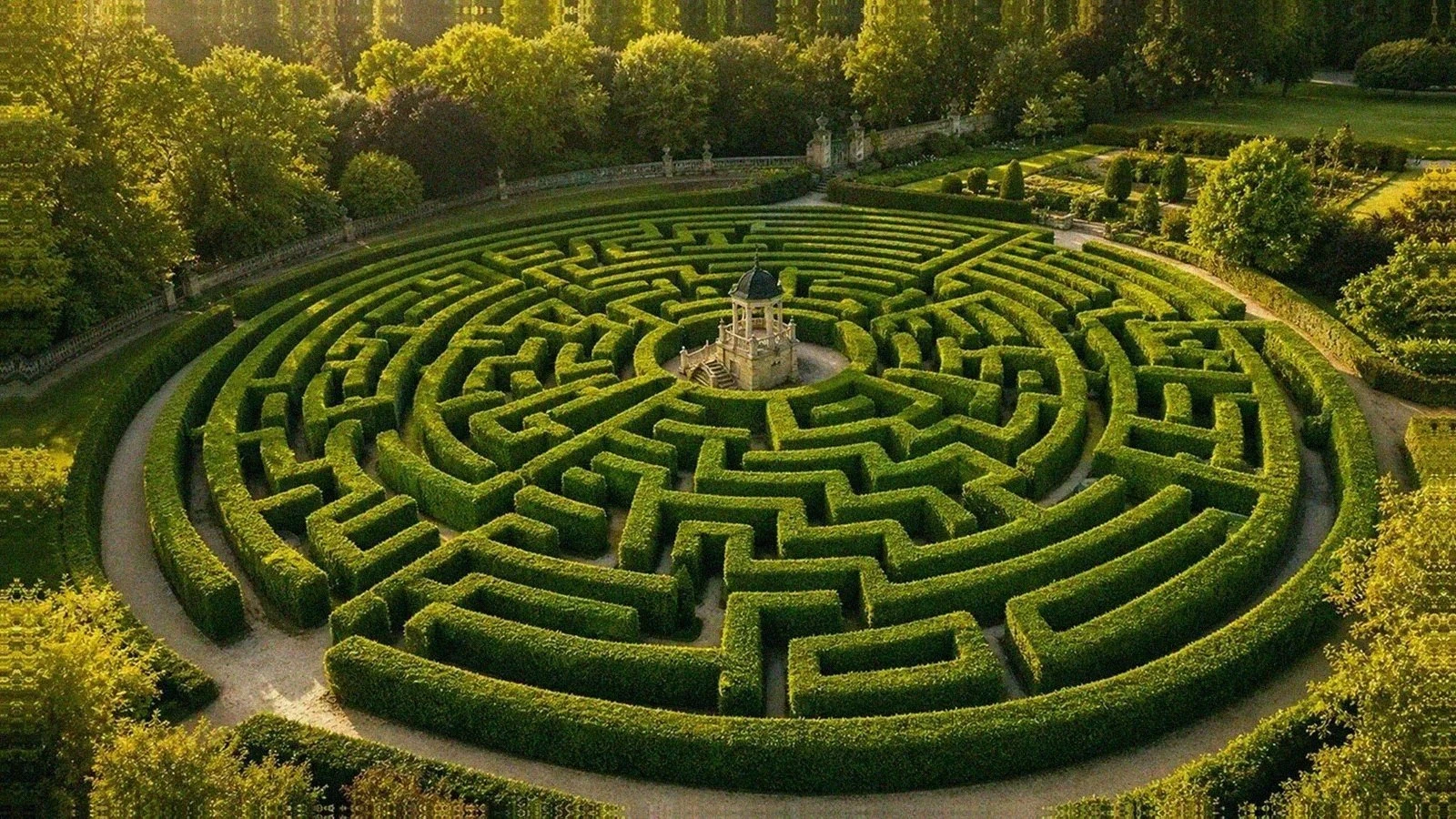
A hedge maze is a branching puzzle with living plants for walls, usually yew, box, hornbeam, cypress, or privet. The walls do the real work. Once they are tall enough to block sightlines, a small garden can feel larger than it is because you lose the entrance, the center, and most landmarks within a few turns.
Adrian Fisher, whose firm says it has created over 700 full-size mazes across 40+ countries, told Country Life the appeal is "being part of an adventure." In a hedge maze, a tower, bell, or center point gives you a target, but the route keeps pulling you away from it.
For the strict terminology, a maze has branches and dead ends; a labyrinth has one path. We go deeper in maze vs labyrinth, but the short version is enough for this list: most famous "mazes" are multicursal, while Chartres is unicursal.
| Maze | Country | Type | Notable stat |
|---|---|---|---|
| Hampton Court Palace | England | Hedge | UK's oldest surviving hedge maze (around 1700) |
| Longleat | England | Hedge | About 1.69 miles of paths, the longest in Britain |
| Peace Maze | Northern Ireland | Hedge | About 2.18 miles of paths, over 6,000 yews |
| Villa Pisani | Italy | Hedge | 18th-century rings, often called Europe's hardest |
| Labirinto della Masone | Italy | Bamboo | About 17 acres, one of the largest mazes on earth |
| Ashcombe Maze | Australia | Hedge | Australia's oldest, over 1,000 cypress trees |
| Pineapple Garden Maze | USA (Hawaii) | Plant | World's largest maze in 2008 (Guinness) |
| Davis' Mega Maze | USA (Mass.) | Corn | Annual Adrian Fisher-designed corn maze |
| Cool Patch Pumpkins | USA (California) | Corn | About 60 acres, former Guinness record |
| Reignac-sur-Indre | France | Corn/sunflower | About 10 acres, grown fresh each summer |
famous hedge mazes to visit
The permanent hedge mazes below are the old-school version of the puzzle: clipped walls, gravel paths, and just enough height to make the garden disappear.
Hampton Court Palace Maze (England)
Hampton Court Palace has the United Kingdom's oldest surviving hedge maze, planted sometime between 1689 and 1695 for William III. George London and Henry Wise laid it out as a trapezoid of about one-third of an acre, with roughly half a mile of paths.
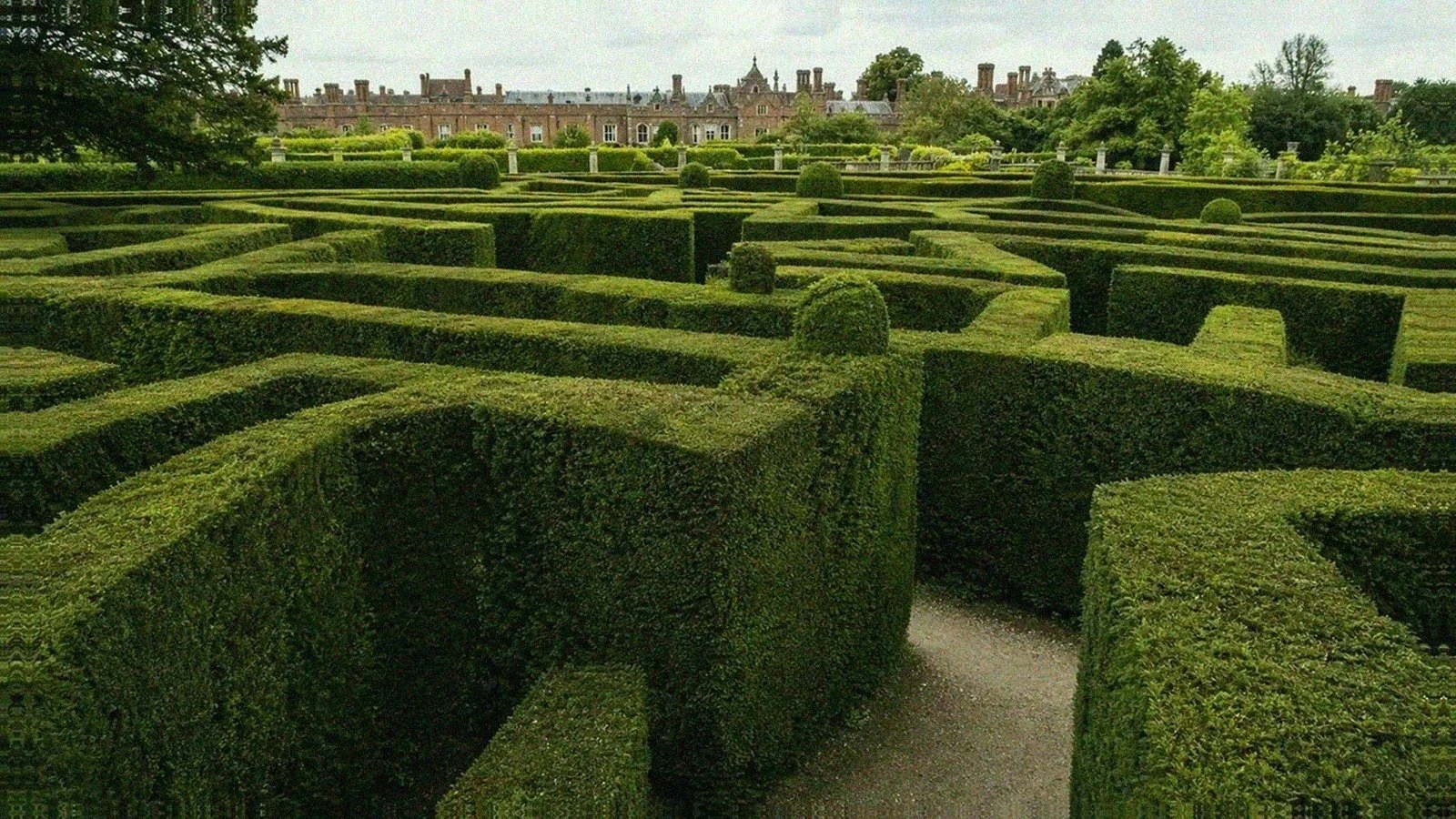
Original digital representation of Hampton Court Palace Maze from a new elevated garden angle.
The maze is small by modern record standards, but it has had more than 300 years to collect stories. Jerome K. Jerome used it in Three Men in a Boat, and frustrated visitors have been known to push through the hedges instead of walking back to a junction.
The right-hand-wall trick works at Hampton Court, although it is a slow way to solve it. The maze is included with palace admission and is busiest in summer.
I did Hampton Court on a sticky July afternoon, and the thing that caught me off guard was how small it looks from the gate. A third of an acre sounds like nothing until the yew closes over your head and the palace simply vanishes behind you. We tried the right-hand rule because my husband was certain about it; it does work, but it marches you down every single limb of the thing, and by the time we reached the middle our six-year-old had loudly rated the whole experience "boring," which is its own kind of review. My real tip is to go first thing. By midday you are basically shuffling through the corridors behind other people's family photos.
Longleat hedge maze (England)
Longleat is where the list stops feeling quaint. Greg Bright designed the Wiltshire maze in 1975 with more than 16,000 English yews, about 2.72 km (1.69 miles) of paths, and six raised wooden bridges inside roughly 1.48 acres.
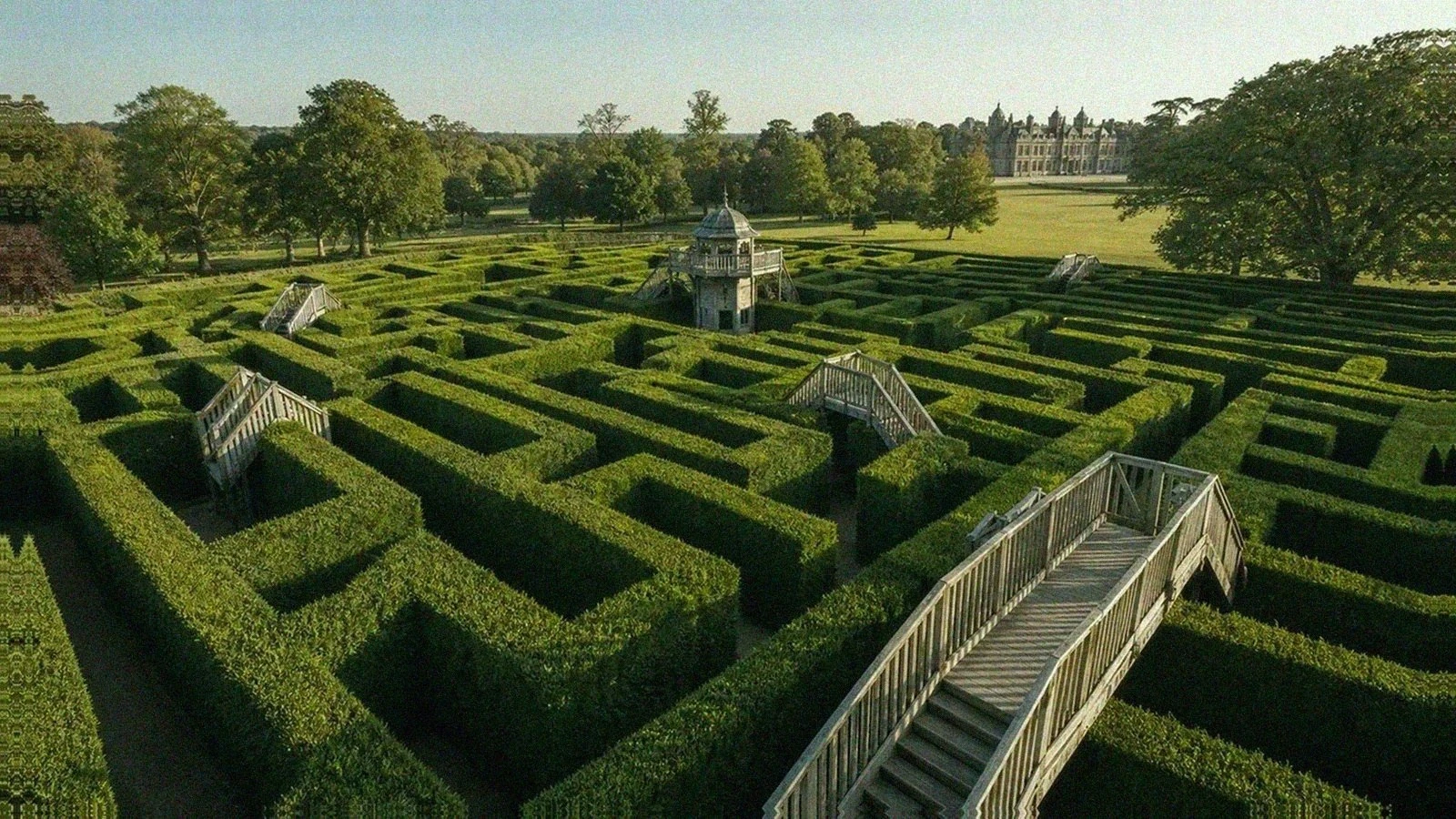
Original digital representation of Longleat's bridges, central tower, and dense yew corridors.
The bridges are not decorative. They let you look across the hedges, misread the route, then drop back into the puzzle and lose the pattern again. Plan on 60 to 90 minutes if you want to reach the central observation tower without rushing.
Longleat is the one that genuinely beat me. We walked in cocky after Hampton Court and came out ninety minutes later, sunburnt and a little short with each other. The bridges are the cruel bit: you climb one, you spot the tower, you feel clever for about ten seconds, then you drop back down and the yew quietly deletes everything you thought you had learned. Bring water, and do not promise the kids it will be quick.
This walkthrough shows the view from the central tower and how dense the yew hedges are at ground level.
Peace Maze, Castlewellan (Northern Ireland)
Castlewellan's Peace Maze opened on 12 September 2001 in County Down. It covers about 1.1 hectares (2.7 acres), uses more than 6,000 yew trees, and has roughly 3.5 km (2.18 miles) of paths.
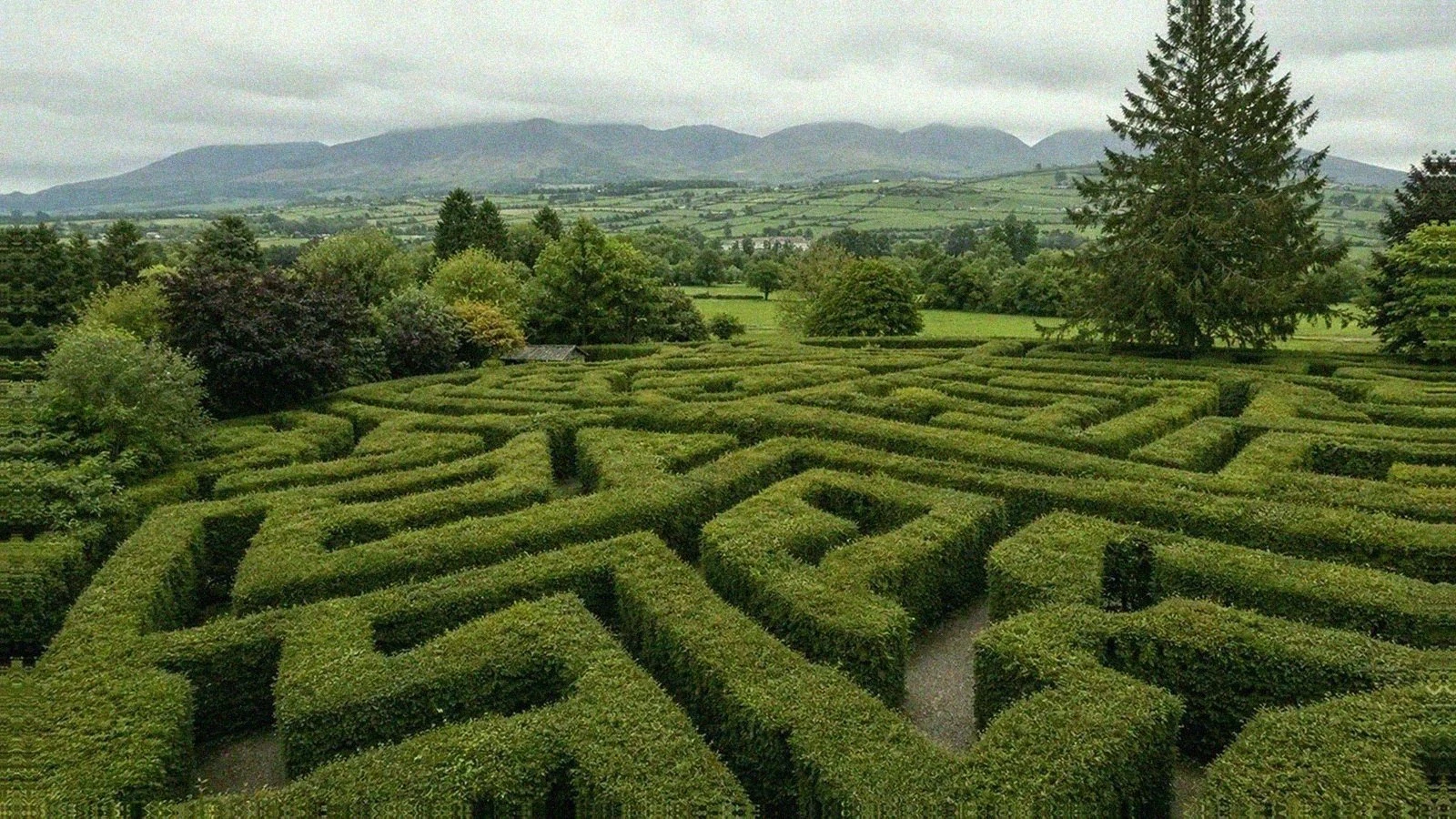
Original digital representation of Castlewellan's Peace Maze against the Mourne Mountains.
Members of the public helped plant it as a peace symbol after the Troubles. A bell waits at the center, which is a small mercy after that much uniform yew. Its length and lack of obvious landmarks are why it belongs in the hardest-maze discussion, not just the famous-maze list.
Villa Pisani maze, Stra (Italy)
Villa Pisani's 18th-century maze near Venice is the one people usually name when they want a European maze with a reputation. It uses concentric rings of boxwood hedge, with a small turret and a statue of Minerva at the center.
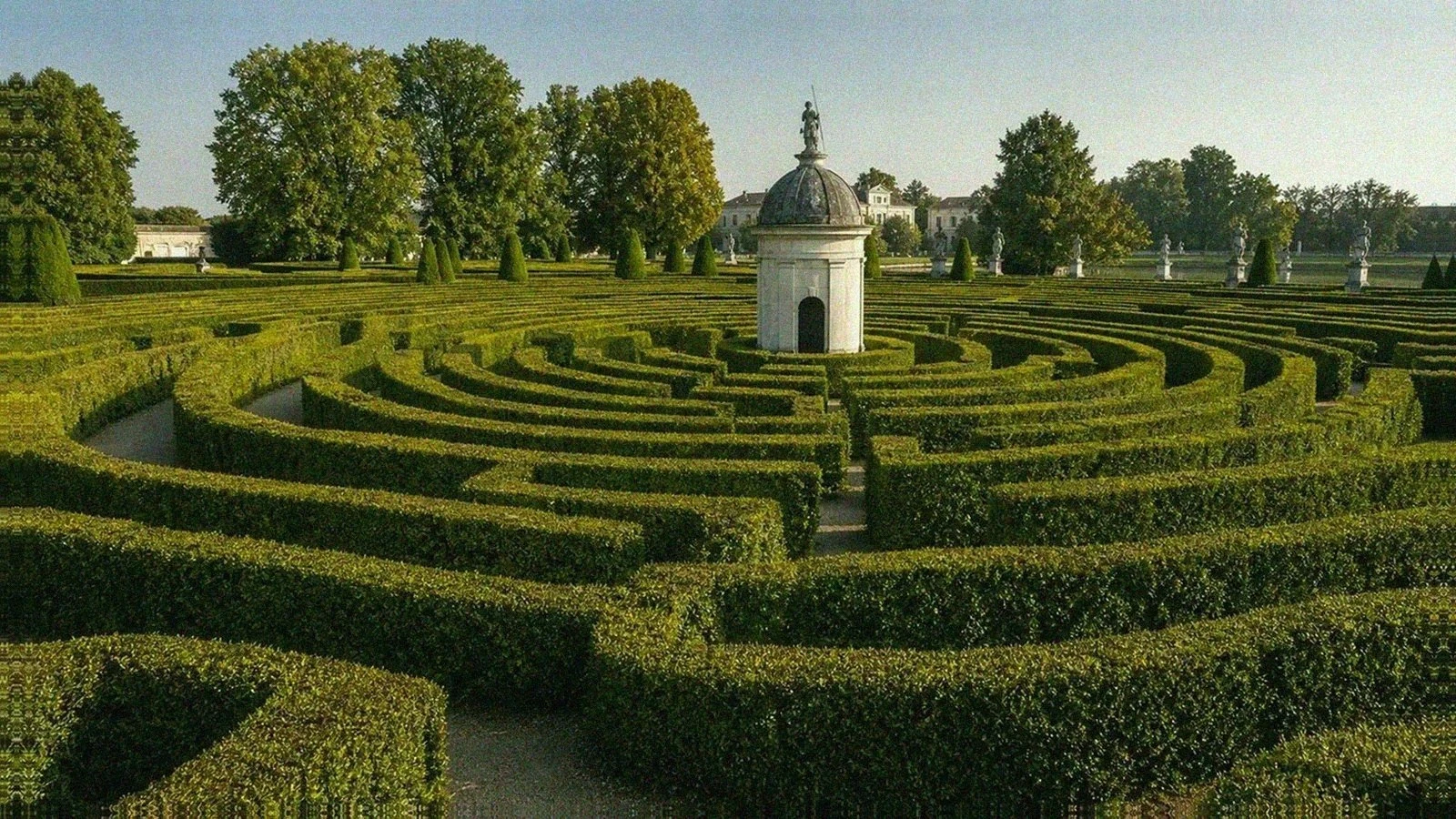
Original digital representation of Villa Pisani's repeating boxwood rings and central turret.
The Napoleon story is the famous hook: he supposedly tried it and gave up after he later owned the villa. Treat that as folklore. The difficulty does not need the legend anyway; repeating rings are enough to make every opening look like the one before it.
I will be honest: Villa Pisani is the only maze that has ever made me slightly panicky. The boxwood rings are low enough to see over in places, which sounds like a help and is exactly the opposite, because you can keep that little turret in view the whole time and still not reach it. I went on a grey October morning with almost no one else around, and the quiet plus those identical hedges did something to my sense of direction that I did not enjoy. Still worth it. I would just bring someone with you if that kind of disorientation tends to get under your skin.
Ashcombe Maze (Australia)
Ashcombe Maze on Victoria's Mornington Peninsula is built from more than 1,000 cypress trees, some over 3 metres tall. The hedges took about 25 years to reach their current size and density, which is why the place feels closer to an old garden than a quick tourist add-on.
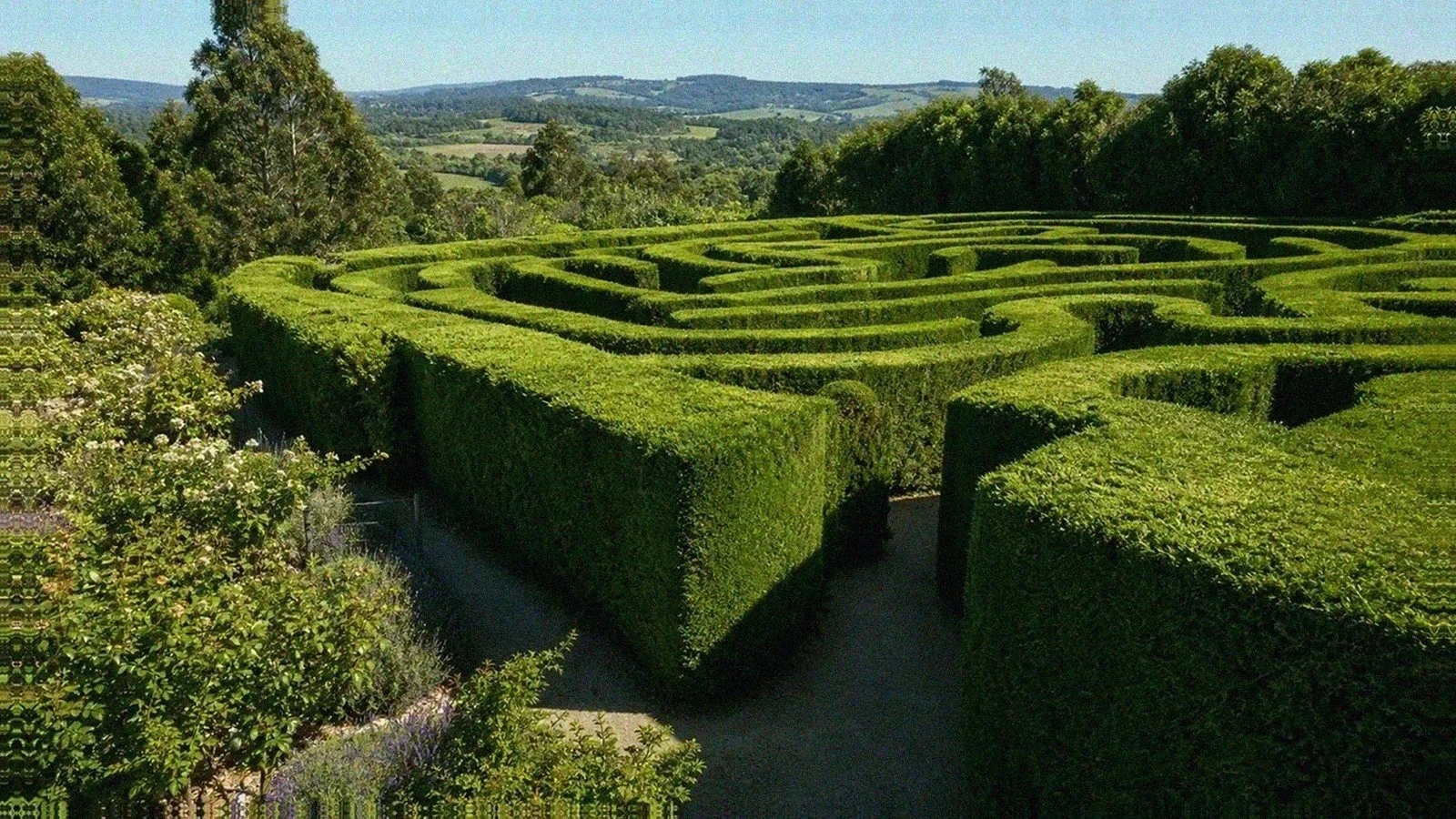
Original digital representation of Ashcombe's tall cypress maze from a garden-side viewpoint.
The site also has a circular rose maze, but the cypress maze is the reason Ashcombe keeps showing up on lists of southern hemisphere hedge mazes.
giant seasonal and modern mazes
The newer famous mazes tend to win on scale or novelty: bamboo in Italy, tropical planting in Hawaii, and crop fields that disappear at the end of the season.
Labirinto della Masone, Fontanellato (Italy)
Labirinto della Masone opened near Parma in 2015 and covers about 7 hectares (17 acres). Franco Maria Ricci, the publisher behind the project, planted it with roughly 200,000 bamboo plants from around 20 species.
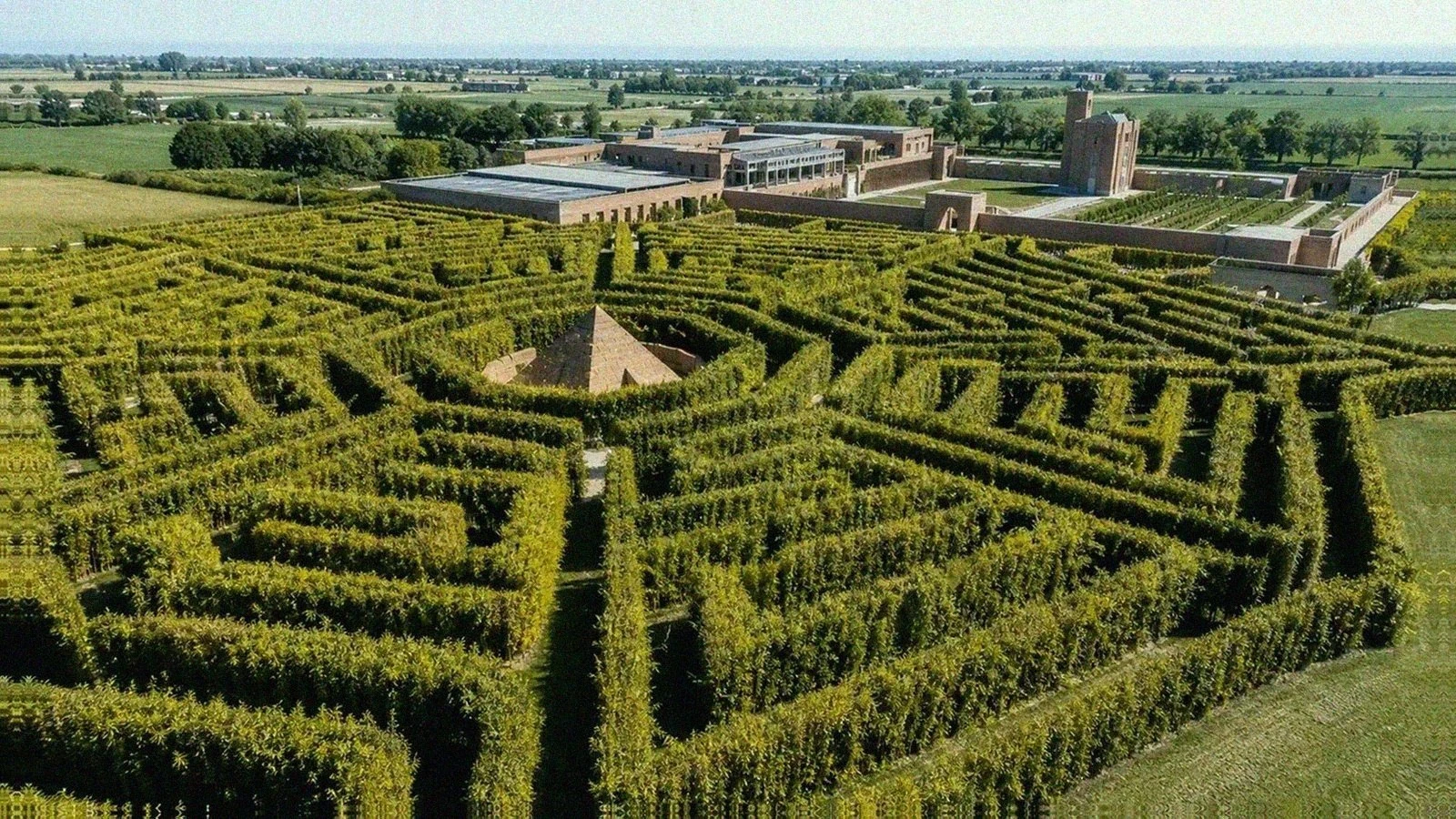
Original digital representation of Labirinto della Masone's bamboo corridors and central complex.
The layout is star-shaped and draws on Roman mosaic patterns, with around 3 km of paths. A museum, library, and chapel sit at the center, so the visit feels less like a garden puzzle and more like a collector's private obsession made public.
Pineapple Garden Maze, Dole Plantation (USA, Hawaii)
The Pineapple Garden Maze at Dole Plantation on Oahu was named the world's largest maze by Guinness World Records in 2008. It uses about 14,000 Hawaiian plants, covers more than 3 acres, and has roughly 2.5 miles of paths.
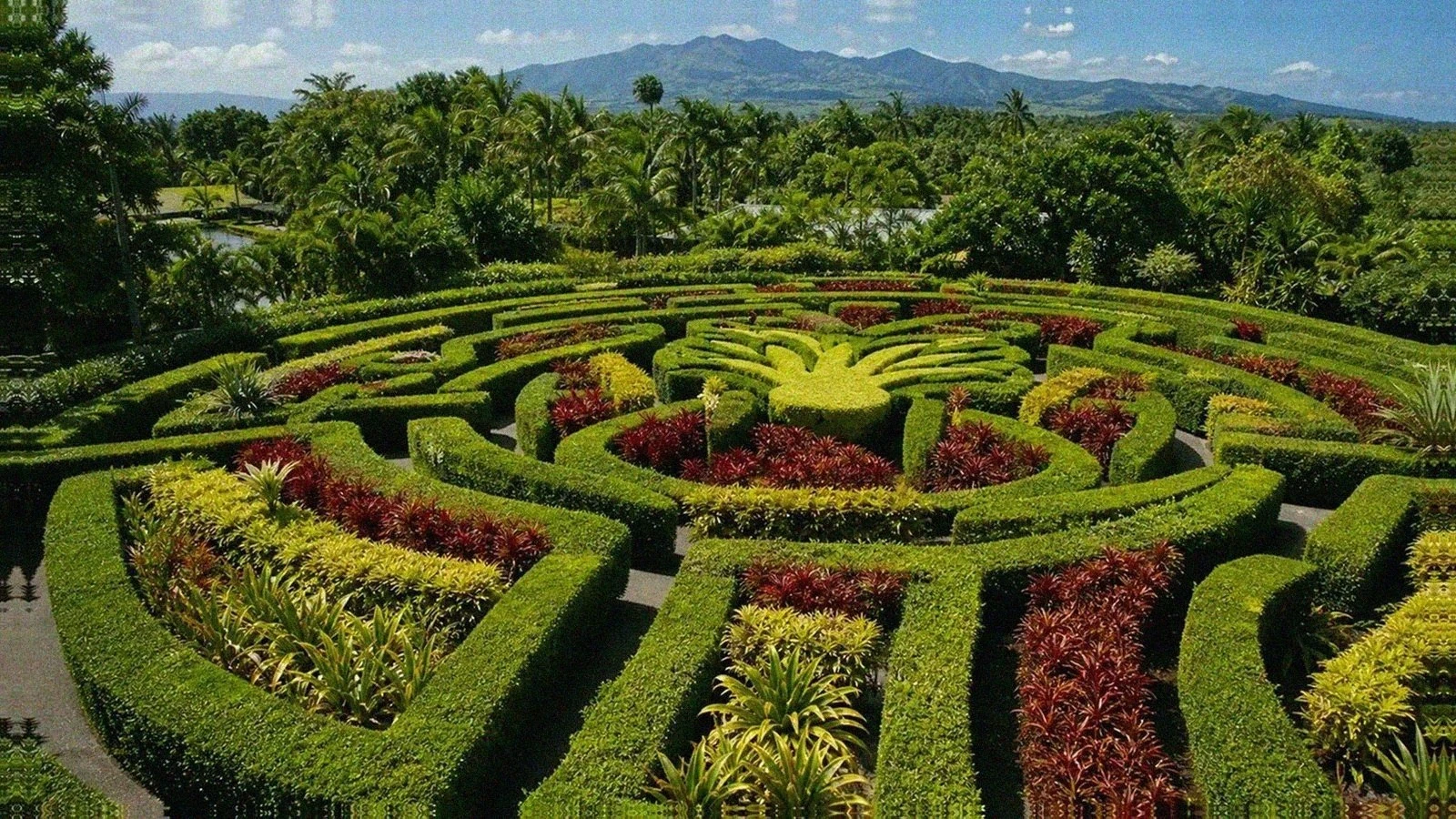
Original digital representation of the Pineapple Garden Maze's tropical planting and pineapple-inspired layout.
Eight hidden stations turn it into a timed hunt rather than a quiet hedge-maze wander. Its record was real in 2008, but the current Guinness categories have moved on.
Davis' Mega Maze (USA, Massachusetts)
The Davis Mega Maze in Sterling, Massachusetts started in 1998 and changes design each year. Adrian Fisher designed it, and the maze uses bridges to add a 3-D layer to the usual cornfield route.

Original digital representation inspired by Davis' Mega Maze, with raised bridges over autumn corn rows.
It is seasonal, usually running from late summer into autumn. The annual redesign matters: a corn maze that repeats the same layout quickly becomes a field with spoilers.
Davis' is the one American corn maze I have done, on a cold New England October, and the 3-D bridges really do change the puzzle. You spend half your time peering down through the slats trying to catch the row you actually need. From experience: it gets muddy, the corn dust ends up in your collar and your shoes, and my kids loved it more than any tidy hedge maze precisely because it felt a little feral.
Cool Patch Pumpkins corn maze (USA, California)
Cool Patch Pumpkins in Dixon, California has held the Guinness title for world's largest corn maze twice, first in 2007 and again in 2014. The 2014 version reached about 60 acres (roughly 24 hectares).
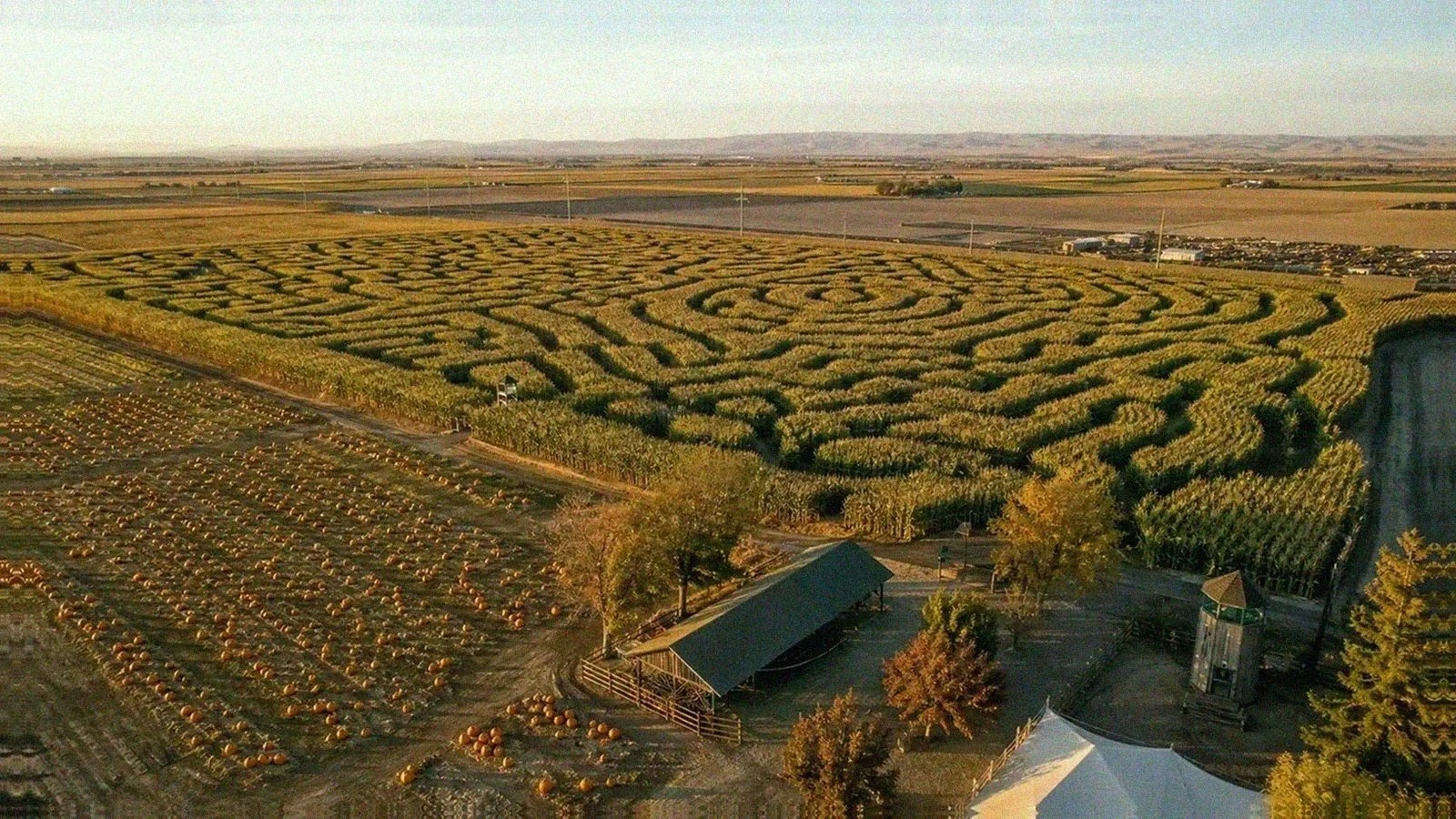
Original digital representation of a giant Dixon-style corn maze with a pumpkin patch for scale.
At that size, the maze is less about elegant design and more about stamina. Lost-visitor calls have become part of the local story, and the maze only exists during pumpkin season.
Reignac-sur-Indre maze (France)
Reignac-sur-Indre in the Loire Valley has grown a seasonal maize-and-sunflower maze every summer since 1996. The field covers about 4 hectares (10 acres), and the design changes each year.
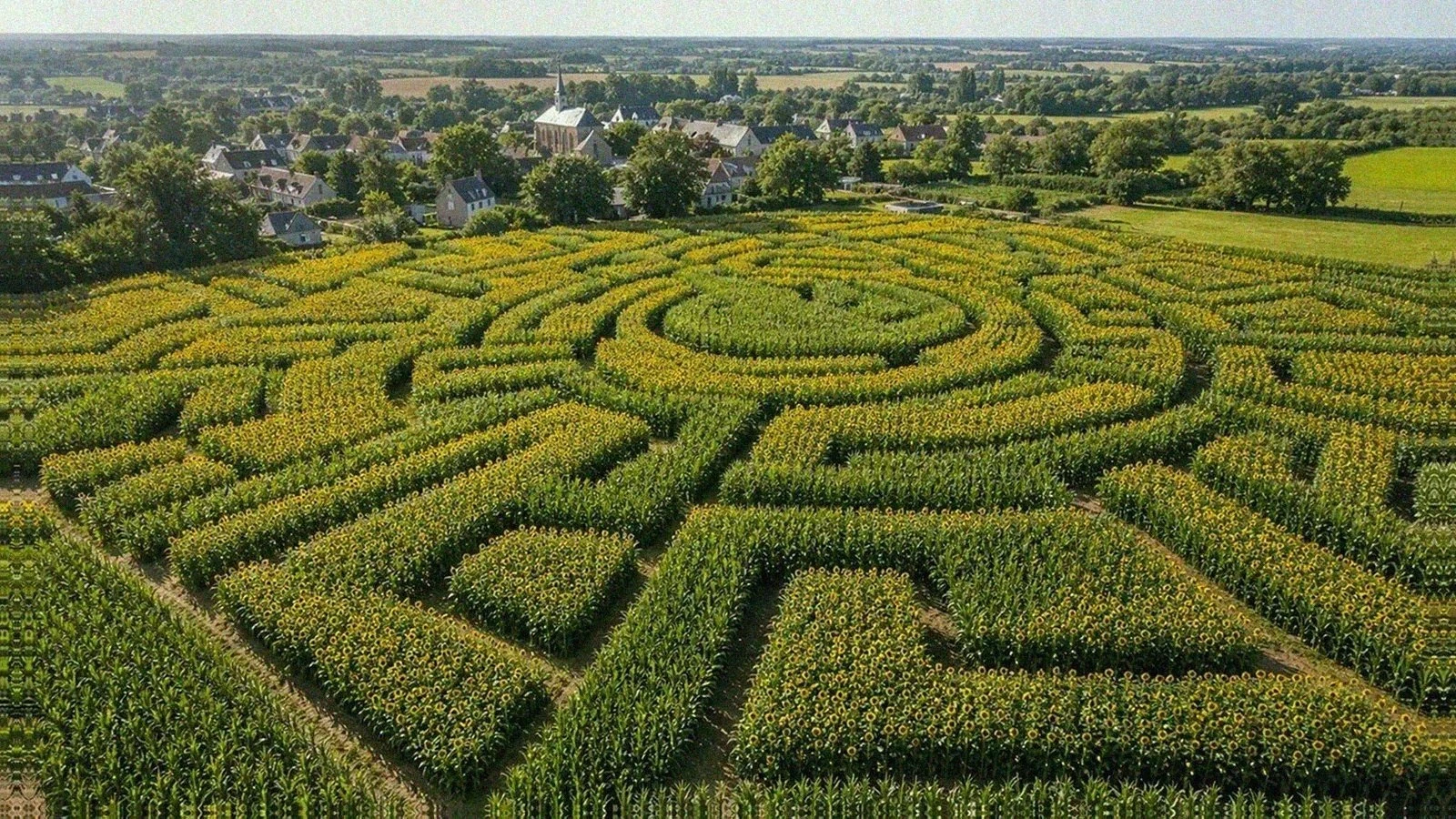
Original digital representation of a Loire Valley maize-and-sunflower maze near Reignac-sur-Indre.
It is a good reminder that "famous maze" does not always mean permanent garden. Sometimes the whole attraction is planted, walked, harvested, and started again.
labyrinths worth a detour
Chartres belongs here because people search for it alongside famous mazes, even though the floor design is a labyrinth.
Chartres Cathedral labyrinth (France)
The Chartres Cathedral labyrinth was laid into the nave floor in the early 13th century, around 1200 to 1230. It is 12.9 metres (about 42 ft) across, with 11 concentric circuits and a single path roughly 261.5 metres (858 ft) long.
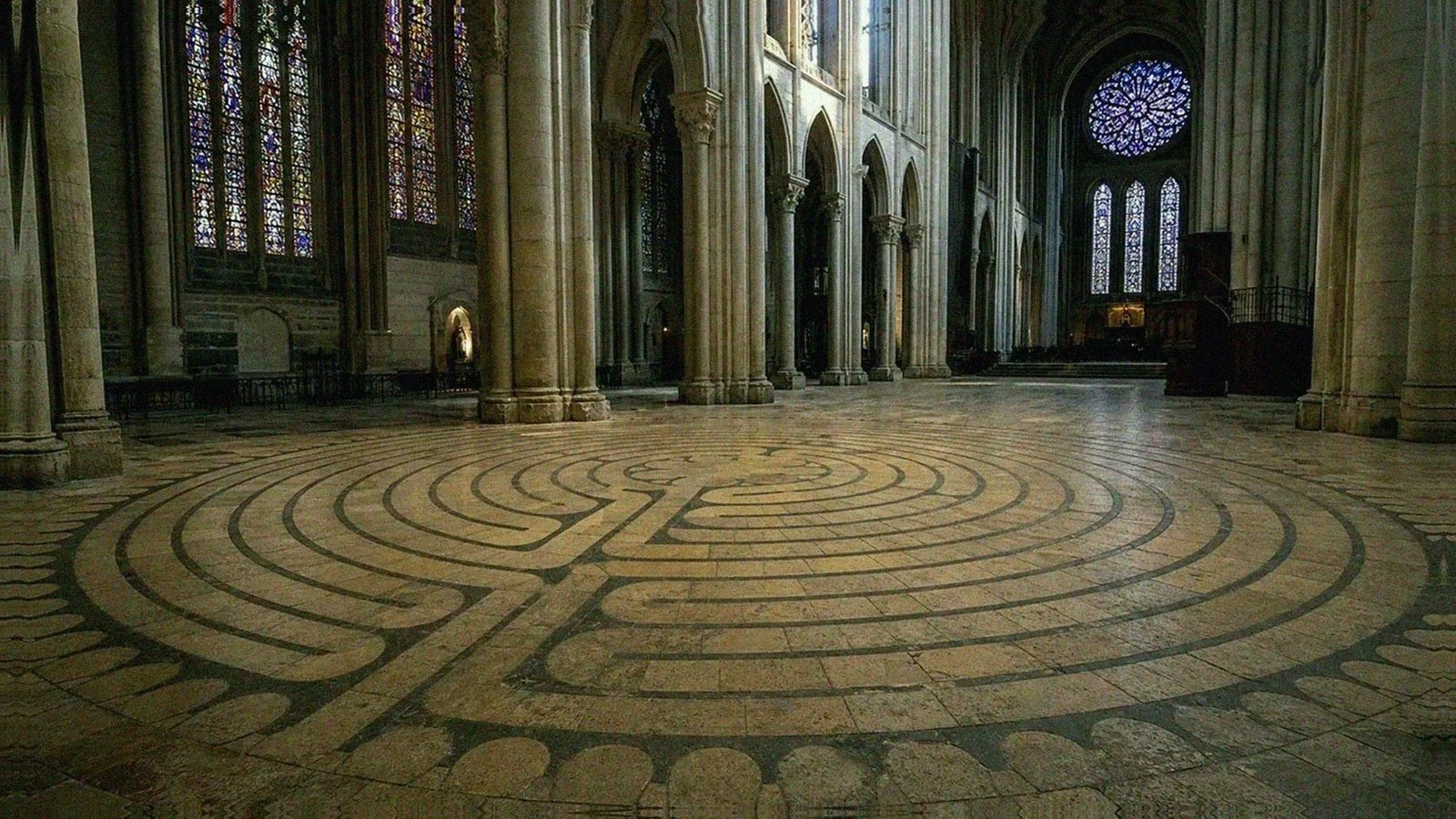
Original digital representation of the Chartres Cathedral floor labyrinth with the nave cleared.
You cannot get lost in it. That is the point. A maze tests choices; this kind of labyrinth turns walking into a slow loop toward the center.
Walking the Chartres labyrinth is the part of this whole list I think about most. On certain days they clear the chairs off it; I happened to be there on one of those days, slipped my shoes off, and walked the full route with a dozen quiet strangers doing the same thing. Because there is nothing to solve, your brain stops bracing for a wrong turn, and somewhere in the loops it actually settles down. I am not a particularly spiritual person and it still got to me.
the hardest maze in the world
Villa Pisani, the Peace Maze, and Longleat are the best physical contenders for "hardest maze in the world," but no official body ranks mazes by difficulty the way Guinness ranks size.
Villa Pisani has repeating rings and very few useful landmarks. The Peace Maze has more than 6,000 yews and about 2.18 miles of path. Longleat has 1.69 miles of path plus bridges, which makes the layout easier to misread from above and below.
Those are different kinds of difficulty. Villa Pisani attacks orientation. The Peace Maze attacks patience. Longleat gives you information, then makes that information hard to use.
Having stumbled through two of those three myself, I can vouch for the categories. Villa Pisani went straight for my sense of direction; Longleat handed me a clear view from every bridge and then made that view almost useless the second I climbed down.
We tested the same idea with Maze Printables' generator. In a deterministic sample of 1,200 mazes (400 rectangular, 400 circular, 400 hex), the hardest 10% had at least 229 solution steps, 102 dead ends, and 149 junctions. Hex mazes had the highest average solution tortuosity in the sample, at 0.76 turns per solution step, which helps explain why a compact hex maze can feel nasty on paper.
There is a mathematical answer outside the travel world. In 2024, physicists working with Ammann-Beenker tilings described maze-like Hamiltonian cycles that can scale into extremely difficult fractal patterns. That is a paper-and-theory kind of hard, not a weekend visit.
the world's largest maze
The largest permanent hedge maze is Yancheng Dafeng Dream Maze in China at 35,596.74 m², and the largest temporary corn maze is Luc Pelletier's La Pocatière, Quebec maze at 266,106 m².
Guinness verified Yancheng Dafeng Dream Maze in Yancheng, Jiangsu, on 30 June 2018. Its 35,596.74 m² footprint is about 383,160 sq ft, and it surpassed the Pineapple Garden Maze at Dole Plantation, the 2008 record holder.
For temporary corn mazes, Guinness verified Luc Pelletier's La Pocatière maze on 18 October 2022 at 266,106 m², or about 65.78 acres. Cool Patch Pumpkins held earlier versions of the title in 2007 and 2014 at around 60 acres.
That is why old travel pages conflict. A place can truthfully say it was the world's largest maze in 2008, while another holds the 2022 temporary crop record and another holds the permanent hedge record.
| Record | Holder | Location | Size | Verified |
|---|---|---|---|---|
| Largest permanent hedge maze | Yancheng Dafeng Dream Maze | Yancheng, China | 35,596.74 m² | 30 Jun 2018 |
| Largest temporary corn maze | Luc Pelletier | La Pocatière, Canada | 266,106 m² (about 65.78 acres) | 18 Oct 2022 |
| Longest hedge maze in Britain | Longleat | Wiltshire, England | About 1.69 miles of paths | Built 1975 |
| World's largest maze (2008) | Pineapple Garden Maze | Oahu, Hawaii | Over 3 acres | 2008 |
Sources: Largest hedge maze, permanent (Guinness World Records), Largest temporary corn maze (Guinness World Records).
a short history of mazes
Mazes and labyrinths are old words for different experiences. The earliest designs most people would recognize are seven-circuit classical labyrinths, found on coins, pottery, and rock carvings around the Mediterranean and beyond. The Greek myth of the Minotaur gave the labyrinth its best-known story, but those old designs were usually unicursal: one route, no wrong turns.
In the Middle Ages, that single-path form moved into churches as pavement labyrinths. Chartres, laid around 1200 to 1230, is the famous survivor.
The branching maze came later in Renaissance and Baroque gardens. By the 17th century, hedge mazes had become estate entertainment: Hampton Court is the famous English survivor, while Villa Pisani shows the harder Italian garden style. The modern era added scale more than subtlety: Longleat's bridges in 1975, giant North American corn mazes, and the 17-acre bamboo Labirinto della Masone in 2015.
For more on the history, what is a maze goes deeper on definitions and types, and rectangular vs circular vs hex mazes covers how the underlying grid changes the puzzle.
faq
What is the most famous hedge maze in the world?
Hampton Court Palace maze in England is the safest answer. It is the UK's oldest surviving hedge maze (around 1700), and it has a long pop-culture history. Longleat is the better-known British maze for sheer size.
What is the world's largest maze?
The largest permanent hedge maze is the Yancheng Dafeng Dream Maze in China (35,596.74 m², 2018 record). The largest temporary corn maze is Luc Pelletier's 266,106 m² maze in La Pocatière, Quebec, Canada (2022 record).
What is the hardest maze in the world?
Villa Pisani (Italy), the Peace Maze (Northern Ireland), and Longleat (England) are the best physical contenders. Difficulty comes from dead ends, loops, length, and repeating hedges that remove landmarks.
What is the difference between a maze and a labyrinth?
A maze has branching paths, junctions, and dead ends, so you can get lost. A labyrinth has one winding path to the center with no choices. In the stricter sense, the Chartres "maze" is a labyrinth. See maze vs labyrinth.
Can I visit these mazes?
Most are open to the public, but hours vary. Historic hedge mazes such as Hampton Court, Longleat, Villa Pisani, and the Peace Maze usually have visitor seasons or site-specific opening days. Corn and crop mazes such as Cool Patch Pumpkins, Davis' Mega Maze, and Reignac-sur-Indre are summer or autumn attractions. Check the official site before you go. One thing I learned the hard way: on a big estate, the maze is almost always the last thing people get to, so by mid-afternoon you are solving it tired, footsore, and stuck behind a crowd. I now do the maze first and save the house and gardens for after.
next step
Whether or not you make it to any of these in person, and I really hope you do, you can get the same pleasant getting-lost feeling on paper this afternoon.
For a printable version of the same idea:
- Browse our printable mazes, including circular mazes that echo the concentric rings of Villa Pisani.
- Grab a stack for the kids with printable mazes for kids, or ramp up the challenge with adult printable mazes.
- Design your own maze with the maze generator.
- New to maze types? Start with what is a maze, then try how to draw a maze or how to solve a maze.
Sources and further reading:
- Hampton Court Maze (Wikipedia)
- Longleat (Wikipedia)
- Castlewellan Peace Maze (Tourism Northern Ireland)
- Villa Pisani, Stra (Wikipedia)
- Labirinto della Masone (Wikipedia)
- Chartres Cathedral (Wikipedia)
- Reignac-sur-Indre (Wikipedia)
- Largest hedge maze, permanent (Guinness World Records)
- Largest temporary corn maze (Guinness World Records)
- Pineapple Garden Maze (Dole Plantation)
- Davis Mega Maze official site
- Cool Patch Pumpkins' record-setting corn maze (KCRA)
- Ashcombe Maze official site
- Labirinto della Masone (Atlas Obscura)
- Hamiltonian Cycles on Ammann-Beenker Tilings (Physical Review X)
- Adrian Fisher Design official profile
- Country Life interview with Adrian Fisher