A mirror maze is a maze whose walls are mirrors, arranged on a grid of equilateral triangles so that every reflection lines up perfectly with a real corridor. Under even lighting you cannot tell a mirror panel from an open passage, which means a good share of the hallways you see do not exist. A paper maze misleads you with junctions and dead ends; a mirror maze misleads your eyes. On paper, the maze is honest and your planning fails you, which is the kind of difficulty we measure on our maze difficulty page. In a mirror maze the layout is usually simple, sometimes only a few dozen panels, and it is your visual system that fails you. I find that genuinely humbling: I spend my days testing printable mazes with hundreds of junctions, and a corridor of thirty mirrors still walked me straight into my own reflection twice.
This post covers how mirror mazes work, the psychology of why they scramble you, where the idea came from, how to get through one without bruising your nose, and which famous mirror mazes are worth a detour, with verified prices where I could find them.
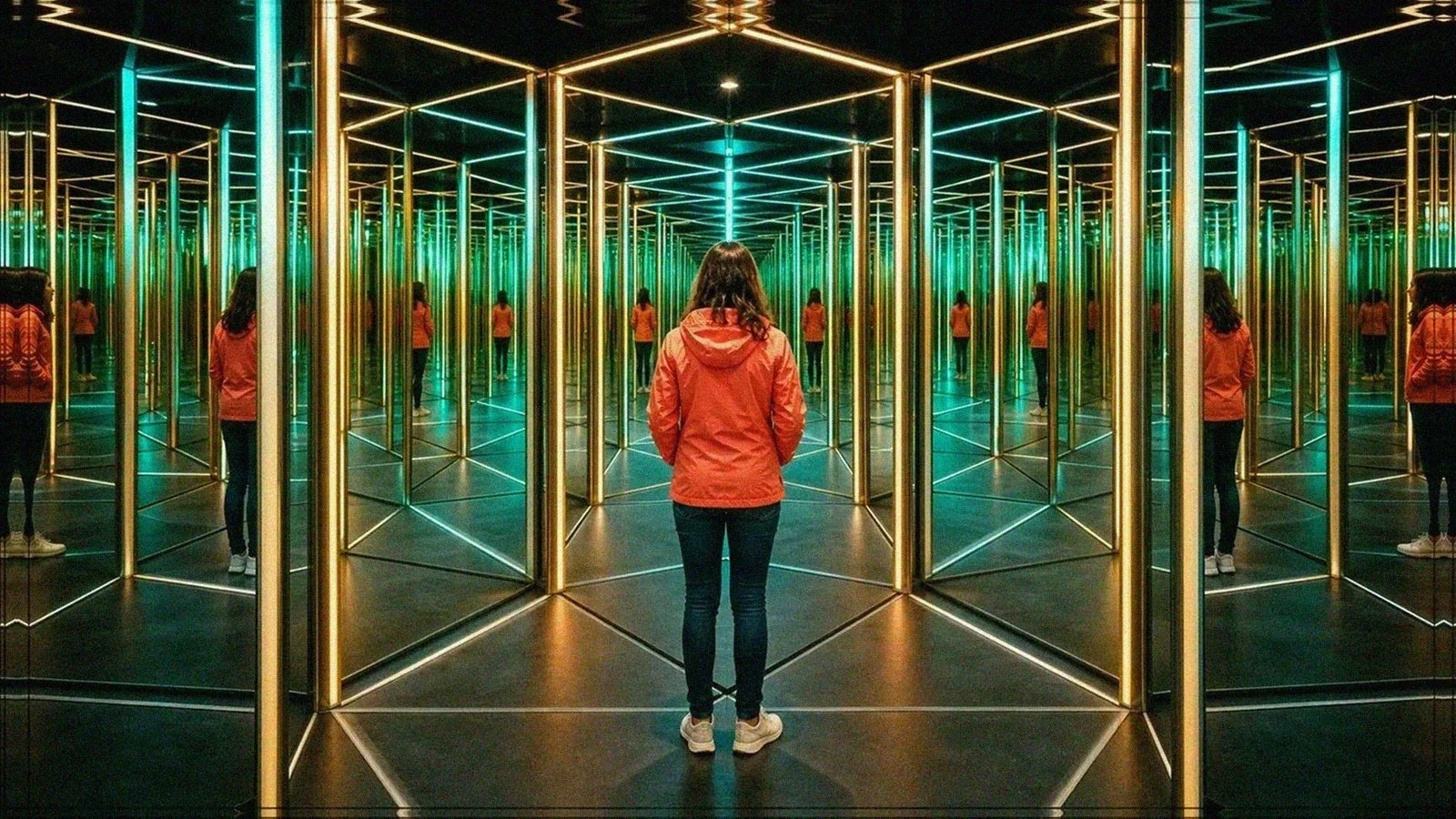
how a mirror maze works
Nearly every walk-through mirror maze is built on the same skeleton: an equilateral triangular grid. Vertical columns stand at the vertices, and the gaps between columns are filled with one of three things, a mirror panel, an open passage, or nothing at all where the triangle sits outside the route.
The 60-degree geometry is the load-bearing part. Because every wall meets every other wall at 60 or 120 degrees, a mirror never reflects a corridor at an odd, obviously fake angle. It reflects it in exactly the direction a real corridor could plausibly run. Stand at one junction and you might see six corridors radiating away from you; two are real and four are reflections, and all six obey the same geometry.
Designers then remove every clue that would let you tell them apart:
- Identical columns and trim. When every column looks the same, a reflected column carries no information. Some builds use Moorish arches, some use plain black posts wrapped in LEDs; what matters is repetition.
- Uniform lighting. Shadows and bright spots would mark specific locations. Even, sourceless light, these days usually LED strips on every column, makes each triangle of floor look like every other triangle.
- Patterned or dark floors. A distinctive carpet seam or scuffed board would act as a landmark, so floors repeat too.
Then there is the infinity effect. Wherever two mirrors face each other in parallel, each reflects the other's reflection, and the corridor appears to repeat forever, each copy a little darker as the mirrors absorb a few percent of the light per bounce. Attractions like Magowan's on San Francisco's Pier 39 put "infinite" in the name because of exactly this effect.
why your brain gets lost
Your sense of where things are rests on a stack of cues, and a mirror maze quietly breaks most of them.
Depth cues get doubled. A mirror shows an object as far behind the glass as the object is in front of it. Your binocular vision reads that reflected corridor as genuinely eight feet deep, because optically it is. There is no "flatness" to detect the way there is with a printed poster.
Motion parallax stops helping. Normally, when you move your head, near things shift more than far things, and your brain uses the difference to build a 3-D map. Reflections shift with correct parallax too, so the false corridors pass the very test your brain uses to spot fakes.
Repetition erases landmarks. Navigation researchers call it landmark-based wayfinding; you chain memories like "turn left at the red arch." When every arch is the same arch, the chain has nothing to hook onto. It is the same reason uniform yew hedges make a big hedge maze feel endless, something we cover in famous mazes around the world, but compressed into a room.
Your body disagrees with your eyes. Proprioception tells you that you have walked forty steps; your eyes report a hall that never changes. That mild sensory argument is why some visitors come out a touch dizzy, and why the disorientation lingers for a minute after you exit onto an ordinary sidewalk.
The failure is fast and physical. You do not gradually realize a corridor is fake; you learn it when your outstretched hand, or your face, arrives at the glass. After the second collision most people slow down to a shuffle, and that is the maze working as designed.
a short history of mirror mazes
The Alhambra mirror labyrinth is really old. It is still open to people at the Glacier Garden in Lucerne, Switzerland. This thing was made in 1896 for the Swiss National Exhibition in Geneva. The Alhambra mirror labyrinth was made to look like the Alhambra palace in Granada. It has arches and lots of decorations. The Alhambra mirror labyrinth has a lot of mirrors. 90 Mirrors are in it.
After the exhibition was over someone bought the Alhambra mirror labyrinth for the Glacier Garden. The Alhambra mirror labyrinth has been at the Glacier Garden since 1899. After a really long time. More, than 125 years. The Alhambra mirror labyrinth still gets people confused. This walkthrough of the Lucerne maze shows how convincingly a 90-mirror room from 1896 still manufactures corridors that are not there:
The idea of a mirror maze has been around for a time and it used to travel with funfairs and carnivals as the house of mirrors. This house of mirrors usually had distorting mirrors that would stretch and squash your reflection, which was really funny. The mirror maze and the funny mirrors were two things but people started to put them together in one place and that is how it has stayed.
Nowadays people have built versions of the mirror maze indoors with bright LED lights. These new versions are based on the design that was used back in 1896. For example Ripleys has mirror mazes in tourist towns like Gatlinburg. There is also a mirror maze at St. Louis Union Station that is themed like the 1904 Worlds Fair and it is actually inside an old train station from 1894. Then there is the Amazing Mirror Maze in San Antonio which is spread out over three floors and is a big puzzle. Even though the technology used to build the mirror maze has changed a lot with materials like acrylic and programmable LEDs the basic idea of the triangular grid underneath is still the same as it was a long time ago. The mirror maze is still a lot of fun. People like to visit mirror mazes like the ones, at Ripleys and the Amazing Mirror Maze.
how mirror mazes are built today
Modern mirror mazes are modular kits. Steel or aluminum columns bolt to the floor at the triangle vertices, and panels clip in between them. Most builds use mirrored acrylic or laminated safety glass rather than plain glass, both for weight and because visitors will walk into the walls; that is not a risk, it is the business model.
Two operational details tell you a lot about how these places really work:
- Cleaning is constant. Every collision leaves handprints, and a fingerprinted mirror is easier to spot than a clean one. Staff wipe panels through the day, and some venues hand out plastic gloves, partly for the glass, partly so guests keep leading with their hands.
- The route is short. Strip out the mirrors and a typical layout would take under a minute to walk. Myrtle Beach's Backstage Mirror Maze advertises over 2,000 square feet, which sounds big until you compare it with a hedge maze; the maze is small, and the mirrors do the stretching.
Designers also tune difficulty the same way we tune paper mazes: more junction columns and longer sightlines make it harder, more wall panels and shorter corridors make it easier. If you have read what is a maze, the underlying graph is the familiar one; mirror mazes just render it dishonestly.
how to solve a mirror maze
The classic wall-follower method works: put one hand on the wall, either wall, and keep it there through every turn. Mirror mazes are small, single-level puzzles without the detached walls that break wall-following in large paper mazes, so the method that we walk through in how to solve a maze will bring you to the exit. Slowly, but it will.
Beyond the hand rule, the reliable tells are all low or high, away from the mirrors' sweet spot:
- Watch the floor. Seams, transitions, and wear lines break the illusion, because reflected floor never quite continues the real floor's pattern at the join.
- Look for fingerprints and smudges. A marked panel is a confirmed mirror. Fresh handprints at chest height are the previous visitor's collision report.
- Track other people. If a person appears in a corridor without an entrance you can account for, you are looking at a reflection of a corridor somewhere behind you.
- Lead with the backs of your fingers. Gentler on the glass than a palm and much gentler than your face.
When I took my two through Magowan's Infinite Mirror Maze on Pier 39, the kids split into two schools of navigation immediately. My eldest went full zombie, arms straight out, patting every panel, and got through on pure collision detection. My youngest figured out within three junctions that the carpet seams gave the game away and navigated staring at the floor the whole time, which I am still a little proud of. I tried to be clever, kept my eyes up, and walked into myself twice. The acrylic panels carry a faint static charge and a very particular squeak under fingertips that I can still hear. Coming out onto the pier afterward, the ordinary crowd looked strange for a solid minute, my depth perception recalibrating like ears popping after a flight.
famous mirror mazes to visit
If you searched "mirror maze near me," the honest answer is that mirror mazes cluster in tourist districts, boardwalks, and malls, so there is a decent chance one of these is within reach. Details verified as of mid-2026; check the official pages before you go.
| Mirror maze | Location | Notable |
|---|---|---|
| Alhambra mirror labyrinth | Glacier Garden, Lucerne | Built 1896, 90 mirrors, oldest still operating |
| Magowan's Infinite Mirror Maze | Pier 39, San Francisco | $10 admission, ages 5 and under free |
| Amazing Mirror Maze | San Antonio, Texas | Three floors plus a "4D" mirror maze |
| A-Maze-Ing Discoveries | Union Station, St. Louis | 1904 World's Fair theme inside the 1894 station |
| Ripley's Mirror Maze | Gatlinburg, Tennessee | LED-lit maze in the Ripley's attraction cluster |
| Mirror Maze at American Dream | East Rutherford, New Jersey | Neon-lit maze inside the American Dream mall |
| OdySea Mirror Maze | Scottsdale, Arizona | $14 for 60 minutes of maze plus laser games |
| Backstage Mirror Maze | Myrtle Beach, South Carolina | Over 2,000 square feet, music-themed |
how much does a mirror maze cost?
Budget roughly $8 to $15 per person as of 2026. Verified examples: Magowan's in San Francisco charges $10 with under-5s free, OdySea in Scottsdale charges $14 for 60 minutes including its laser room, and smaller boardwalk mazes advertise single admissions around $8 to $13. Most visitors take 10 to 25 minutes to get through, and many venues let you re-run the maze on the same ticket, which kids will absolutely insist on.
next step
You cannot print a mirror maze, but you can print the honest version of the same puzzle and get lost on paper instead:
- Generate a maze with real junctions and dead ends with the maze generator.
- Browse ready-made printable mazes, from easy to hard.
- Curious why some layouts feel so much worse than others? That is maze difficulty, measured.
- Planning real-world maze travel? Start with famous mazes around the world.
Sources and further reading:
- Mirror maze — Glacier Garden Lucerne (official)
- Glacier Garden Lucerne — Switzerland Tourism
- House of mirrors (Wikipedia)
- Magowan's Infinite Mirror Maze (official)
- Magowan's Infinite Mirror Maze — Pier 39
- OdySea Mirror Maze — hours and admission
- The Amazing Mirror Maze, San Antonio (official)
- Mirror Maze at St. Louis Union Station (official)
- Ripley's Mirror Maze, Gatlinburg (official)
- Mirror Maze at American Dream (official)
- Backstage Mirror Maze, Broadway at the Beach