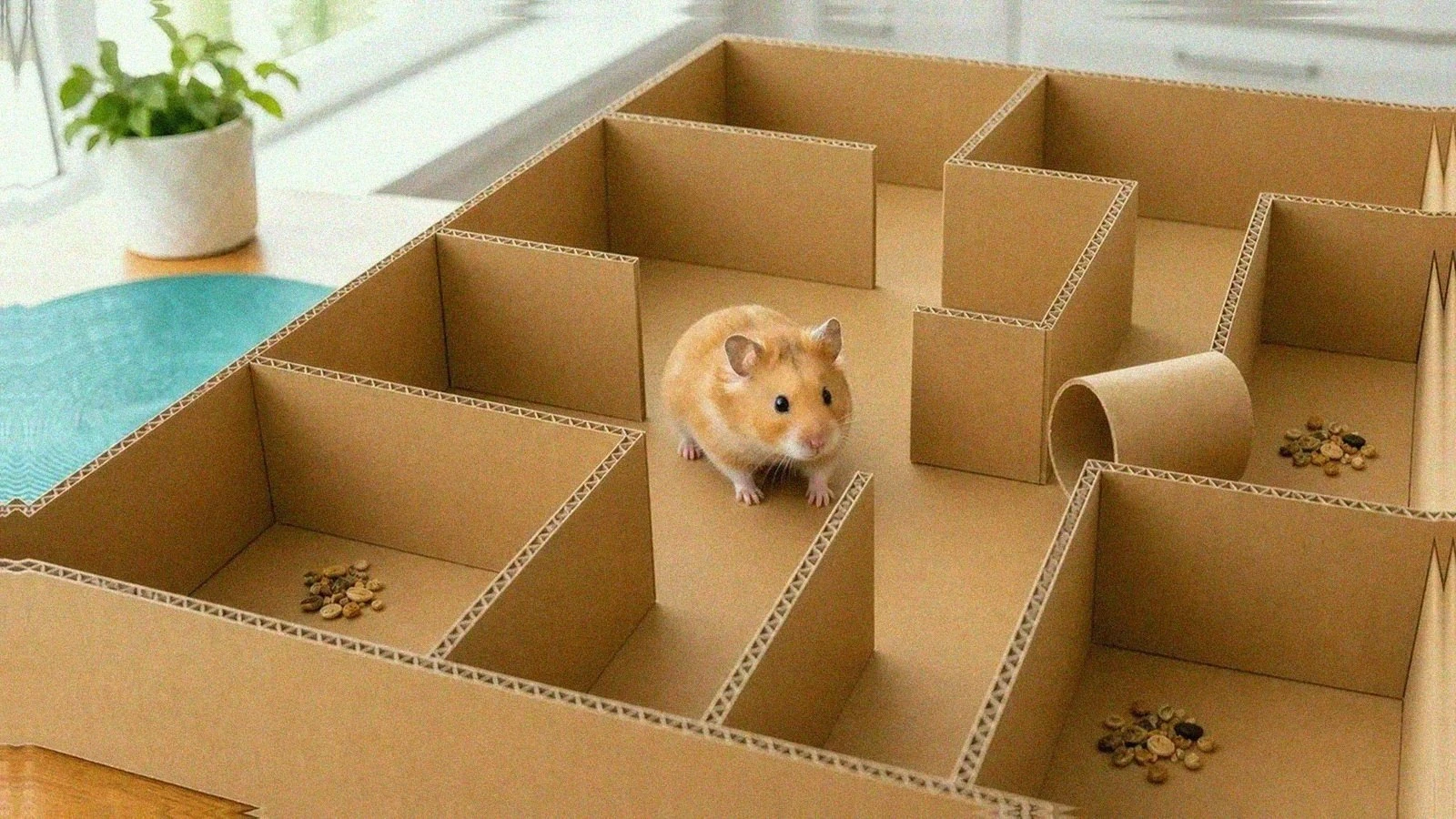
A hamster maze is a floor puzzle you build from cardboard, tubes, or bricks and let your hamster explore for treats. Done right, it is genuinely good enrichment: hamsters are burrowing animals that navigate tunnels by whisker and smell, and a maze is the closest thing to a burrow you can build on a kitchen table.
Done wrong, it is a stressed animal in a plastic box, which is why this guide starts with safety and sizing before the fun part. YouTube is full of spectacular hamster maze videos, but almost nobody writes down how to actually build one: what materials are safe to chew, how wide the corridors need to be for a Syrian versus a dwarf, and how to get a hamster to run the thing instead of climbing out of it. That is this post.
One honest disclosure before we start: I write for a maze generator site, and yes, we use it to design the floor plans before we cut any cardboard. Our maze-consultant-in-residence is Waffle, a Syrian hamster my six-year-old named at breakfast, and most of what follows was learned by watching her ignore, defeat, or eat my early attempts.
do hamsters actually like mazes?
Yes, with two caveats: it has to happen at the right time of day, and it has to be the hamster's idea.
The RSPCA's care guidance describes hamsters as exploratory animals that sense objects with their whiskers and need enrichment that permits natural behaviours: exercise, foraging, and digging. A maze scattered with hidden food hits all three. Wild hamsters live in tunnel systems and cover serious ground at night looking for food, so a corridor puzzle with treats stashed in dead ends is not a trick you are playing on them. It is roughly their commute.
The caveats matter, though. Hamsters are nocturnal, and the same RSPCA guidance is blunt that they need to sleep undisturbed during the day. A maze session at 2pm is not enrichment; it is a rude awakening. Run the maze in the evening when your hamster is naturally up and foraging. And hamsters are solitary. One hamster per maze, always. Syrians in particular should never share a space, maze included.
The first time we put Waffle in a maze she sat in the entrance and cleaned her face for four full minutes while both kids slowly lost their minds. That is normal. A new space gets a sniff-everything survey before it gets speed. The zoomy footage you see online is usually a hamster on its fifth or tenth run, not its first.
safe and unsafe materials for a hamster maze
Everything in the maze will eventually be chewed, so build only from things that are safe to chew.
| Material | Safe? | Cost | Survives how long? |
|---|---|---|---|
| Plain corrugated cardboard | Yes, the default | Free | 2–4 sessions before serious gnawing |
| Cardboard tubes (kitchen roll) | Yes, remove any glue seams with tape residue | Free | A week, they love destroying these |
| Untreated aspen or plain pine boards (kiln-dried) | Yes for walls | Cheap | Months |
| LEGO / plastic bricks | Supervised only, take it apart if chewed | You own it | Indefinite |
| Cedar and fresh pine shavings or offcuts | No. Aromatic oils are linked to respiratory problems | — | — |
| Hot glue, plastic tape, sticky tape in reach | No. Chewed and swallowed | — | — |
| Anything printed, painted, or scented | No | — | — |
Three rules cover most of it. First, plain over printed: heavily inked or glossy cardboard is out, plain brown boxes are in. Second, joins should be mechanical, not sticky. Cut slots and tabs so walls interlock, and if you must glue, keep it on the outside of corners where teeth cannot reach. I use paper tape only on the outer face of the outer wall. Third, no cedar and no fresh pine anywhere near a hamster; the aromatic compounds in those woods are consistently flagged by welfare sites as a respiratory risk. Kiln-dried plain wood is fine for a reusable maze frame.
The good news is that the best material is also the free one. Corrugated cardboard cuts cleanly, stands up straight, and when the maze is finally destroyed, undyed shreds can go straight into the cage as nesting material. Waffle's first maze lasted three weekends before it retired as bedding, which I choose to describe as recycling rather than defeat.
how big should the corridors be?
Size the maze to the hamster. An adult Syrian can reach around 18 cm (7 in) long, while dwarf species run roughly 6–10 cm; a Roborovski is barely 6 cm fully grown. The corridor has to let the hamster turn around comfortably, and the walls have to be tall enough that climbing out is not the obvious move.
Working numbers that have held up for us:
- Syrian: corridors 10–12 cm wide, walls at least 20 cm tall.
- Dwarf species: corridors 7–8 cm wide, walls 15 cm or taller.
- Junctions and dead ends: cut them a couple of centimetres wider than the corridor so the hamster can turn without reversing. If you have read our post on maze sizes, this is the same idea as cell size on paper: the grid stays the same, the comfort changes.
Do not skimp on wall height. Version one of our maze had 12 cm walls, which I had privately judged plenty. Waffle put one paw on a corner, went over the top like it was a step, and toured the kitchen instead. Hamsters are shockingly good climbers, corners are their favourite ladders, and a cardboard edge is exactly the texture they grip best. Go taller than feels necessary and keep the top edges clean of footholds.
One more sizing note: keep the maze on the floor or on a table with supervision and raised edges. A fall from table height is genuinely dangerous for a hamster. We run ours inside a shallow storage-box lid, which doubles as a base that catches the inevitable pee corner (see the FAQ).
how to build a cardboard hamster maze, step by step
Total time for a first build: about ninety minutes, most of it cutting.
- Design the floor plan first. Freehand mazes drift: corridors pinch, dead ends multiply in one corner, and you only notice after cutting. Generate a small maze instead and use it as the blueprint. We use our own maze generator set to a 10×10 or smaller easy maze, print it, and scale it up so one printed cell equals one 10–12 cm corridor square. A 10×10 plan at Syrian scale is already over a metre wide, so for a first build, crop the plan to a 6×6 corner of the printed maze. If you would rather sketch it by hand, our guide to how to draw a maze works at hamster scale too; just draw fat corridors.
- Cut the base. One large sheet of cardboard, or the storage-box lid mentioned above. Draw the scaled grid on it in pencil so wall placement is paint-by-numbers.
- Cut wall strips. Long strips of corrugated cardboard, 20 cm tall for a Syrian, cut with the corrugation running vertically so the walls do not fold at the first lean.
- Slot, don't glue. Cut halfway slits where walls cross and slot them together like a wine-box divider. The maze gets stiff surprisingly fast, survives being chewed at one junction without collapsing, and packs flat afterwards.
- Anchor the outer wall. Paper tape on the outside face only, where teeth cannot reach.
- Add the payload. A treat in two or three dead ends, a bigger one at the finish, and a handful of familiar bedding scattered along the route so the maze smells at least partly like home.
This build video is a good visual companion; the technique translates directly even though the maze in it is bigger than a starter build:
seven hamster maze ideas
Once the basic build works, vary it. Novelty is most of the enrichment value; the same maze every week stops being a puzzle and becomes a hallway.
1. the classic cardboard grid
The build above: square grid, slotted walls, treats in dead ends. This is the baseline and honestly the one our hamster runs best. Rebuild it with a fresh printed plan each time so the route actually changes.
2. the tube-and-tunnel maze
Connect kitchen-roll tubes into a network with cardboard junction boxes. Closest to a natural burrow, and the darkness inside the tubes makes shy hamsters noticeably bolder. Cut every tube open along one side if your hamster is a Syrian; adult Syrians can jam in standard tubes, and a stuck hamster panics.
3. the ball-pit room
One oversized room in the middle of the maze filled with clean, dry play balls over a layer of bedding. Some hamsters dig through it happily; Waffle treats it as an unacceptable obstacle and climbs the room's corner instead, which is its own entertainment.
4. the treat-hunt scatter maze
Instead of one prize at the end, bury tiny fragments of plain treat under loose bedding at six or seven points. This turns the maze from a race into a foraging patrol, which is closer to what the RSPCA means by letting hamsters forage, and it stretches a session to a happy ten minutes.
5. the LEGO maze
Bricks on a baseplate make crisp, reconfigurable walls, and kids can rebuild the layout in minutes. Two rules: supervised sessions only, and any brick that shows tooth marks comes out of rotation. Plastic is not a chew toy, it is a wall.
6. the obstacle course maze
Ramps, a small bridge, a cardboard flap door. This is the genre that dominates hamster maze YouTube, and the videos are fun, but keep the obstacles low and optional at home; a hamster that cannot see a way through will climb the nearest wall. For reference, this is the style, executed with more patience than most of us have:
7. the digging-box finale
End the maze at a deep box of clean bedding with the final treat buried in it. Digging is the behaviour most home cages under-serve, and finishing with it means the maze ends on the hamster's favourite note instead of at an arbitrary wall.
how to run a hamster maze session
- Evenings only, when the hamster is naturally awake. Never wake a sleeping hamster for maze time.
- Five to ten minutes, then back to the cage regardless of progress. Short and frequent beats long and stressful.
- First visit is a sniffing tour. Let it happen. No nudging, no picking the hamster up and pointing it the right way; a hamster that gets steered learns that the maze is where hands come from.
- Treats at junctions on early runs, then progressively only at the finish. Tiny fragments, and count them toward the day's food, not on top of it.
- Expect cheating. Climbing a wall is not failure, it is information: the walls are too short, a corner has a foothold, or the session has run long and the hamster is done. End on the cheat, fix the wall, try again tomorrow.
- Supervise every second. A cardboard maze is a session toy, not an enclosure. Chewed gaps appear fast.
filming your hamster maze
Since half the people searching "hamster maze" arrive from YouTube, the filming notes we have accumulated: shoot top-down with the phone on a cheap tripod or clamped to a chair back, because handheld overhead footage drifts exactly when the run gets good. Film in warm, bright room light rather than a lamp aimed at the maze; a spotlight makes most hamsters freeze at the boundary between bright and dark. And record the whole session rather than chasing moments, since the best clip is always the one where you had just put the phone down. The maze itself films better if you leave the top edges clean: no tape flags, no decorations. High-contrast plain walls, dark hamster.
faq
Can hamsters actually solve mazes?
Yes. Rodent spatial memory is excellent, and a hamster that has run the same layout a few times will visibly stop exploring and start commuting: fewer dead-end visits, faster times. That is also your cue to change the layout.
How big should a hamster maze be?
Corridors about 10–12 cm wide with 20 cm walls for a Syrian, 7–8 cm corridors with 15 cm walls for dwarf species. Footprint-wise, a 6×6-cell maze is a solid first build; bigger mazes mostly add walking, not difficulty.
Is cardboard safe for hamsters?
Plain, unprinted corrugated cardboard is safe to chew and is the standard DIY material. Avoid glossy print, heavy ink, and any join where tape or glue is reachable by teeth. Chewed plain cardboard can be reused as cage material.
How do I get my hamster to go through the maze?
Run sessions in the evening, scatter familiar bedding along the route so it smells like home, hide small treats at junctions, and let the first session be pure exploration. Never push or steer. If the hamster only wants to climb out, the walls are too short or the session is over.
Can I reuse a hamster maze?
For a while. Expect a designated pee corner by session two; a removable cardboard floor patch or a washable base under that corner extends the maze's life considerably. Retire any section with chew-holes, and when the whole thing is done, shred the plain parts into the cage as bedding.
next step
The pattern behind a good hamster maze is the same one behind a good paper one: fair corridors, honest dead ends, one satisfying route. Design your blueprint with the maze generator, start from an easy printable maze if you want a ready-made floor plan, or browse the full library of printable mazes for layouts worth scaling up to rodent size. And if the humans in the house get jealous of the hamster's puzzle, that is what the rest of this site is for.
Sources and further reading: