The original Pac-Man has exactly one maze: a 28×31 tile grid holding 240 dots and 4 energizers, repeated on every level until the game breaks at level 256. That single layout, designed by Toru Iwatani's team at Namco and released on May 22, 1980, is probably the most recognized maze on the planet.
Here is the strange part, and the reason this post exists. By the strict definition we use everywhere else on this site, the Pac-Man maze is barely a maze at all. It has no dead ends, no single solution path, and nothing to solve. And yet it works so well that people have spent four decades studying why.
I spend my days around maze generation software, so I came at this layout the way I come at any maze: dump it into a graph, count the dead ends, measure the junctions. The numbers surprised me enough that I spent a weekend reading everything serious ever written about it, most of it in Jamey Pittman's Pac-Man Dossier and Shaun LeBron's maze-generation research. This post is the summary I wish I had found: the layout's anatomy, the hidden design rules, how the ghosts actually use the corridors, and what any of it teaches you about designing mazes of your own.
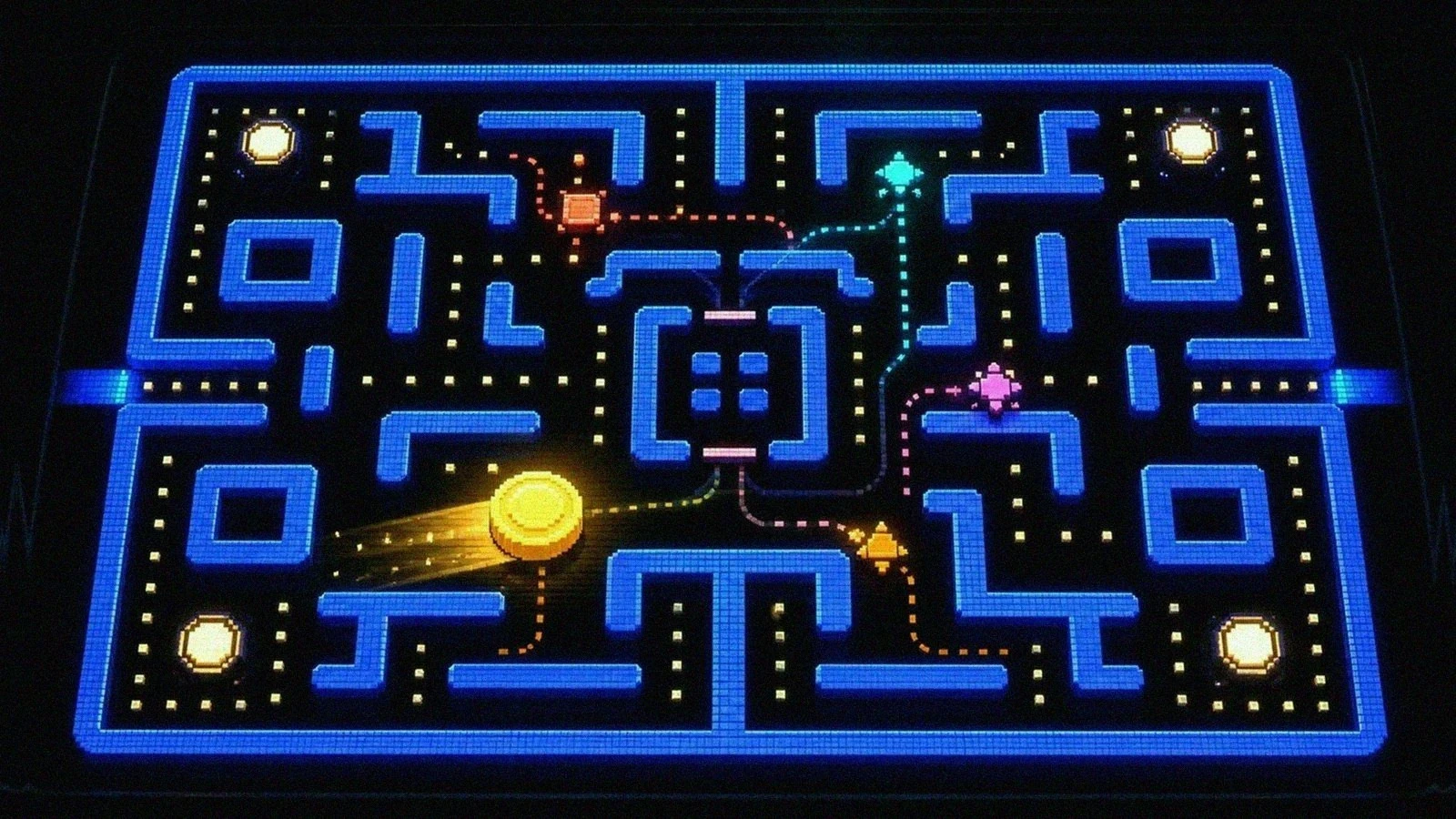
anatomy of the pac-man maze
The playfield is a grid of 28 tiles across by 31 tiles tall. Every corridor is exactly one tile wide. The layout is mirrored down its vertical centerline, so the left half and right half are identical.
The key numbers, all from the original 1980 arcade game:
| Element | Count / size | Detail |
|---|---|---|
| Grid | 28 × 31 tiles | Corridors exactly 1 tile wide |
| Dots | 240 | Clear them all to finish the level |
| Energizers | 4 | One near each corner, turn ghosts vulnerable |
| Tunnels | 1 (two openings) | Left and right exits wrap around the screen |
| Ghost house | 1 | Center of the maze, off-limits to Pac-Man |
| Dead ends | 0 | Every corridor connects at both ends |
| Mazes in the game | 1 | Same layout every level, recolored in later games |
Two features do more work than the rest. The side tunnel connects the left and right edges, so the maze wraps around on itself; ghosts slow to roughly half speed inside it, which makes it the game's best escape hatch. And the energizers sit in the four corners, the most dangerous real estate on the board, which turns every corner trip into a bet.
The dead-end count is the line that stops maze people short. In what is a maze we define a perfect maze as one with no loops and exactly one route between any two points, which means plenty of dead ends. Pac-Man's designers did the exact opposite: every corridor loops back into the network. In maze terminology it is a fully braided maze. There is nothing to solve, because you can never get stuck. The puzzle was never the maze itself; the maze is a racetrack, and the puzzle is the four things chasing you around it.
the hidden design rules
The layout looks casual. It is anything but. Shaun LeBron reverse-engineered the maps of Pac-Man and Ms. Pac-Man for his maze generation project and deduced a strict rulebook behind them:
- The map is 28×31 tiles, with paths exactly 1 tile thick.
- No sharp turns: intersections are separated by at least 2 tiles.
- There are 1 or 2 tunnels, and no dead ends anywhere.
- Wall pieces only come in I, L, T, or + shapes, plus the occasional rectangle.
- Non-rectangular wall pieces are only 2 tiles thick.
- The whole map is mirrored across the vertical axis.
His generator builds new maps by stacking Tetris-like pieces on a small 5×9 cell grid, mirroring it, and scaling it up by three, and the results look convincingly like lost Namco levels. That is the tell: if a simple rulebook can imitate the style, the style was a rulebook all along.
I tried to fake a Pac-Man-style maze in the site's own generator before I read any of this, mostly to see what would happen. The library mazes came out wrong in a way I could not name at first: dead ends and irregular walls everywhere; corridors pinched and wandered. What makes the Pac-Man layout read as "Pac-Man" is the uniformity: one-tile corridors, chunky rounded wall blocks with empty space between them, and that strict mirror symmetry. Symmetry is doing most of the aesthetic work. Your eye completes the right half while reading the left, which is why you can take in the entire maze in a glance between deaths.
There is a practical reason for readability, too. You are meant to plan routes three junctions ahead while being chased. A maze you have to study is a maze that kills you.
how the ghosts use the maze
The maze and the ghost AI were designed as one system, and this is where the layout gets genuinely clever. Everything below is documented in the Pac-Man Dossier, Jamey Pittman's exhaustive study of the game's internals.
Each ghost picks corridors by steering toward a target tile. What makes them feel like personalities is that each one computes that target differently:
| Ghost | Color | Chase target |
|---|---|---|
| Blinky | Red | Pac-Man's current tile — direct pursuit |
| Pinky | Pink | 4 tiles ahead of Pac-Man's direction — the ambusher |
| Inky | Cyan | Double the vector from Blinky to a spot 2 tiles ahead of Pac-Man |
| Clyde | Orange | Pac-Man, until he gets within 8 tiles — then he retreats to his corner |
Two famous quirks live inside that table. When Pac-Man faces up, an overflow bug makes Pinky aim 4 tiles up and 4 tiles left, and gives Inky's intermediate point the same diagonal error. The bug shipped in 1980 and has been part of the game ever since.
The maze pushes back on the ghosts in three ways:
- Scatter mode. Four times per level, the ghosts break off and head for fixed tiles near their home corners, which is why pursuit comes in waves rather than a constant pile-on.
- The no-up zones. In two zones of the maze, near the ghost house, ghosts are forbidden from turning upward during chase and scatter. Experienced players park in these corridors because pursuit there is predictable.
- The tunnel. Ghosts crossing the side tunnel are cut to roughly half speed (40% of normal on level 1). Pac-Man is not. The wrap-around is a designed escape route, priced into the layout.
If you want to see the targeting logic animated, this breakdown is the best one on the internet:
My kids and I have a cheap plug-and-play cabinet on the kitchen counter, and teaching them the ghost rules changed how they play in about ten minutes. My eight-year-old now baits Blinky down one side of a wall block and peels off at the T-junction; my younger one just camps the tunnel and giggles as the ghosts crawl through after her. The maze supports both strategies. That is not luck; that is the design.
how many mazes are in pac-man?
One. The original arcade Pac-Man uses a single maze layout for the entire game, recolored by nothing and changed by nothing, until an integer overflow shreds the right half of the screen at level 256 and the game becomes unfinishable.
The sequels are where the variety arrived:
| Game | Year | Mazes |
|---|---|---|
| Pac-Man | 1980 | 1 layout, every level |
| Ms. Pac-Man | 1982 | 4 layouts, each with its own color scheme |
| Jr. Pac-Man | 1983 | Scrolling mazes wider than the screen |
| Pac-Man 256 | 2015 | One endless, procedurally continued maze |
Ms. Pac-Man's four mazes were the meaningful upgrade, and they follow the same design rulebook: symmetric, one-tile corridors, no dead ends. Several add a second tunnel, which shifts the escape math. Pac-Man 256 closed the loop nicely by turning the level 256 glitch itself into the premise of an endless maze.
why the design still holds up
Strip the nostalgia off and the layout is a checklist of things good maze design still cares about:
- Read-at-a-glance. Symmetry and uniform corridors mean the whole map fits in your head. Our post on how maze difficulty works makes the same point in reverse: landmarks and structure are what keep a maze fair.
- No dead stops. Braiding every corridor keeps the chase flowing. Getting cornered in Pac-Man always traces back to a bad decision, not a bad map.
- Risk placed on the map. The four energizers sit in the four corners, so the reward is physically located where the pursuit is worst.
- One asymmetric feature. The tunnel breaks the rectangle's logic in exactly one place, and it is the place every close call runs through.
design your own arcade-style maze
You can steal all of this for paper mazes, and it is a genuinely fun exercise.
An honest note on tools first: our maze generator produces perfect mazes — every corner of the grid reachable, exactly one solution, plenty of dead ends — which is the opposite philosophy to Pac-Man's braided racetrack. That difference is the lesson, not a limitation. A perfect maze is a puzzle you solve once; a braided maze is a space you flow through. Rectangular mazes are the right starting shape for the arcade look.
The conversion trick: print a rectangular maze, then go through it with an eraser and open the far end of every dead end you find. Each wall you remove creates a loop. Erase them all and you have a fully braided, Pac-Man-style network; erase half and you get something between a puzzle and a racetrack. It pairs well with the freehand techniques in how to draw a maze. I have done this at the kitchen table with a printed 15×15 maze, two pencils, and a die for ghost movement, and it kept both kids busy for most of an hour — one of them navigating, one of them playing the ghosts. (Keep your homemade version to generic shapes and colors; the characters are Bandai Namco's, the geometry is not.)
If you want the deep end, LeBron's generator and the Dossier will absorb an entire evening. For the walkable cousins of these ideas, our tour of famous mazes around the world covers what braiding and landmarks feel like at hedge scale.
faq
How many mazes are in Pac-Man?
The original arcade game has exactly one maze layout, used on every level. Ms. Pac-Man (1982) introduced four different mazes. Later entries vary: Jr. Pac-Man used scrolling mazes wider than the screen, and Pac-Man 256 runs one endless maze.
Is the Pac-Man maze actually a maze?
By the strict definition, barely. A maze normally has branching paths, dead ends, and a solution to find. The Pac-Man layout has no dead ends and no goal tile — it is a fully braided loop network built for chasing, not solving. See what is a maze for the taxonomy.
How do you make a Pac-Man style maze?
Follow the original's rulebook: a 28×31 tile grid, one-tile-wide corridors, mirror symmetry down the middle, no dead ends, and wall pieces limited to I, L, T, and + shapes. The fastest paper method is to print a maze from a maze generator and erase the closed end of every dead end until every corridor loops.
What is the trick to the Pac-Man maze?
Learn the ghost targeting rules. Blinky chases you directly, Pinky aims four tiles ahead of you, Inky triangulates off Blinky, and Clyde backs off inside eight tiles. Add the two corridors where ghosts cannot turn upward and the tunnel that halves their speed, and the maze becomes very exploitable.
Where can I play the Pac-Man maze today?
Bandai Namco ships the original in most Pac-Man Museum-style collections on modern consoles, arcade cabinets still turn up in pizza places and barcades, and World's Biggest PAC-MAN hosts endless fan-built mazes playable in a browser.
next step
The Pac-Man maze proves a layout can be famous without being solvable. If reading this left you wanting a maze you can solve, that is the kind we make:
- Generate a rectangular maze to braid with the eraser trick in the maze generator.
- Browse printable mazes, from easy warmups to hard ones with real dead-end density.
- Want a video-game look on paper? Try the blocky pixel mazes: a pickaxe, a sword, and a diamond built from square blocks.
- Curious what makes one maze meaner than another? Start with how maze difficulty works.
Sources and further reading: