A kid is stuck. The pencil has stopped, the bottom lip is out, and your hand is already drifting toward the page to fix it. That drift is the moment this article is about. Educators call the alternative productive struggle: letting a learner keep wrestling with a problem that is hard but within reach, because the wrestling is where the learning happens.
This guide explains what productive struggle actually means, how to tell it apart from useless frustration, and gives you a coaching script you can run tonight. We use mazes as the worked example because they are the cheapest productive-struggle exercise there is: print a free one from printable mazes for kids or the Easy Starters Pack and you have a complete struggle-sized problem on one page.
what is productive struggle?
Productive struggle is the effortful work a learner does on a problem they have not been shown how to solve, when the problem is hard enough to require real thinking but close enough to their ability that persistence pays off. The term comes from math education: the National Council of Teachers of Mathematics lists "support productive struggle in learning mathematics" as one of its eight research-based teaching practices in Principles to Actions. The related memory research calls the same idea "desirable difficulties": effort during learning makes the learning stick.
The key word is productive. Nobody is arguing that suffering builds character. Struggle is productive when the learner is making moves, noticing what fails, and adjusting. It stops being productive the moment they are just hurting. Edutopia's summary of the neuroscience makes the same point: challenge drives growth, but only inside a manageable range.
Which is why the adult's job is not "never help." It is to keep the struggle in the productive zone: adjust the task, teach a strategy, offer the smallest possible hint. Rescue only ends the learning.
productive struggle vs plain frustration
The whole skill is telling these two apart from across the table. After years of watching kids solve mazes at home and in classrooms, here is the honest checklist:
| Productive struggle looks like | Destructive frustration looks like |
|---|---|
| Leaning in, eyes moving along the paths | Staring at one spot, or looking away |
| Trying a different branch after a failure | Re-erasing the same three turns over and over |
| Muttering strategy ("not that way...") | Muttering verdicts ("I'm bad at this") |
| Wanting you to watch, not to take over | Pushing the page toward you |
| Annoyed at the maze | Upset at themselves |
Two physical tells I trust more than anything verbal: pencil pressure and paper condition. When the pencil starts gouging or one corner of the page is going thin and gray from erasing, the struggle has tipped. Time to step in, not with the answer, but with a smaller maze or a strategy.
why a maze is the perfect productive-struggle activity
You can practice struggle on long division, but a maze has properties that make it the ideal training ground:
- Wrong turns are visibly information. A dead end is not a red mark from a teacher; it is the maze saying "not this way." Kids accept that feedback from a puzzle far more gracefully than from an adult.
- Progress is visible. The pencil line shows exactly how far they have come, which fuels persistence.
- It is genuinely low stakes. No grade, no permanent record, finished in ten minutes.
- Difficulty adjusts in tiny steps. One size up, one label up; our mazes by grade guide maps the whole ladder from kindergarten to 5th.
This is not just our theory about our own product: Harvard's Center on the Developing Child lists mazes among the activities that exercise executive function in 5-to-7-year-olds, precisely because they demand planning, working memory, and recovering from wrong turns.
the coaching script: ask, don't steer
Your job is to help them see the maze, not to drive the pencil. The script is three questions, asked in order, with silence in between:
- "Where was the last place you had more than one choice?" The single most useful question. It teaches backtracking without ever using the word.
- "What's your plan if this one is a dead end?" This turns the next failure into part of a plan instead of a defeat.
- "Can you mark the ways you already tried?" This hands them a system (the X strategy below) instead of an answer.
Then the hard part: wait. I count ten seconds in my head after asking, because the silence feels three times longer than it is. Most kids restart on their own somewhere around second six.
What to avoid, from someone who has done all three: drawing the correct turn "just this once," hovering a finger over the right corridor, and narrating directions ("left... no, your other left"). Every one of these teaches the same lesson: if I stall long enough, an adult solves it.
three strategies that turn struggle into skill
Teach exactly one of these, then repeat it for a week. Repetition is what turns a rescue into a skill they own.
1. mark dead ends with an X (grades 2+)
When a path stops, put a small X at the dead end, walk back to the last fork, and take the next option. The maze shrinks with every mark, and the kid can see their search working:
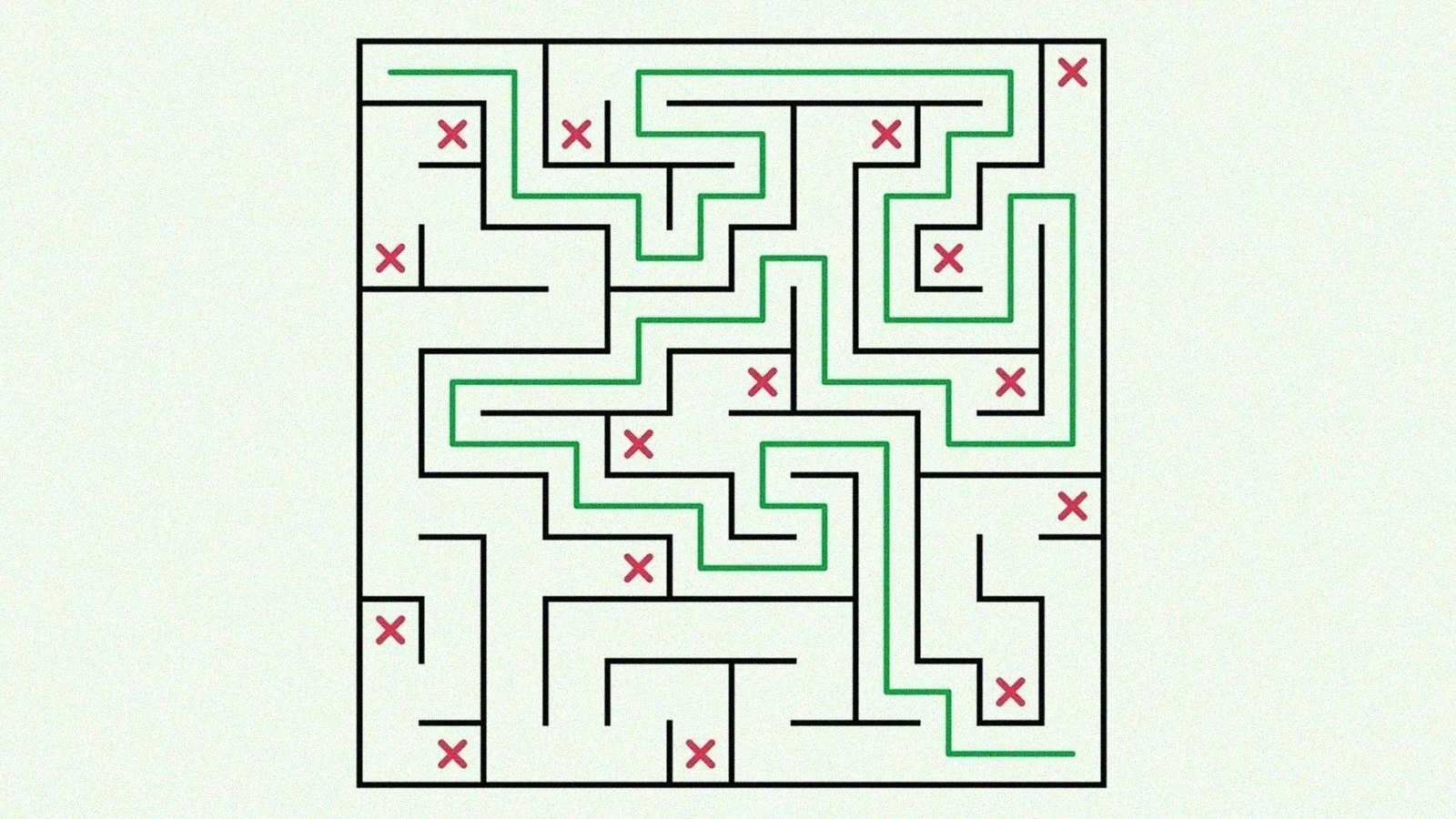
The X strategy, finished: every dead end eliminated (red), route found (green). This 12×12 maze has 16 dead ends; each X is one wrong turn that will never be repeated.
This is dead-end filling, the same method our how to solve a maze guide covers formally. For a kid, frame it as detective work: every X is a clue collected, not a mistake made.
2. finger scout first (all ages)
Trace a candidate path with a finger before committing the pencil. If it fails, nothing is on the page, so nothing needs erasing and nothing feels ruined. This is the strategy for kids who press hard, tear paper, or treat every erased line as evidence against themselves.
3. wall-following (the emergency fallback)
Keep a fingertip on one wall and follow it; in most printable mazes it eventually reaches the exit. It works, but it is mechanical, so save it for the moment a kid is about to quit entirely. Teach it with its own off-switch: "if the wall trick stops making progress, go back to marking dead ends."
using hints without killing the learning
Hints are not cheating; unlimited hints are. Solving online makes this easy to govern, because the hint is a button you control instead of an answer you blurt. Every maze page on Maze Printables has a built-in solver with three controls: Hint reveals a small piece of the correct path, Show/Hide toggles the full solution, and Reset wipes the attempt cleanly.
The ladder I use, in order: strategy first ("mark your dead ends"), then one Hint, then keep solving, and Show only at the very end as a check. On paper, the equivalent is the pack answer key: it stays with the adult, and you reveal one junction, not the route. Browse the maze packs for Letter and A4 sets with separate answer keys.
If you want to try the online version, open any maze from the mazes hub and solve it in the browser.
when to make it easier (and when not to)
Sometimes the right move is not coaching; it is a different maze. Struggle is only productive inside the kid's reach, and reach is adjustable:
- Drop one size or one difficulty level. A win on a 10×10 rebuilds the confidence to re-attempt the 12×12. The grade guide shows the steps.
- Time-box it. "Two more minutes, then we switch mazes" keeps a hard maze from becoming the whole afternoon.
- Check the print before you judge the kid. A maze printed at "fit to page" has shrunken corridors that make tracing physically hard; that is fake difficulty. Print at 100% scale (here is how). The struggle should be in the maze, not in seeing it.
Do not make it easier the moment they complain. One groan followed by re-engagement is the sound of productive struggle working. Rescue at the first groan and the groan becomes the strategy.
productive struggle in the classroom (and in math)
The term earns its keep in classrooms, where the audience makes rescue even more tempting: one stuck kid, twenty-five watching.
What works, from my years running maze warm-ups:
- Normalize dead ends out loud. End the warm-up with "best wrong turn": one student shows a dead end they found and what it told them. It reframes errors as findings for the whole room.
- Coach quietly, at the desk. Public hints rescue one kid and spoil twenty-four.
- Run two difficulty lanes. An easy maze on every desk, a medium stack at the front, kids self-upgrade. Nobody sits in the unproductive zone and nobody is bored. The full routine is in classroom maze warm-ups.
The math connection is direct, since that is where the research lives: NCTM's guidance is that students need regular chances to grapple with problems they have not been shown a procedure for. A five-minute maze before the math block is a low-stakes rehearsal of exactly that stance: try, fail, adjust, persist. Same muscles, no math anxiety attached.
This short video is a good staff-room overview of the concept:
FAQ
What is productive struggle in simple terms?
Working hard on a problem you have not been shown how to solve, where the difficulty is real but within your reach. The struggle itself, trying, failing, adjusting, is what builds the skill; being handed the answer skips the learning.
What does productive struggle look like?
Leaning in, trying a different approach after a failure, and talking about the problem ("not that way") rather than about themselves ("I'm bad at this"). When a kid repeats the same failing move, gouges the pencil, or pushes the page away, the struggle has stopped being productive.
How long should I let a child struggle before helping?
Longer than feels comfortable, but watch the signs, not the clock. After asking a coaching question, give a silent ten-count. Step in when you see repeated identical failures or self-directed anger, and step in with a strategy or an easier maze, not the answer.
Should I ever just show the answer?
At the end, as a check, yes. Our packs ship a separate answer key PDF so the solution stays with the adult until the attempt is over. Mid-solve, prefer the smallest hint that restarts movement.
Is productive struggle the same as frustration?
No. Frustration is a feeling; productive struggle is a working state that can include some frustration. The line is crossed when frustration stops the work: no new attempts, only distress. Your job is to keep the challenge inside the zone where effort still moves things.
What are examples of productive struggle activities?
Anything hard, low-stakes, and self-checking: mazes, puzzles, building challenges, estimation games, open-ended math problems. Mazes are a favorite because wrong turns give instant, neutral feedback and difficulty adjusts in small steps; start with easy printable mazes and climb from there.
next step
- Print tonight's struggle: easy rectangular mazes or the Easy Starters Pack with its answer key.
- Teach one strategy (the X marks) and repeat it for a week before adding another.
- Match the challenge to the kid with printable mazes for kids by grade, and keep the Medium Mix Pack ready for the day the easy ones stop producing any struggle at all.
Sources and further reading: NCTM, Principles to Actions (the eight Mathematics Teaching Practices, including "support productive struggle in learning mathematics"); Edutopia on the neuroscience behind productive struggle; Harvard Center on the Developing Child, Executive Function Activities Guide.