A correct sum can sit in a square the route never reaches. In a math maze, students need to check two things: does the answer fit the rule, and can they move to that cell? The directions must explain both.
This packet has three original mazes for addition, multiplication, and skip counting. Each page gives its rule and marks START and FINISH. Separate keys show the route and the numbers along it.
Begin with a skill your students already know. Use these short grids to find out how they choose a path, not to ask them to guess at math they have not learned yet.
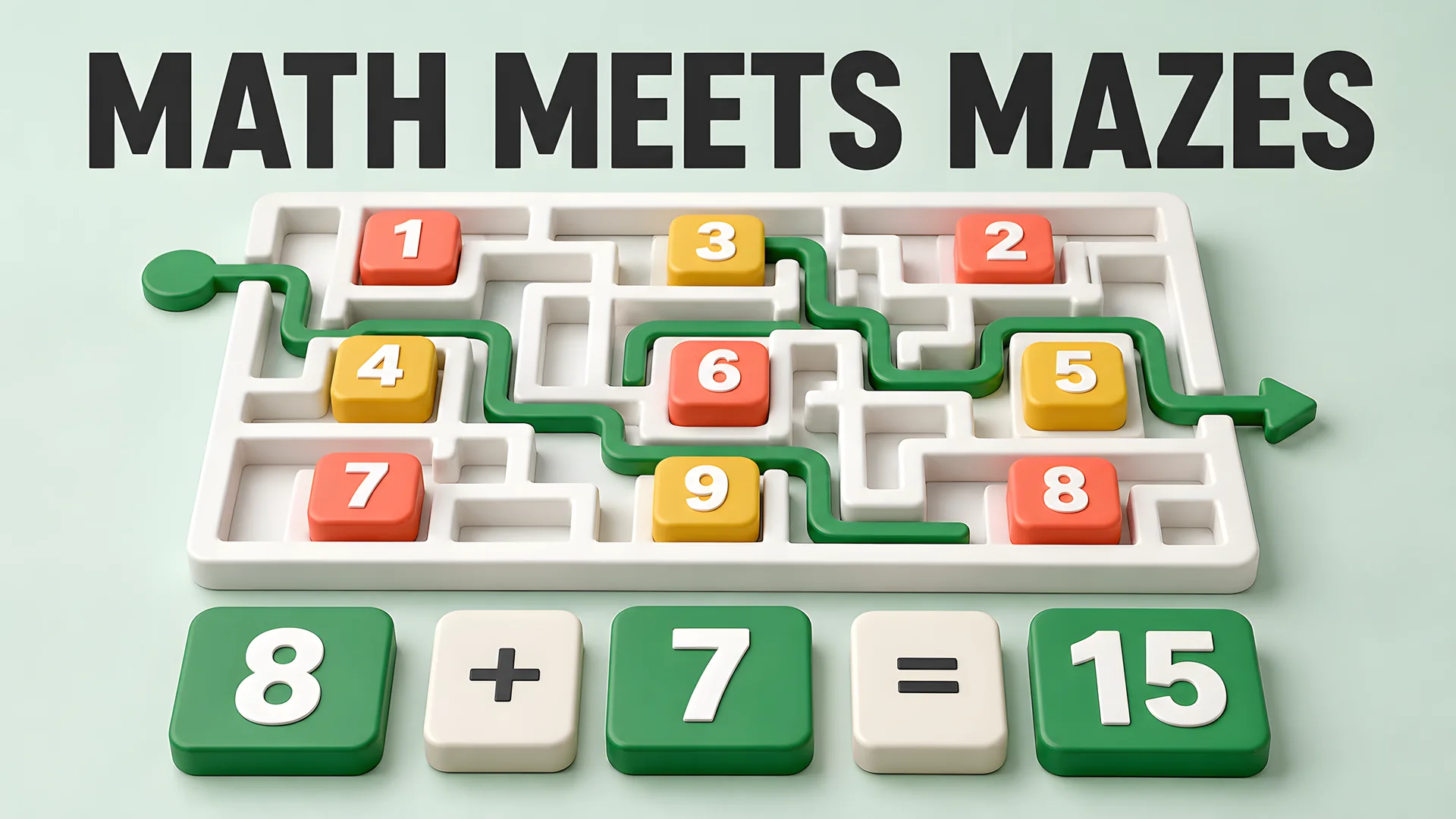
Math-maze cover concept. Printable activities and verified keys follow.
Use the packet
Print a student sheet and keep its key separate. Read the rule aloud, including how to move. In all three mazes, students move one cell up, down, left, or right. They may not move diagonally or visit a cell twice.
Use pencil first. Ask students to calculate on scrap paper or in the response space before tracing a permanent path.
A quick check need not take long. Ask students to mark one wrong turn and write why it fails. Or ask a partner to point to the first place a route breaks the rule.
The sheet alone cannot tell you whether a child worked out each sum or copied another student's line. Ask them to explain one choice. That tells you more than checking whether the path reaches the finish.
Check the math and the moves separately. A student can add well and still miss the rule against diagonal moves.
Activity 1 - Addition to 15
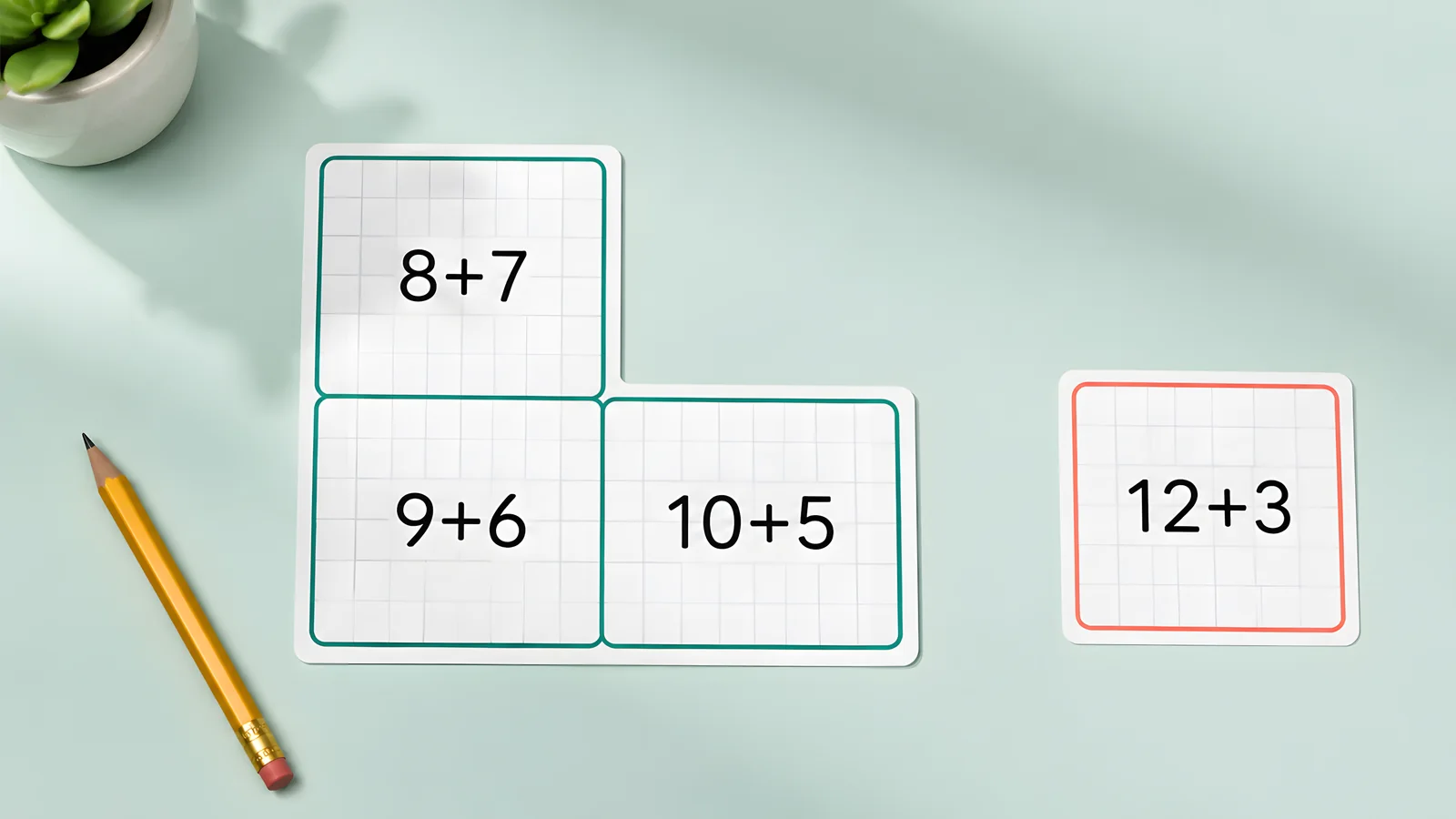
Arithmetic-and-adjacency concept. A correct sum may sit outside the route.
Skill: addition with sums up to 20. Follow only sums that equal 15. Trace an unbroken path from START at the top left to FINISH at the bottom right.
Print the addition maze. Store its answer key separately.
| 1 | 2 | 3 | 4 | 5 | |
|---|---|---|---|---|---|
| 1 | 8+7 START | 9+6 | 10+5 | 7+7 | 12+3 |
| 2 | 4+8 | 6+6 | 11+4 | 8+8 | 9+4 |
| 3 | 13+2 | 7+8 | 6+9 | 5+8 | 7+5 |
| 4 | 14+1 | 9+8 | 3+9 | 8+6 | 6+7 |
| 5 | 5+10 | 4+11 | 3+12 | 2+13 | 1+14 FINISH |
Have students work out each sum and mark the cells that equal 15. Then ask them to trace a route through the marked cells. Some correct sums may sit outside that route.
For example, 12+3 = 15 in the top-right corner. Its neighbors are 7+7 and 9+4, neither of which equals 15. It is an isolated correct answer and cannot join the route.
By contrast, 4+8 sits right below START. You could move down to it, but its sum is 12. The math rule blocks that move.
The intended route uses 13 cells. Its turns move down from the third top-row cell, across the middle toward the left edge, then down to the bottom row.
Addition route
Using row-column coordinates, trace (1,1), (1,2), (1,3), (2,3), (3,3), (3,2), (3,1), (4,1), (5,1), (5,2), (5,3), (5,4), (5,5). Every expression on that route equals 15.
Activity 2 - Multiples of 6
Follow positive multiples of 6: 6, 12, 18, 24, and so on. Some cells give a number; others give a multiplication to work out. In either case, the number or product must be a positive multiple of 6.
This distinction matters. 4 x 9 = 36 qualifies even though neither factor is 6. If your lesson is restricted to recall of the six-times table, replace that cell with 6 x 6 before using the page.
Print the multiplication maze and its separate key.
| 1 | 2 | 3 | 4 | 5 | |
|---|---|---|---|---|---|
| 1 | 2x6 START | 18 | 4x6 | 14 | 7x6 |
| 2 | 16 | 5x5 | 30 | 22 | 35 |
| 3 | 4x9 | 6x7 | 48 | 20 | 26 |
| 4 | 9x6 | 28 | 7x7 | 32 | 44 |
| 5 | 60 | 3x6 | 24 | 5x6 | 36 FINISH |
Ask students to write each product they use. Before drawing a move, check that the two cells share a side. All factors on the sheet are between 2 and 10.
The 7x6 cell at the top right equals 42, which meets the math rule. But the cells around it do not, so you cannot reach it. From START at 2x6, a move down to 16 also fails: 16 is not a multiple of 6.
The Crafty Classroom's multiplication-maze resource is an example of this established worksheet format. A ready-to-use page still needs its own exact rule; "multiplication maze" doesn't identify the target products by itself.
Multiplication route and values
The route follows the same coordinates as the addition page. Its values in order are 12, 18, 24, 30, 48, 42, 36, 54, 60, 18, 24, 30, 36. Every value is divisible by 6.
This activity doesn't require ascending order. The skip-counting page below does.
Both sheets use the same layout, so students can try a new math skill without learning a new route. Use them in separate lessons if remembering the route would make the second sheet too easy.
Activity 3: Count by 5s
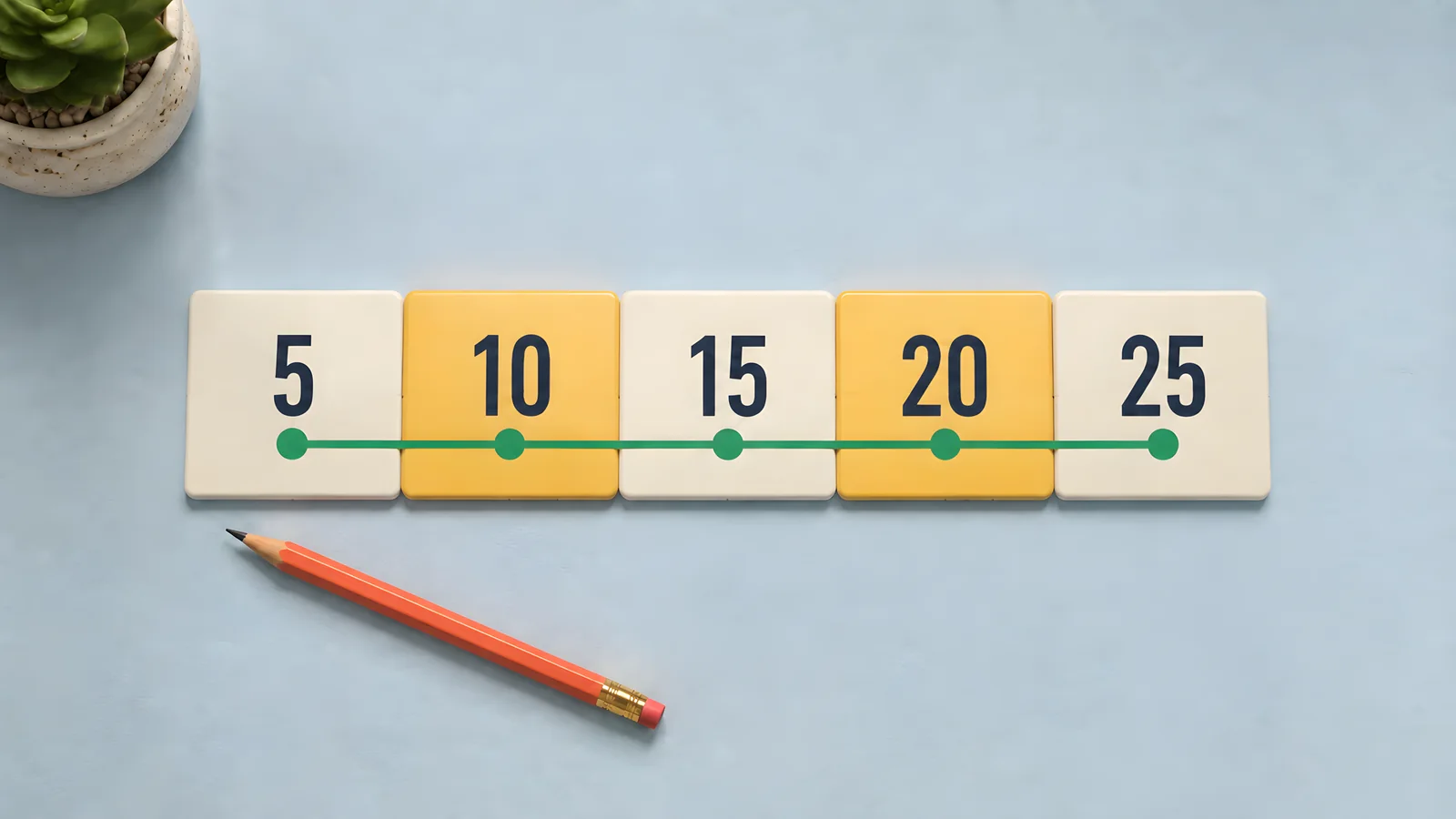
Begin at 5 and count by 5s to reach 50. Each move must lead to the next number in that count. A cell with a multiple of 5 is still wrong if it is not the next one you need.
Print the skip-counting maze and answer key.
| 1 | 2 | 3 | 4 | |
|---|---|---|---|---|
| 1 | 5 START | 10 | 15 | 20 |
| 2 | 16 | 28 | 42 | 25 |
| 3 | 45 | 40 | 35 | 30 |
| 4 | 50 FINISH | 20 | 15 | 10 |
Ask students to say or write the expected next number before looking at neighboring cells. After 25, they need 30. The nearby 42 has no place in this sequence.
At 30, the 10 immediately below is a multiple of 5 and touches the current cell. It still fails because the required next number is 35. Students must move left.
Skip-counting answer
Read 5, 10, 15, 20, 25, 30, 35, 40, 45, 50. Move right three times, down twice, left three times, then down once. Ten visited cells require nine moves.
For an easier replacement, count forward by 2s over a shorter route. For an extension, begin at 53 and count backward by 5s. That produces 53, 48, 43, and so on, which tests the interval without relying on familiar multiples ending in zero or five.
If you change the count, recheck every wrong choice and remake the key. A nearby number that used to be wrong may now be the next step.
Confessions of a Homeschooler's skip-counting collection uses the counting-maze format across several intervals, with printable pages and reuse ideas.
Verify the mathematics and the route
Use two passes when designing or editing a math maze.
Math pass. Work out every sum or product, including the wrong choices. For a counting maze, check the gap between each pair of numbers in the route. A number does not become wrong just because you placed it off the answer path.
Maze pass. Begin at START and try each move that the printed rule allows. Check that the route reaches FINISH. Look for shortcuts and other routes that also work.
We used code to check the math and legal routes in these original grids. You should still test a print and check that the task suits your class.
- Endpoints are unmistakable.
- Directions identify one mathematical rule and the permitted movement.
- Correct cells don't form an unintended shortcut.
- The answer key shows a visible route, with enough contrast for a photocopy.
- Wrong branches have a reason a student can explain.
- Font size and spacing remain readable after printing at the chosen scale.
The first two mazes each have a correct answer that sits apart from the route. Tell students this can happen. They do not need to join every cell they marked.
Adjust difficulty within one packet
Use smaller numbers in the sums for review, or harder times-table facts with the same route rule. Counting backward is another way to make the task harder.
Ask students to suggest a wrong choice that looks tempting, then explain why it fails. Before putting it on the sheet, check that it does not create a new legal route.
Choose numbers students can work with and explain. Use maze worksheets and the guide by grade to choose a page. The guide to productive struggle can help you decide when to step in if a learner gets stuck.
Respond to the error you can see
When a learner stalls, ask them to show their most recent calculation before offering a route hint. If they write 8+7 incorrectly, pause on the addition: splitting 7 into 2 and 5 gives 8+2+5, or 10+5. Let them check that total before choosing a neighbor. Pointing to the next square would bypass the arithmetic they need to revisit.
If the math is right but the path jumps diagonally, draw an empty two-by-two grid. Show a move between cells that share a side. Leave the numbers on the worksheet as they are. The learner can try the same math again once the movement rule is clear.
A completed line needs a different check. Choose a cell away from the highlighted route and ask whether it satisfies the mathematical rule. On the multiplication page, the isolated 7x6 should still be recognized as 42, a multiple of 6. This separates knowing the rule from remembering where the line goes.
A wrong route does not always mean the numbers were too hard. First check what went wrong: the math, the gap between steps in the count, or the move from one cell to the next.
An extension: repair a broken maze
On a spare addition worksheet, change the expression in row 1, column 2 from 9+6 to 9+5. Ask students whether START can still reach FINISH under the same rule, then request a repair to that changed cell.
The altered expression equals 14, so the first rightward move is blocked by the mathematics. Moving down from START doesn't help: 4+8 equals 12. With no other side-sharing neighbors, START has no legal next move.
A repair must restore a sum of 15. Students could write 10+5 or 8+7 in the changed cell and explain why the original route works again. Neither repair changes the adjacency rule or requires a new opening.
This gives an early finisher a concrete design problem instead of another copy of the same maze. Have them hand the repaired sheet to a partner, who checks the expression and replays the route before accepting the answer.
Downloads
- Addition PDF and key.
- Multiplication PDF with its key.
- Skip-counting PDF and key.
- Editable grids and teacher directions (Word).
When checking a completed sheet, ask for one calculation and one justified move. Either can reveal a misunderstanding the finished line alone would hide.