That tempting A in the next diagonal square may be completely off limits. Word mazes combine route-finding with letters or words, and the movement rule determines which promising choices you can use.
First identify the format. Some puzzles ask you to spell along adjacent cells. Others make you follow whole words, while a third group hides a message inside a physical maze.
These examples state their rules on the page and include separate answers. For the broader meaning of a maze, see what is a maze.

Word-path concept. The original grids below state the exact movement rules.
Three common types
Letter-path mazes use individual letters as stepping stones. You might spell one target word or connect a longer sequence. The final letter may be marked FINISH, or the instructions may say that completing the word ends the puzzle.
Whole-word mazes put a complete word in each cell. A valid route could follow number words in order, stay within a category, or select words that satisfy a grammar rule. Reading a word correctly is only part of the work; it must also be a legal next move.
In a collect-the-message maze, walls define the route. Letters placed along that route are read in travel order to reveal a phrase. Marks inside dead ends are decoys unless the instructions explicitly tell you to explore and collect from branches.
Published worksheets use overlapping names. Super Teacher Worksheets' word puzzles include connected-letter routes, while K5 Learning's word mazes use vocabulary definitions as clues. Those examples help explain why the title alone cannot tell you how to play.
Treat the following three types as useful reading categories, rather than a universal naming standard.
Rules to check before moving
Read the directions with your pencil still off the grid.
- Movement. Are moves up, down, left, and right only? Does the sheet expressly allow diagonals?
- Can a cell be revisited? A repeated letter in the target doesn't automatically permit reuse of its square.
- Identify the goal. It may be a marked destination, a completed word, or a message you must write elsewhere.
- Must your selected cells make one continuous route?
- Check whether both endpoints are marked.
- Do you read letters as you travel, or use a different order after solving?
For the examples on this page, adjacent means sharing a side. Diagonal corners don't count, the route stays continuous, and no cell is revisited.
Changing even one rule can create a second answer. Allowing diagonals introduces new neighbors; allowing revisits can let a route return to a letter already used. A worksheet that needs either behavior should say so directly.
If instructions are genuinely missing, ask the person who supplied the puzzle. Guessing several different rule sets won't establish which answer they intended.
Word maze versus word search
| Feature | Word maze | Word search |
|---|---|---|
| Main task | Navigate under a route and language rule | Find listed or clued words in a letter grid |
| Route | Usually one continuous, constrained path | Words are often independent straight runs |
| Reuse | Determined by the printed rules | Letters commonly belong to more than one word |
| Endpoint | Often a start and finish, or a final required word | Usually no physical destination |
In a conventional word search, you can circle a word near the bottom without first reaching it from the top-left corner. A word maze may make that same move illegal because the intervening squares matter.
Hybrid worksheets exist. Some combine word-search clues with a snaking letter route, so use the printed directions when the categories overlap.
Example 1 - Spell MAZE
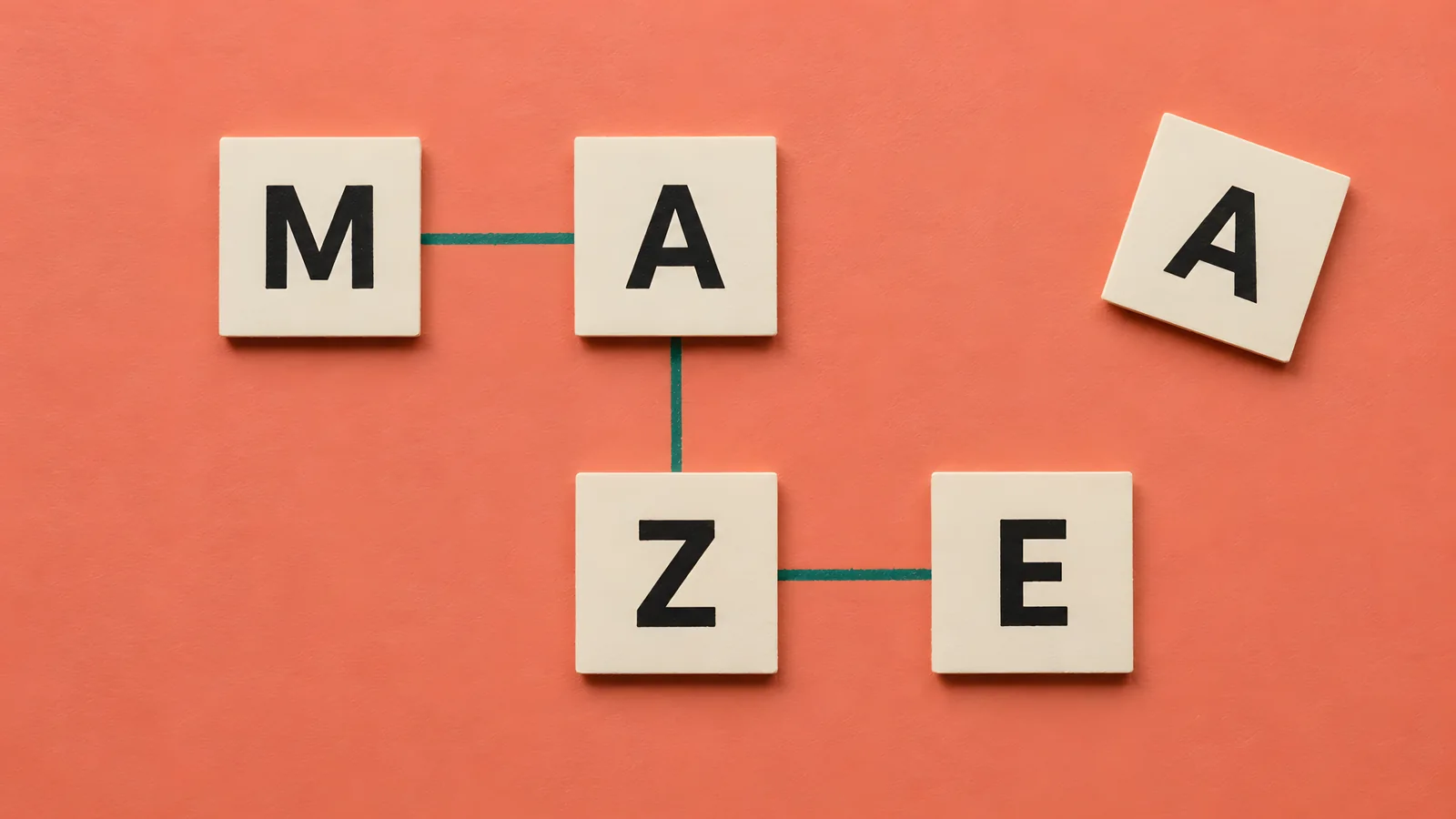
Adjacency illustration. A matching letter still needs a legal connection.
Use the original 5-by-5 grid below. Start at the M in row 2, column 2. Finish at the E in row 3, column 4, spelling MAZE along the way.
Move one square up, down, left, or right. Don't revisit a square.

| 1 | 2 | 3 | 4 | 5 | |
|---|---|---|---|---|---|
| 1 | A | R | T | Z | E |
| 2 | P | M | A | L | N |
| 3 | U | S | Z | E | O |
| 4 | D | H | I | C | B |
| 5 | F | G | J | K | Q |
The A at row 1, column 1 sits diagonally from START. It supplies the right letter but fails the movement rule.
Letter-path answer
Move right from M to A at (2,3), down to Z at (3,3), then right to E at (3,4). The route is right, down, right.
From A, the Z at (1,4) is another diagonal temptation. You cannot jump to it, even though an E waits beside it.

The coordinates use row first, column second. Rows count downward from the top, so (2,3) means the third square in the second row.
Example 2 - Consecutive number words
Start at one in the upper-left cell. Follow consecutive number words through six, which is FINISH. Move through side-sharing cells without revisiting.

| 1 | 2 | 3 | 4 | |
|---|---|---|---|---|
| 1 | one | two | stone | six |
| 2 | blue | three | four | five |
| 3 | seven | cloud | ten | leaf |
| 4 | two | road | three | eight |
The second two, at (4,1), is a valid number word. It cannot be the next step because it is separated from START by other cells.
Whole-word answer
Follow one, two, three, four, five, six. The moves are right, down, right, right, up.
At four, the ten directly below is adjacent but breaks the sequence. You need five next. Reaching any other number word doesn't satisfy the rule.

For a younger reader, reduce the range to one through four. Keep the adjacency rule unchanged so the adjustment practices reading without silently changing the puzzle.
Example 3 - Collect the message
This time, solve the wall maze from S to F. Follow open passages, then copy each letter encountered on the successful route. Read each letter once, in order. Ignore S and F as endpoint labels.

Try tracing the whole route before writing the message. A plausible word fragment inside a dead end can tempt you to keep collecting after the route has already failed.
Message answer
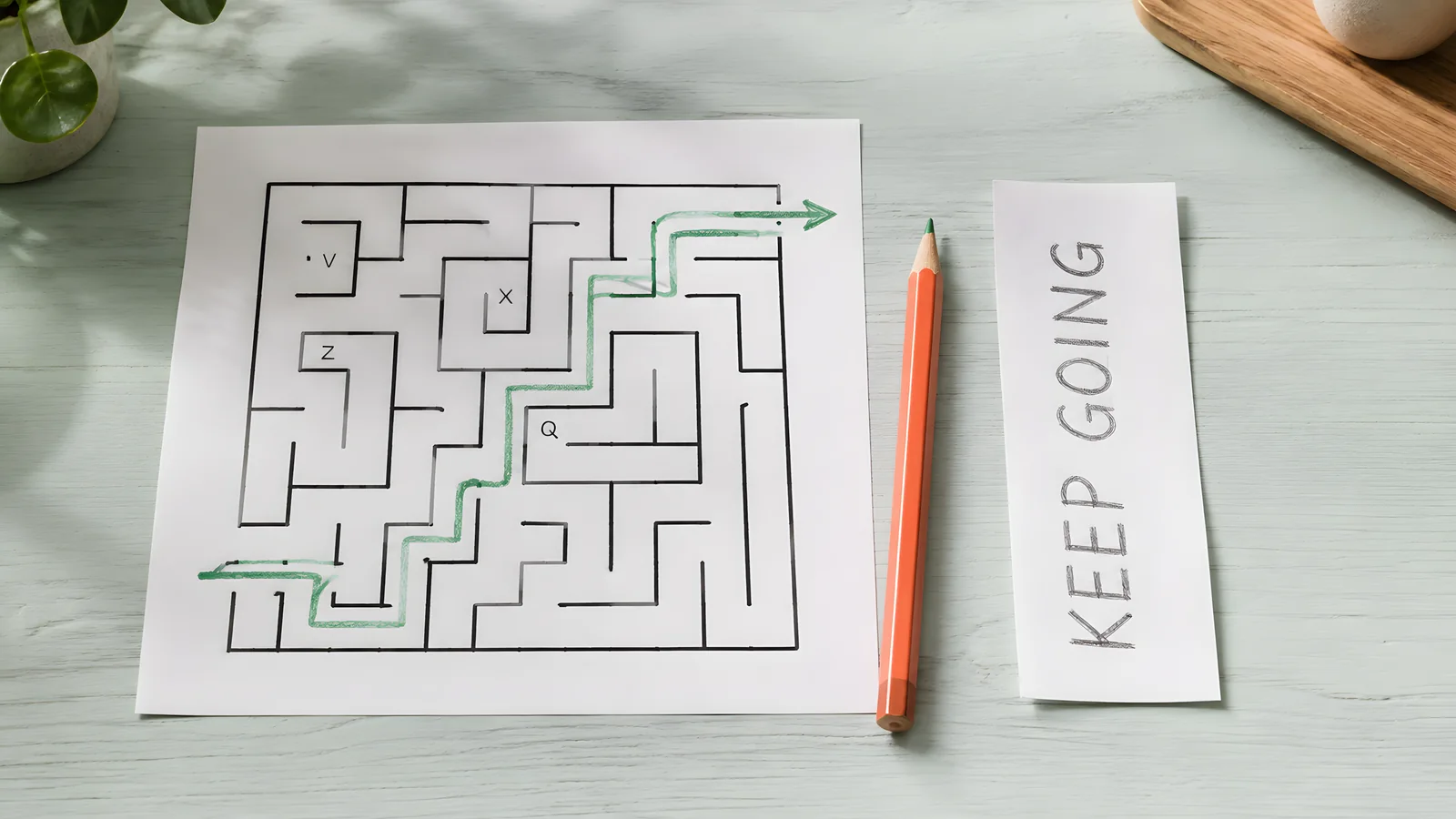
Message concept. Copy letters from the successful route in travel order.
Travel right across the top passage, down the right edge, then left across the bottom passage to F. The collected letters are K E E P G O I N G, giving KEEP GOING.
The X and Q belong to dead-end branches. Exploring one while solving is allowed, but erase that unsuccessful detour before transcribing the final route.

Repeated letters need separate cells
A word containing the same letter twice exposes an easy rule mistake. Try this miniature letter maze: start at B in the upper-left corner and spell BOOK, ending at K in the lower-left corner. Use side-sharing moves and don't revisit a cell.
| 1 | 2 | |
|---|---|---|
| 1 | B | O |
| 2 | K | O |
The route goes right, down, then left. The two O letters occupy different squares, so each supplies one position in the word. Remaining on the first O and reading it twice would not be a move. Leaving it and returning would break the no-revisit rule.
For longer words, write the letter's position beside your route: B is 1, the first O is 2, the second O is 3, and K is 4. This records progress when the board contains several copies of a letter. Two visits to a matching letter aren't interchangeable if one would spell the second character and the other the fifth.
When a branch fails, erase its temporary route numbers before trying another branch. Keep a failed-branch note on scrap paper instead of crossing out every letter involved. A square used in an unsuccessful partial route may still belong to the successful answer reached another way.
Match the language challenge to the reader
Keep the target word visible when the purpose is practicing movement rules. Once the reader can trace adjacent cells reliably, replace the printed target with a clue they can solve. Otherwise, a blank route leaves you unsure whether the obstacle was vocabulary or navigation.
For whole-word category mazes, choose a rule with answers you can explain. "Follow color words" gives clearer choices than "follow nice words." Grammar categories need more care: words such as light can play different roles in different sentences. Add sentence context or choose less ambiguous examples instead of marking a reasonable interpretation wrong.
Check the language before checking the path. Ask the reader which word or category they are following, then have them identify one legal next square. If they understand the clue but keep choosing diagonals, demonstrate side-sharing movement on the small BOOK grid before returning to the larger puzzle.
Make your own
Choose one format and write its rules before drawing the grid. Decide whether revisits are legal, then mark the endpoints and build a complete solution.
Add decoys only after checking the route. In a letter maze, inspect every square containing the next required letter, especially near a corner. An extra A can accidentally connect two parts of your intended answer.
Test with someone who hasn't heard your spoken explanation. Ask them to point to the rule that justifies each disputed move. If they need an unwritten exception, revise the instructions or the layout.
Maze worksheets offer ordinary printable practice. The brain-teaser collection introduces other logic formats. The regular maze generator makes corridor layouts; it doesn't automatically add or verify word-maze rules.