An area maze asks you to find a missing side length or area in a group of rectangles. You solve it using the numbers on the diagram, not by measuring the drawing.
Start with a rectangle whose area and one side length are given. Divide the area by that length to find the other side. If a neighboring rectangle shares that whole side, you now know one of its side lengths too.
The three examples below show each calculation. After those, you can try three practice questions and check your answers. For other types of puzzles, see the brain-teaser guide.
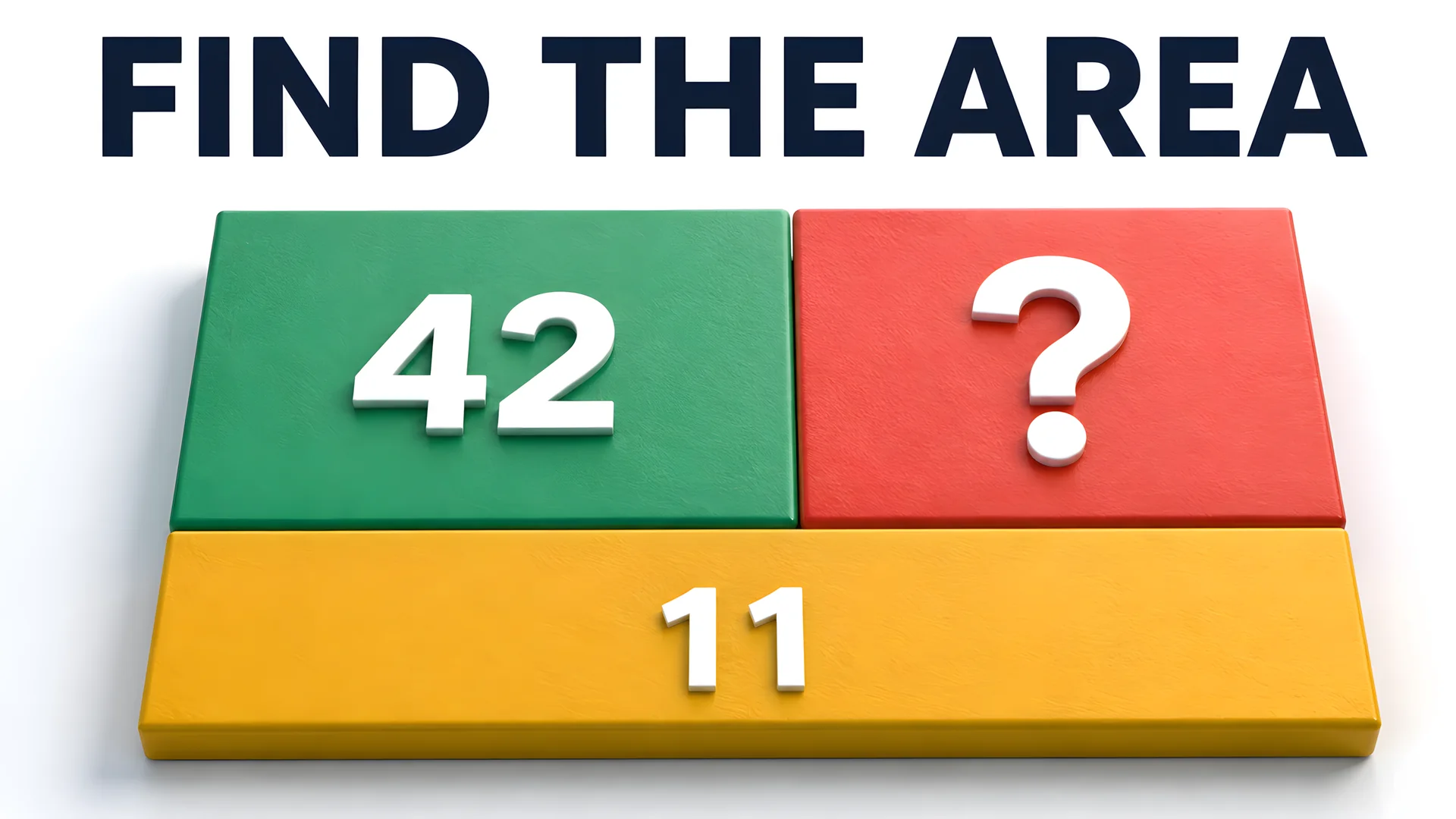
Cover illustration. The labeled diagrams below define the worked examples.
Rules before solving
An area of 36 means 36 square units. A side labeled 4 means 4 units. Writing the units beside your calculations helps keep a discovered width from becoming an accidental area label later.
Rectangles may share a whole side, or just part of one. You can transfer the length of the overlapping segment. You cannot assume that the entire sides match when their endpoints differ.
Many area-maze collections expect whole-number reasoning. Math = Love's area-maze resource explicitly uses a no-fractions rule. That is a puzzle convention, rather than a restriction on rectangle geometry; check the instructions for the sheet in front of you.
Diagrams may be stretched. The Waterloo Region District School Board's activity warns that its figures aren't drawn to scale. A ruler can measure the printing, but that measurement has no guaranteed relationship to the labeled quantities.
If a calculation unexpectedly gives a fraction, inspect the shared endpoints and the numbers you copied. Don't round it to make the picture seem reasonable.
Follow the available information
- Find a rectangle with a known area and one known side.
- Divide the area by that side to discover the other length.
- Copy the length to any exactly matching shared segment.
- Add adjoining segments, or subtract a known part from a whole.
- Use the new length with another rectangle's area.
- Continue until you can calculate the requested value.
Follow the information even when it sends you away from the question mark. The nearest rectangle may be useless until a distant width becomes known.
A few terms will help.
| Term | Meaning on the page |
|---|---|
| Area | Space inside a rectangle, measured in square units |
| Shared edge | A boundary segment belonging to both neighboring shapes |
| Whole | The full length or region being considered |
| Part | A segment or region contained within that whole |
| Target rectangle | The rectangle whose missing value you need |
Pencil a new length beside its actual segment. A floating number in the middle of the diagram is easy to attach to the wrong shape when you return after a pause.
Example 1 - Direct division
The upper rectangle has area 36 square units and height 4 units. Its unknown width is the target. A second rectangle sits immediately below it, sharing the full width, and has height 3.

Start with the upper rectangle.
36 / 4 = 9
Its width is 9 units. You can check the division by multiplying 9 by 4 to recover the given area of 36.
The lower rectangle's left and right endpoints align exactly with the upper rectangle. That full shared edge gives the lower rectangle a width of 9 too.
9 x 3 = 27
The lower area is 27 square units. Notice the change in units between the two answers. The first calculation finds a distance; the second finds the space inside a shape.
Neither rectangle needed measuring. The drawing's job was to show which edges coincide.
Example 2 - Shared-edge reasoning
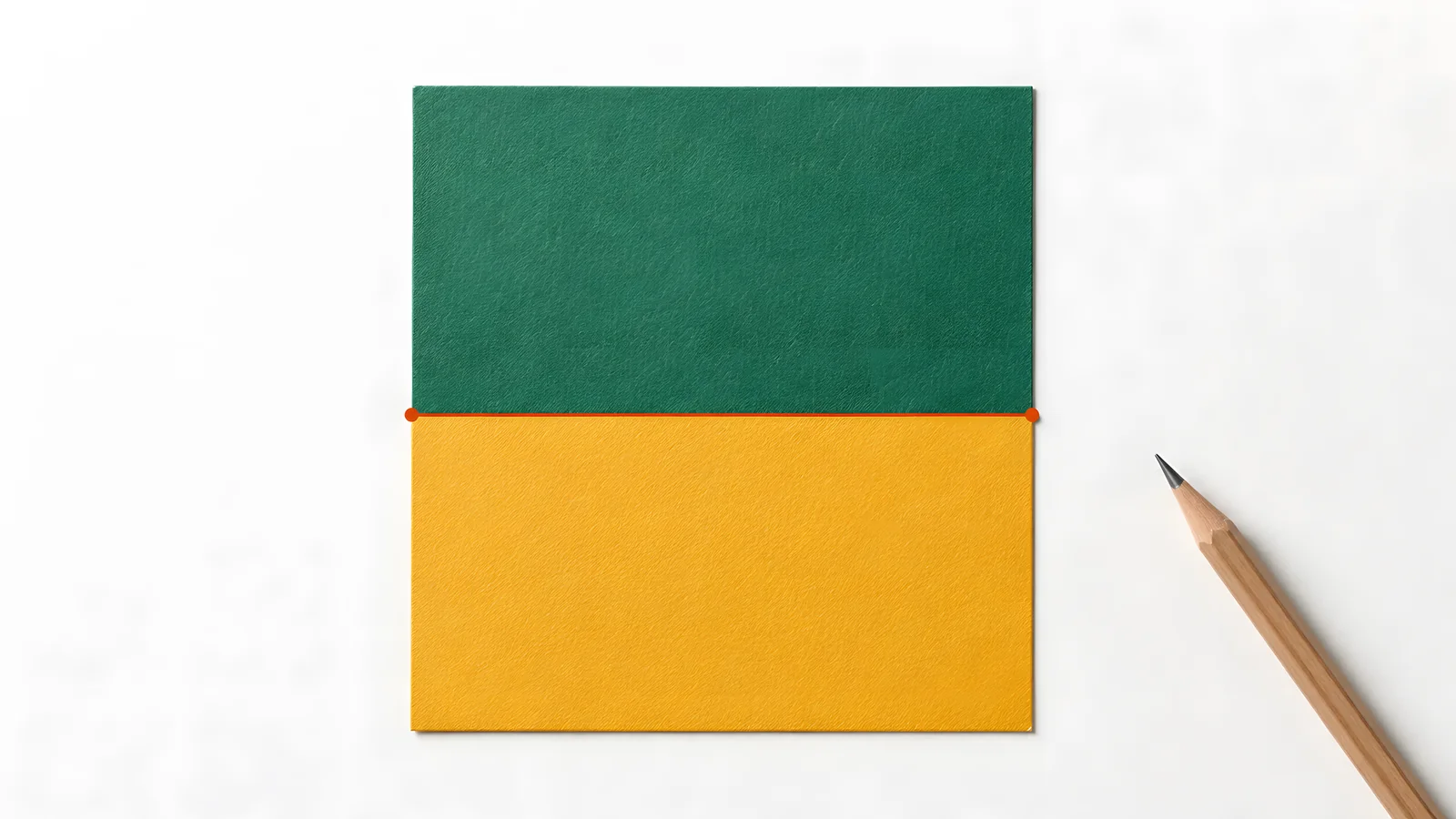
Shared-edge illustration. Matching endpoints establish which length transfers.
Two rectangles sit side by side above a third rectangle. Together, their widths span the lower rectangle's full width of 11 units.
The top-left area is 42 square units, and both upper rectangles have height 6. Find the top-right area.

First discover the left-hand width.
42 / 6 = 7 units
That uses 7 units of the total width. The upper rectangles meet without an overlap or gap, so the remaining segment is available by subtraction.
11 - 7 = 4 units
The 4-unit segment along the lower rectangle's top is the entire bottom edge of the top-right rectangle. Transfer the value there. With height 6 already given, its area follows.
4 x 6 = 24 square units
There is no need to know the lower rectangle's height or area. It contributes a labeled total width, which is enough for this step.
A useful check is to rebuild that total. The discovered widths, 7 and 4, add to 11. If you wrote 5 for the right-hand width, this check would catch the mismatch before you calculated an area of 30.
The shared line is a fact because the diagram specifies the same endpoints. A pair of sides that merely looks similar would not justify copying the measurement.
Example 3 - Whole minus part
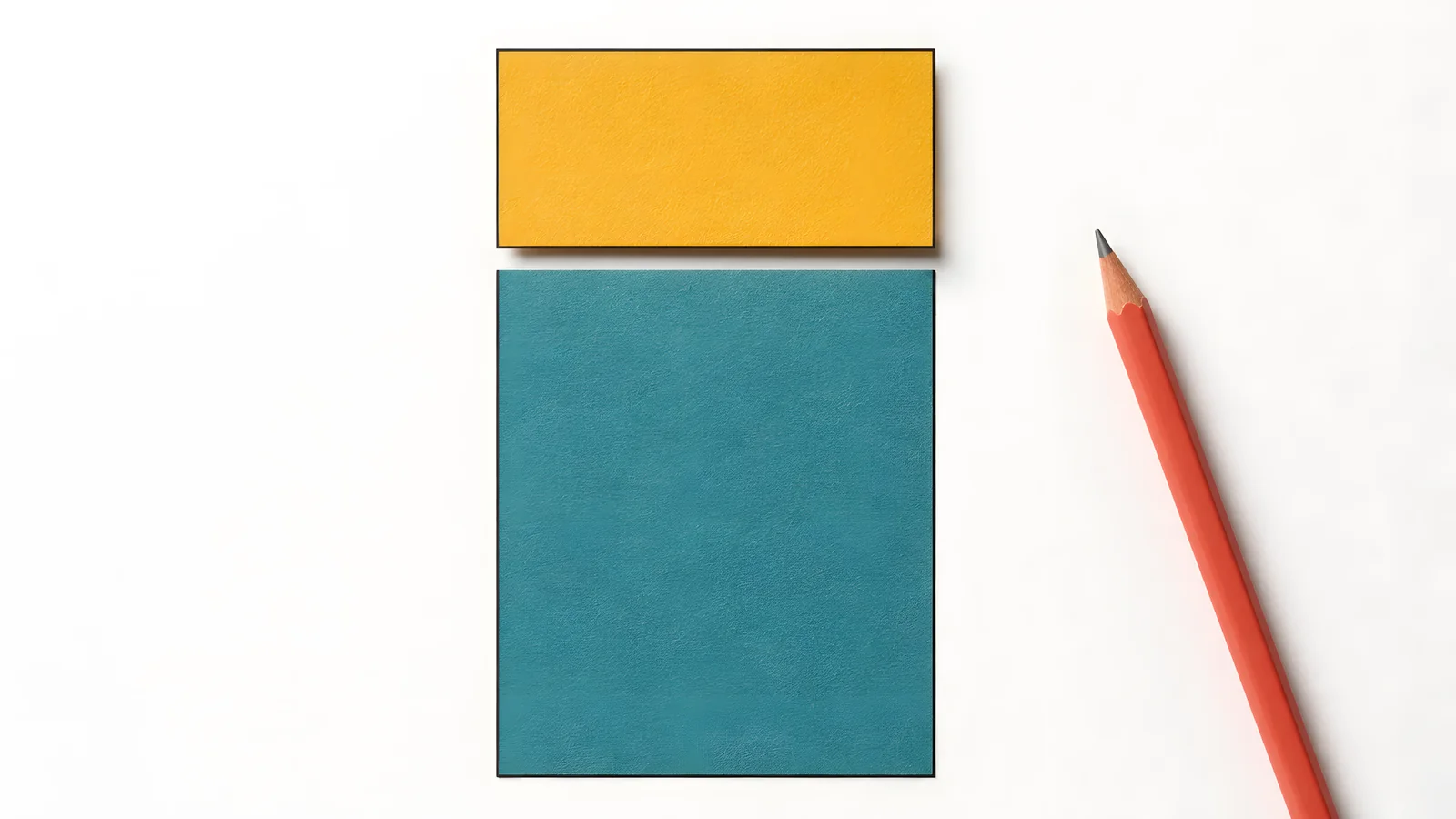
Whole-and-part concept. Use the printed dimensions for the calculation.
A tall rectangle has area 96 square units and width 8 units. A horizontal division creates an upper rectangle of height 5 and a lower target rectangle. Both pieces keep the full 8-unit width.

Derive the whole height first.
96 / 8 = 12 units
If a worksheet also supplies the total height as 12, treat it as a confirmation. It is redundant information here.
Take away the upper height.
12 - 5 = 7 units
The lower rectangle's height is 7. Multiply by its unchanged width.
7 x 8 = 56 square units
There is a second valid calculation in this arrangement. The upper area is 5 x 8 = 40, and 96 - 40 = 56.
Watch what you're subtracting. You can subtract an area's value when that region is genuinely contained within the whole being considered. Here the two pieces tile the full rectangle exactly. Equal widths or heights alone don't make any two areas a whole-and-part pair, and differently shaped regions can still be subtracted when containment is established.
Keep lengths with lengths and areas with areas. The expression 96 - 5 mixes square units with units and cannot represent the lower area.
When rectangles share only part of a side
Consider a tall rectangle with a right-hand edge measuring 10 units. A shorter rectangle sits against the bottom portion of that edge, with its bottom aligned to the tall rectangle's bottom. The exposed segment above the shorter rectangle measures 4 units. The shorter rectangle's area is 42 square units. Find its width.
The shared segment is 10 - 4 = 6 units long. That segment supplies the shorter rectangle's full height, so its width is 42 / 6 = 7 units.
Dividing 42 by 10 would use the taller rectangle's entire edge, including a section extending beyond the shorter rectangle. The resulting 4.2 isn't a value to round; it comes from attaching the area to the wrong height.
Mark the shared segment's two endpoints before transferring a length. One endpoint aligns at the bottom. The other is where the shorter rectangle's top meets the taller rectangle's side. That second endpoint divides the 10-unit edge into the 4-unit exposed segment and the 6-unit overlap.
You still cannot calculate the taller rectangle's area from these facts. Its width hasn't been supplied or derived. Knowing when the information runs out prevents you from borrowing a nearby measurement simply because the calculation needs another number.
Look for a larger rectangle
Example 2 also has a whole-area solution. The two upper rectangles together form an 11-unit-wide, 6-unit-high rectangle. Their combined area is 11 x 6 = 66 square units. Subtract the known left-hand area of 42 to get the right-hand area: 66 - 42 = 24.
This route avoids calculating either smaller width. Before starting several divisions, look for adjacent regions that form a complete rectangle with known outer dimensions. Outline that larger rectangle lightly, checking for gaps or overlaps. You can then calculate its area and subtract known pieces, as long as the regions cover the whole exactly once.
Why measuring fails

This rectangle is drawn with a 2-to-1 visual ratio. Its labels describe a 7-by-4 rectangle, whose area is 28 square units.
Resizing the image on a phone could change its screen dimensions again. The answer remains 28.
- Don't measure screen dimensions.
- Equal-looking sides need a label or an established geometric relationship before you treat them as equal.
- Never round a result to fit the picture. Return to the given information.
Practice set
Use the same rules as the worked examples. All dimensions below are in units, and all areas are in square units.
Puzzle A. A rectangle has area 54 and height 6. Find its width.
Puzzle B. A rectangle has area 35 and height 5. A rectangle directly below shares its entire width and has height 4. Find the lower area.
Puzzle C. A rectangle has total area 90 and width 6. It is split horizontally into two rectangles. The upper height is 4. Find the lower area.
Write the intermediate lengths as well as the final values. Open the answers after you've attempted all three.
Solutions and complete workings
A. Width = 54 / 6 = 9 units. Check 9 x 6 = 54.
B. Shared width = 35 / 5 = 7 units. Lower area = 7 x 4 = 28 square units.
C. Whole height = 90 / 6 = 15 units. Lower height = 15 - 4 = 11 units. Lower area = 11 x 6 = 66 square units. Check the other part too, since 4 x 6 = 24 and 24 + 66 = 90.
Another kind of maze
Maze-solving algorithms deal with navigating connected passages. For a separate visual-navigation challenge, try hard printable mazes; their corridor rules use different reasoning from the rectangle calculations on this page.